


Disclosure: awardtrail earns revenue through display advertising and may earn commissions on some links at no cost to you. Commercial relationships never influence our editorial content or recommendations. Full disclosure →
How Much Are JetBlue TrueBlue Points Worth? About 1.4 Cents — I Priced Three Real Flights to Prove It
Summary: JetBlue TrueBlue points don't have an award chart, a sweet spot, or a devaluation cliff — they have a price, and it barely moves. I priced three real JetBlue flights on jetblue.com and they came back at 1.31 to 1.55 cents a point, and Rove's 20% transfer bonus into TrueBlue ends tonight.
Hashtags: #JetBlue #TrueBlue #JetBluePoints #AwardTravel #Mosaic
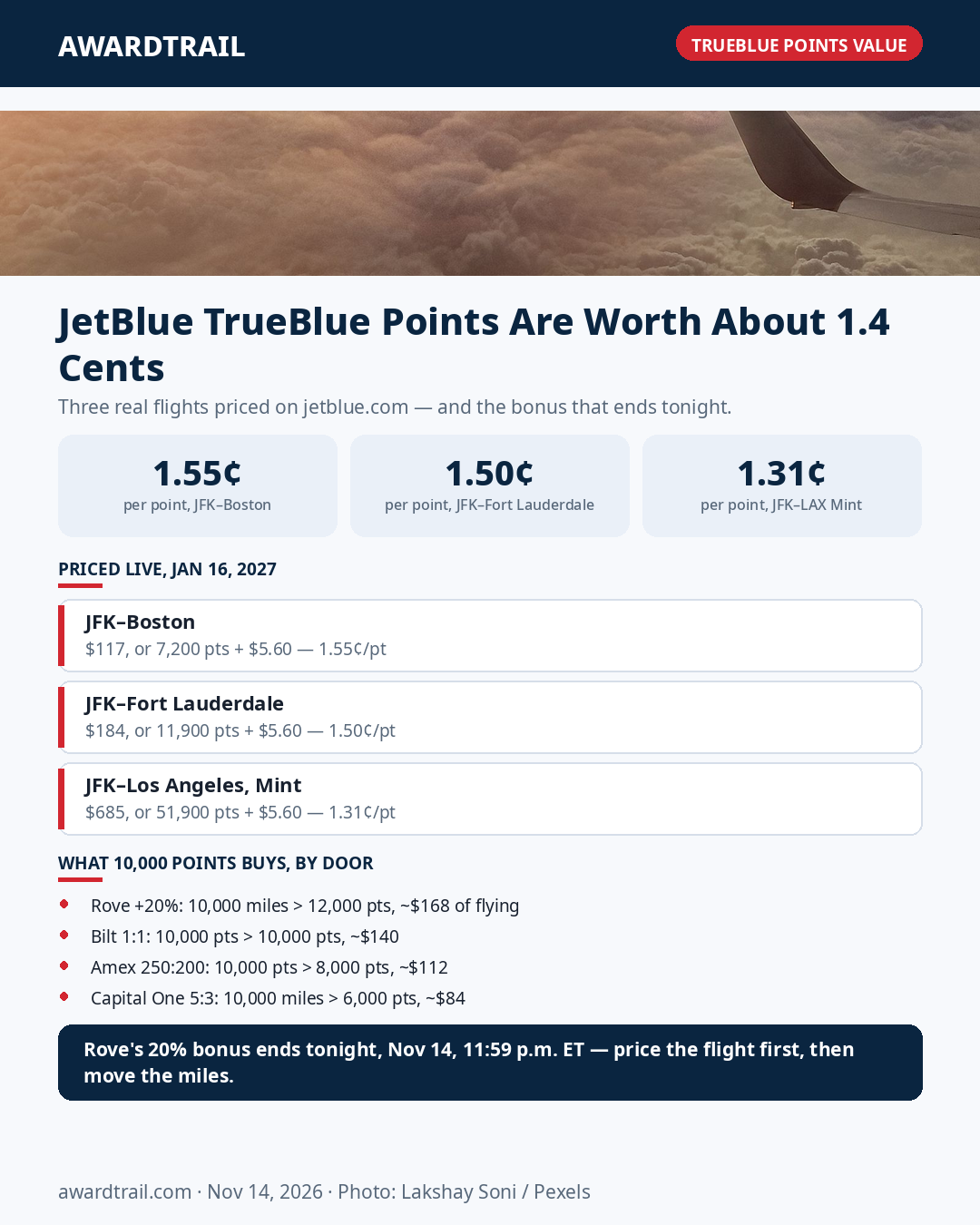
Ask how much JetBlue TrueBlue points are worth and you will get a different answer depending on who you ask — 1.2 cents, 1.3, 1.4, 1.5. The reason the answers disagree is that everyone is averaging something different. TrueBlue has no award chart. JetBlue prices its award flights off the cash fare, so a point is worth roughly the same thing on every flight, and the only honest way to pin the number down is to price real flights. So I did. Three routes, one Saturday — January 16, 2027, one-way, one adult, searched as a guest on jetblue.com, cash fare against points price on the same flight.
Here is what came back. New York JFK to Boston, flight B6 118, 6:50 in the morning, nonstop: $117 in cash, or 7,200 points plus $5.60 in taxes and fees. Take the taxes out of the cash fare and divide: $111.40 over 7,200 points is 1.55 cents a point. JFK to Fort Lauderdale, B6 601, 6:00 a.m., nonstop: $184 cash, or 11,900 points plus $5.60 — 1.50 cents a point. JFK to Los Angeles in Mint, the lie-flat seat, B6 123, 6:00 a.m., nonstop: $685 cash, or 51,900 points plus $5.60 — 1.31 cents a point. The same route in Main, for comparison: $179 cash, or 12,700 points plus $5.60 — 1.37 cents a point.
Four prices, one narrow band: 1.31 to 1.55 cents, averaging about 1.4 cents. That is the whole story of TrueBlue in one paragraph, and it is also the reason the program is both underrated and easy to misuse. The value is consistent. It is also capped. There is no route where a TrueBlue point is suddenly worth three cents, and there is no route where it collapses to half a cent. You will never find a hidden sweet spot in this program, and you will never get burned by one disappearing.
Why the value barely moves — and why that is the point
JetBlue says it plainly on its own TrueBlue page: points redeem "based on current fare price — no blackout dates." When the cash fare is cheap, the points price is cheap. When the fare spikes, the points price spikes with it. Every seat for sale can be booked with points, which is genuinely useful, and your points never expire, which removes the slow leak that quietly drains balances in other programs. But the flip side is that a TrueBlue point is a fixed-value coupon dressed up as a mile. It cannot beat the fare. It can only match it.
That changes the strategy completely. In a program with an award chart, the game is finding the route where the chart underprices the seat. In TrueBlue, there is no game — there is only the fare. A short hop on a cheap day is the best value in the program not because of some trick, but because short hops on cheap days are where the fare is lowest relative to the points formula. Boston at 1.55 cents beat Mint to Los Angeles at 1.31 cents, and that is not an accident: the formula gives a little more on short, cheap flights and a little less on long, expensive ones. If you want outsized value from TrueBlue, stop hunting for it in the redemption and start hunting for it in the fare. A $117 Boston flight is the sweet spot. A $685 Mint seat is the same 1.3 cents buying a much nicer seat.
The Mint test: same rate, different decision
Mint is where the fixed-value math gets interesting, because the rate is the same and the experience is not. At 1.31 cents a point, 51,900 points buys a $685 lie-flat seat to Los Angeles. The same points in Main buy the same flight for 12,700 points. The points are worth the same either way; the question is what you want the points to do. Fifty-one thousand points is a lot of flying to spend on one seat, and on a cash basis $685 for a transcontinental lie-flat is already one of the cheaper Mint fares JetBlue sells. The case for spending points on Mint is not that the rate is better — it is not — but that Mint turns a fixed-value currency into a premium experience at a cash price most people would not pay out of pocket. If you have the balance and you want the seat, take it. If you are counting value per point, the Main cabin wins by a hair and the Boston hop wins by more.
There is one more Mint consideration that does not show up in the fare. Mosaic 3 members get four Premium Upgrade Certificates a year, good for moving a core seat to any Mint seat when available, and Mosaic 4 adds four more. Those certificates are the only way to get Mint out of TrueBlue at a rate better than 1.3 cents, because they cost tiles, not points. Which brings us to the part of TrueBlue that actually rewards loyalty.
Mosaic is the real program. The points are the side dish.
TrueBlue runs on two currencies, and only one of them buys flights. Points are the spendable currency. Tiles are the status currency: you earn one tile per $100 of qualifying JetBlue travel spend, or one tile per $1,000 of spending on a JetBlue credit card, and tiles reset to zero every January 1. Perks You Pick — a menu of selectable perks — opens after just 10 tiles. Mosaic status starts at 50 tiles.
Run the tile math and the tiers sort themselves out fast:
- Mosaic 1, 50 tiles: $5,000 of JetBlue travel spend, or $50,000 of card spend. You get a 3-point Mosaic bonus on top of base earning, one free checked bag, a free first alcoholic drink, EvenMore seat upgrades from 36 hours out, same-day switches, priority security and boarding.
- Mosaic 2, 100 tiles: $10,000 of travel spend, or $100,000 on a card. EvenMore seats at booking, and a second free bag.
- Mosaic 3, 150 tiles: $15,000 of travel spend. Four Premium Upgrade Certificates — the Mint upgrades — plus a dedicated phone line.
- Mosaic 4, 250 tiles: $25,000 of travel spend. Four more certificates, the ability to gift Mosaic 1 to someone else, and complimentary BlueHouse lounge access at JFK and Boston for you and a guest.
The honest read is that Mosaic 1 is the only tier most people should chase, and only on travel spend. Fifty thousand dollars of card spend to reach Mosaic 1 is a terrible trade — that same spend on a 2% cash-back card is $1,000, which buys more JetBlue flights than the status saves you. Mosaic 3 is the tier with a real payoff, but $15,000 of JetBlue flying in a year is a lot of flying, and the certificates only pay off if you actually use them on Mint. Mosaic 4 at $25,000 is a lounge and a gift, and the lounge only exists at two airports. The earning side helps a little: booking on jetblue.com earns 6 points per dollar on non-Base fares (3 base plus 3 booking bonus), 2 per dollar on Base fares, and Mosaic members add 3 more per dollar at Mosaic 1 and 2, 4 more at Mosaic 3, and 5 more at Mosaic 4 — 9, 10, and 11 points per dollar respectively. That is real, but it is still 1.4 cents a point on the other end.
Every door into TrueBlue, ranked by what your points become
JetBlue added two new transfer partners in the last month, and the doors into TrueBlue are now worth ranking, because the same 10,000 points from different programs buy very different amounts of flying. At about 1.4 cents a TrueBlue point, here is what 10,000 of each currency becomes:
- Rove Miles: 10,000 Rove Miles become 12,000 TrueBlue points until tonight — Rove's 20% launch bonus runs through November 14, 11:59 p.m. ET, on a 1:1 base. That is about $168 of JetBlue flying. After tonight it is 10,000 points, about $140. Price the flight first, then move the miles.
- Bilt Rewards: 10,000 Bilt Points become 10,000 TrueBlue points, about $140 of flying. Bilt added JetBlue on October 20 at 1:1, in 1,000-point increments, with a 1,000-point minimum for Silver, Gold, and Platinum members and 2,000 for Blue, usually completing within 48 hours.
- Chase Ultimate Rewards: Chase lists JetBlue TrueBlue as a transfer partner and moves points in 1,000-point blocks, most transfers landing by the next business day. Chase publishes no transfer ratio on its public pages, so confirm the rate on your own transfer screen before moving anything — do not assume it.
- American Express Membership Rewards: 250 points become 200 TrueBlue points, so 10,000 Membership Rewards points become 8,000 TrueBlue points, about $112 of flying. The worst of the major bank doors, and the one to use only when you are topping off a priced award.
- Capital One miles: 1,000 miles become 600 TrueBlue points at the published 5:3 ratio, so 10,000 miles become 6,000 points, about $84 of flying. The weakest door on the board — a Capital One mile is worth far more almost anywhere else.
The pattern is blunt: Rove and Bilt are the only doors that hand you TrueBlue points at par or better, and Rove's better rate dies tonight. Amex and Capital One both take a cut, and the cut is the whole story — moving 10,000 Amex points into TrueBlue throws away $28 of value against the Bilt door, and Capital One throws away $56. The other way in is the co-branded cards: the JetBlue Plus Card earns 60,000 bonus points after $1,000 of spending and paying the $99 annual fee in full within the first 90 days, and the JetBlue Premier Card earns 80,000 after $5,000 and paying the $499 fee in full within 90 days. Both earn 6 points per dollar on JetBlue purchases. At 1.4 cents a point, the Plus bonus alone is about $840 of flying for $1,000 of spend — the cheapest TrueBlue points on the board, and the only door where the points come to you instead of the other way around.
The Blue Sky wrinkle, and the partners that do not count
TrueBlue's newest trick is not a transfer partner but an airline partner. The Blue Sky collaboration with United lets TrueBlue members earn and redeem points on United flights, which matters because JetBlue flies to about 100 destinations and United flies everywhere else. It is the closest thing TrueBlue has to an alliance, and it is the one partner award that can stretch a TrueBlue balance past JetBlue's own map. The catch is in the fine print on JetBlue's own partner page: the codeshare and interline partners — Aer Lingus, Air Serbia, British Airways, El Al, Porter, Turkish Airlines, Brightline — look like partners and book like partners, but JetBlue says plainly that you cannot earn or redeem TrueBlue points with them. Do not plan a trip around earning TrueBlue points on a British Airways flight. It will not happen.
What this post deliberately does not price
Two transfer doors are missing from the ranking above, and they are missing on purpose. Citi ThankYou and Wells Fargo Rewards both move points to JetBlue, but neither program's public pages state the transfer ratio, and I will not print a ratio I cannot read on the issuer's own page. If your points live at Citi or Wells Fargo, check your own transfer screen before moving anything — the rate there is the only one that counts. I also checked the JetBlue Premier Card's welcome offer twice: Barclays' own current terms, accurate as of October 30, 2026, say 80,000 points after $5,000 in 90 days, and that is the figure used here. And the no-annual-fee JetBlue Card's welcome offer is not stated here because I could not confirm it on Barclays' pages today — the Plus and Premier figures above are the only card bonuses in this post, and both come from Barclays' own terms.
The play, in order
First, price your actual flight on jetblue.com in cash and in points before you move a single point into TrueBlue — the points price follows the fare, so the fare is the decision. Second, if you hold Rove Miles, decide before 11:59 p.m. ET tonight whether the 20% bonus is worth using, and only move miles against a flight you have already priced; after tonight the Rove door is worth exactly what the Bilt door is. Third, get TrueBlue points from a card bonus or from Bilt before you raid Amex or Capital One — the transfer cut at those two doors is $28 to $56 per 10,000 points, and it is pure loss. Fourth, treat Mosaic 1 as the status goal and only on travel spend; do not chase tiles with card spend, and do not chase Mosaic 4 unless you already fly $25,000 of JetBlue a year. Fifth, remember the two things that never expire and never black out: the points themselves, and the ability to pool them with up to seven friends and family. A pooled balance is the fastest way to a Mint seat in this program, and Cash + Points — starting at 500 points — is the way to use a balance that falls just short.
TrueBlue is the most honest program in American aviation, and that is both its appeal and its limit. A point is worth about 1.4 cents, on every flight, every day, with no blackout dates and no expiry. You will never beat the program. You will also never lose to it. The only way to win is to pay attention to the fare, take the bonus that ends tonight if you have a flight priced, and let Mosaic — not the points — be the reason you stay loyal.
💡 Why This Matters for Your Strategy
News in the points-and-miles world moves fast, and promotional changes often have a short window. If this announcement affects a card or program you hold, log into your awardtrail dashboard to check your current benefit usage, bonus progress, and whether a transfer or redemption makes sense right now — before terms change.
As a general rule: transfer points only when you have a specific redemption in mind — transfers are almost always one-way and non-reversible. If you're unsure of the value, check our redemption guides before acting.
View Redemption Guides · Read Our In-Depth Analysis
Explore Related Tools
- 🎯 Sign-Up Bonus Tracker — Track your MSR progress and deadlines
- 💳 Benefit & Credit Tracker — See which card credits you haven't used yet
- 🔢 Chase 5/24 Calculator — Know exactly when slots open up
- ❓ Rewards FAQ — Answers to the most common questions
Written by Brian — Founder, awardtrail
Brian has been travel hacking for over 17 years and has personally completed 300+ credit card applications across Chase, Amex, Citi, Capital One, and more. He built awardtrail out of frustration with spreadsheet chaos, and writes from direct, first-hand experience — not marketing copy. All analysis and recommendations on this site reflect real-world strategy tested across hundreds of card applications and award bookings.
Continue Reading
Comments (0)
Join the Discussion
Sign in to share your thoughts and experiences with fellow award travelers.