


Disclosure: awardtrail earns revenue through display advertising and may earn commissions on some links at no cost to you. Commercial relationships never influence our editorial content or recommendations. Full disclosure →
A 35% bonus on a cheap currency
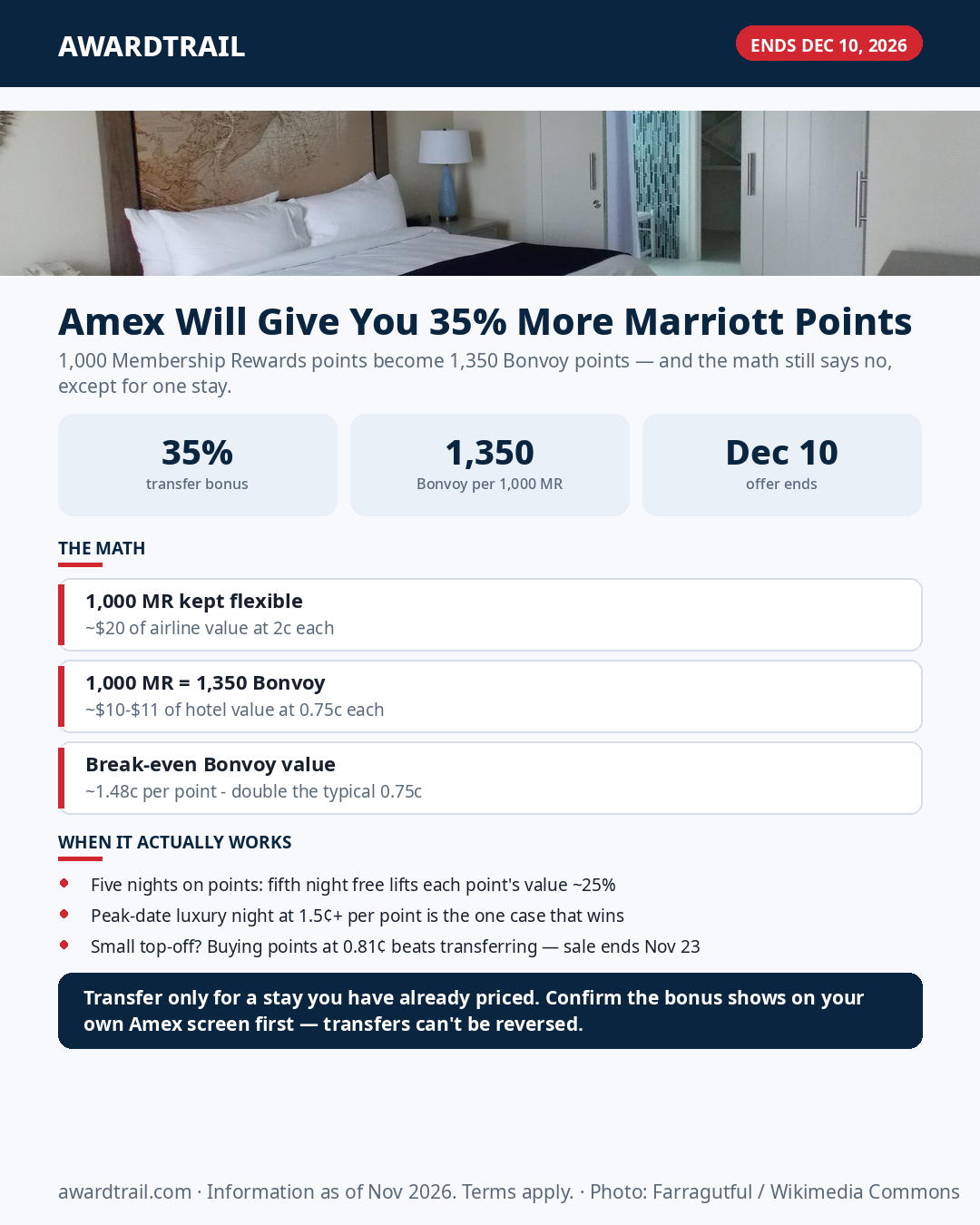
American Express is running a 35% transfer bonus from Membership Rewards to Marriott Bonvoy, and it runs through December 10, 2026. The standard ratio is 1:1, so during the bonus every 1,000 Membership Rewards points land as 1,350 Bonvoy points. Transfers move in 1,000-point increments and Amex lists an estimated transfer time of 48 hours, though they often arrive faster.
It is also the longest-running bonus on the board right now — most of November's other transfer bonuses expire before it does. None of that changes the underlying problem, which is what a Bonvoy point is worth.
The exchange rate is the whole story
A Membership Rewards point kept flexible is worth roughly 2 cents when it is eventually spent on a good airline partner redemption. A Marriott Bonvoy point is worth roughly 0.7 to 0.8 cents on a typical hotel redemption. Those are editorial estimates, not published rates, but they are the numbers that decide this transfer.
Run the bonus through them: 1,000 Membership Rewards points, worth about $20 kept flexible, become 1,350 Bonvoy points worth about $10 to $11 at typical redemption values. The 35% bonus closes about a third of the gap and leaves the rest wide open. For the transfer to break even, each Bonvoy point would have to return about 1.48 cents — roughly double what a typical Marriott award night delivers. That is the test every transfer has to pass, and most Marriott stays fail it.
The reason is not the bonus percentage. It is that Marriott prices award nights dynamically, with the points price tracking the cash rate. When a hotel is expensive in cash, it is expensive in points too, and the ratio between the two stays stubbornly near 0.7 or 0.8 cents. A bonus on the transfer side cannot fix a redemption side that is capped by dynamic pricing.
Worked example: the five-night stay
The one mechanic that changes the redemption side is Marriott's Stay for 5, Pay for 4 benefit. Book five consecutive award nights in a single reservation and the lowest-priced night is free. It applies to Standard and PointSavers awards, any member can use it, and it does not work on Free Night Awards or Cash + Points bookings.
Take a hotel at 40,000 points a night. Five nights list at 200,000 points; with the fifth night free you pay 160,000. With the 35% bonus, those 160,000 Bonvoy points cost about 118,519 Membership Rewards points — call it 119,000 once you round to 1,000-point increments. Without the bonus the same stay would cost 160,000 Membership Rewards points, so the bonus saves about 41,000 points on this booking.
That is a real saving, and it is the only way the bonus starts to look respectable. But run the value test again: 119,000 Membership Rewards points are worth roughly $2,380 at 2 cents each. If the five-night stay would cost $1,400 in cash, you are still spending $2,380 of flexible point value on $1,400 of hotel. The fifth night free lifts the value of each Bonvoy point by 25% on a five-night stay, from roughly 0.75 cents to roughly 0.94 cents. It does not get you to 1.48.
The one stay where it works
There is a narrow case where the transfer wins, and it has three ingredients at once. First, a high-end property on a peak date, where the points price lags the cash rate — the kind of night where 60,000 points buys a room selling for $900 or more, which is 1.5 cents per point before any bonus. Second, a five-night stay, so the fifth night free lifts the effective value further. Third, a booking you have already priced and can make now, before the December 10 deadline.
At 1.5 cents per Bonvoy point, 1,000 Membership Rewards points become 1,350 Bonvoy points worth about $20.25 — a hair above the $20 those points are worth kept flexible. Add the fifth night free and the margin grows. This is not a common booking. It is a specific luxury stay on a specific expensive date, priced in advance. If you do not have that booking in front of you, you do not have the case.
The other legitimate use is the top-off, and it is much more common. Marriott now lets you add up to 25,000 points to a Free Night Award, so a 35,000-point certificate from a card anniversary covers a night priced up to 60,000 points. If you are a few thousand points short of a priced award, the bonus is the cheapest way to close a small gap — but check the other price first.
Buying the points is usually cheaper than transferring
Marriott is selling its own points with up to a 55% bonus through November 23, 2026. At the top tier, a point costs about 0.81 cents; the list price is 1.25 cents. The bonus you actually get is the one shown at checkout, and it can fall as low as 35%, which works out to about 0.93 cents a point. Purchases start at 2,000 points, the annual cap is raised to 200,000 points for 2026, and points generally post within 72 hours.
Compare the two ways of closing an 8,000-point gap. Buying at the 55% tier costs about $64.80 in cash. Transferring costs about 6,000 Membership Rewards points, which is roughly $120 of flexible point value. Buying wins by a wide margin, and it leaves your Membership Rewards balance untouched for the airline redemptions where it earns its keep. The only time transferring beats buying for a top-off is when the points sale has already ended on your account or your bonus tier has dropped — the sale ends November 23, while the transfer bonus runs until December 10, so there is a two-and-a-half-week window where transferring is the only discount left.
One more comparison, for anyone holding Chase points instead: Chase Ultimate Rewards also transfer to Marriott at 1:1, with no bonus running. A Chase point sent to Hyatt remains the stronger use of a Chase balance — Hyatt points routinely return far more than a cent each on a good redemption. That is the opportunity cost hiding behind this bonus. Every point you send to Marriott is a point that cannot go to Hyatt, and the gap between those two destinations is larger than the 35% bonus.
The decision
Check your own Amex transfer screen first. Transfer bonuses are sometimes limited to eligible accounts, and the bonus only counts if it shows on your account before you move anything. Transfers cannot be reversed, so confirm the 1,350-per-1,000 rate is there, then transfer only the exact number of points the priced stay needs.
Transfer if you have a specific Marriott award already priced, the points price per night clears roughly 1.5 cents against the cash rate, and ideally the stay is five nights so the fifth night free stacks on top. Transfer a small top-off if the points sale cannot cover the gap and the certificate top-up is what stands between you and the booking.
Skip it in every other case. Do not move points speculatively because a 35% headline looks generous, and do not move a large balance to "use the bonus before it expires." Bonvoy points do not expire for 24 months as long as some qualifying activity posts to the account, but a balance parked in Marriott is a balance that has already lost half its flexible value, bonus included. The bonus makes a bad exchange less bad. It does not make it good.
💡 Why This Matters for Your Strategy
News in the points-and-miles world moves fast, and promotional changes often have a short window. If this announcement affects a card or program you hold, log into your awardtrail dashboard to check your current benefit usage, bonus progress, and whether a transfer or redemption makes sense right now — before terms change.
As a general rule: transfer points only when you have a specific redemption in mind — transfers are almost always one-way and non-reversible. If you're unsure of the value, check our redemption guides before acting.
View Redemption Guides · Read Our In-Depth Analysis
Explore Related Tools
- 🎯 Sign-Up Bonus Tracker — Track your MSR progress and deadlines
- 💳 Benefit & Credit Tracker — See which card credits you haven't used yet
- 🔢 Chase 5/24 Calculator — Know exactly when slots open up
- ❓ Rewards FAQ — Answers to the most common questions
Written by Brian — Founder, awardtrail
Brian has been travel hacking for over 17 years and has personally completed 300+ credit card applications across Chase, Amex, Citi, Capital One, and more. He built awardtrail out of frustration with spreadsheet chaos, and writes from direct, first-hand experience — not marketing copy. All analysis and recommendations on this site reflect real-world strategy tested across hundreds of card applications and award bookings.
Continue Reading
Comments (0)
Join the Discussion
Sign in to share your thoughts and experiences with fellow award travelers.