


Disclosure: awardtrail earns revenue through display advertising and may earn commissions on some links at no cost to you. Commercial relationships never influence our editorial content or recommendations. Full disclosure →
The most valuable piece of paper in hotel loyalty has no price limit
Every major hotel chain hands out free night certificates. Marriott caps its best one at 85,000 points. IHG caps its at 40,000. Hyatt's top certificate stops at Category 7. Hilton's does something none of the others will: it has no cap at all.
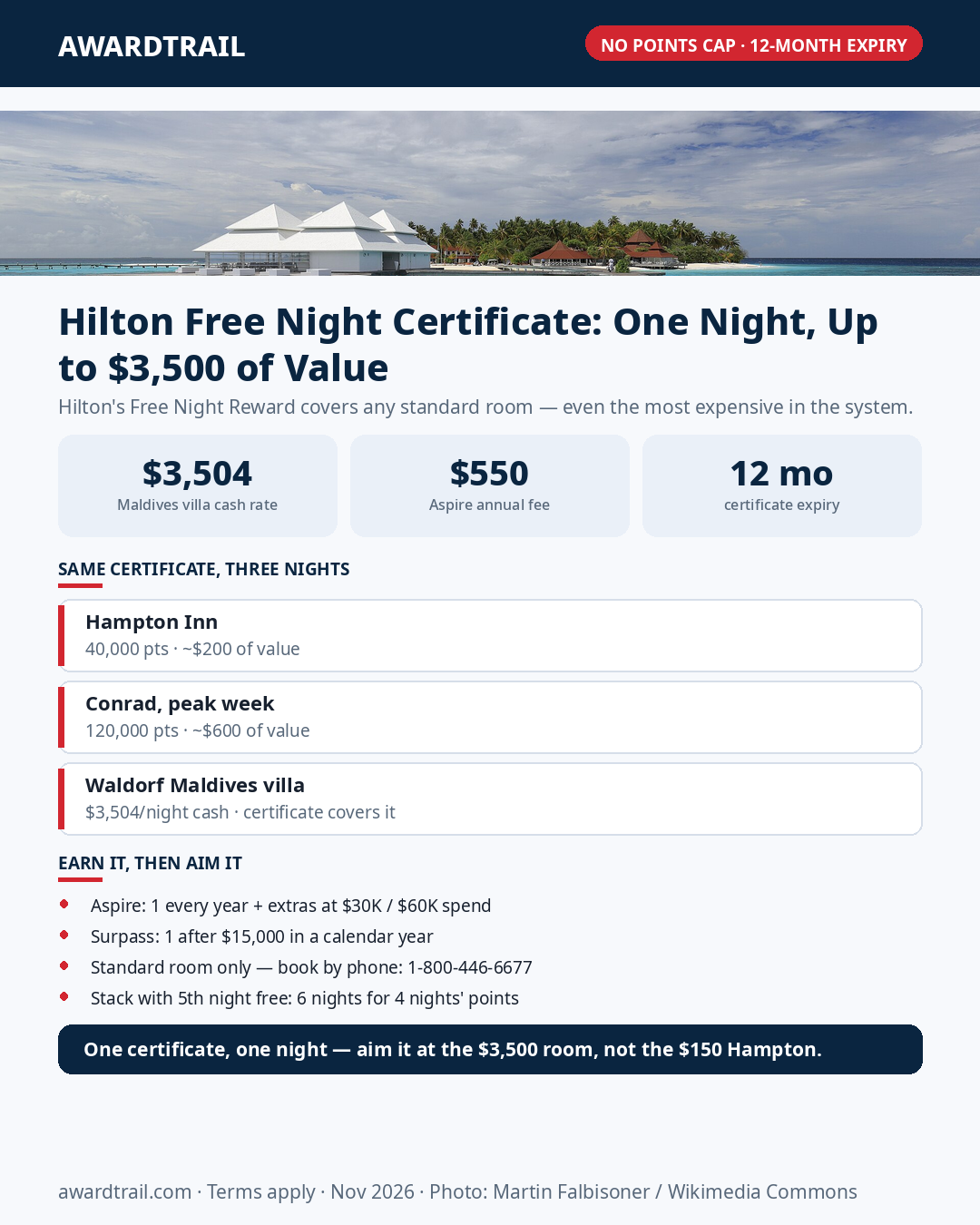
A Hilton Honors Free Night Reward covers one standard room at virtually any Hilton property in the world, whatever that room costs. And the rooms it covers have gotten very expensive. A King Overwater Villa with Pool at the Waldorf Astoria Maldives Ithaafushi lists at $3,504 a night on Hilton's own site for February 2027 dates — and the points price shown for that same room runs past 1.25 million when only premium rewards are available. A certificate covers the standard version of that room for zero points and zero cash. The same certificate spent on a Hampton Inn off the interstate buys a night worth maybe $150.
That gap is the entire game. The certificate is not a coupon. It is a claim on the most expensive standard room you can find, and the difference between using it well and using it casually is measured in thousands of dollars. Everything below is about closing that gap: how to get one, the rules that quietly kill redemptions, and where to point it.
What a Hilton Free Night Reward actually is
The terms are simple, and the fine print is where people lose nights. A Free Night Reward books one standard accommodation, double occupancy, subject to availability, at properties across the Hilton portfolio. There are no blackout dates — if a standard room is available for points, the certificate can book it. The certificate covers the room rate plus all applicable taxes and resort fees for that night. You pay only incidentals.
Three constraints matter more than the rest. First, it has to be a standard room reward. Hilton also sells Premium Room Rewards — the inflated rates that appear when standard award inventory is gone, which ran past 1.25 million points a night for a Maldives villa on the dates we checked. Certificates do not work on those. If you do not see a standard rate, the certificate does not apply, no matter how many points the night would cost. Second, the certificate expires 12 months from the date it is issued, and the stay must be completed by that date. You cannot book a stay that runs past expiration. In practice the usable window is closer to ten months, because you need the property to release standard award inventory inside it. Third, there is a short list of excluded properties — roughly 60, almost all of them Hilton Grand Vacations and Hilton Club timeshare properties, plus a handful of distinctive properties. Hilton publishes the list, and the other roughly 8,000 hotels in the portfolio are fair game.
Booking is the part that surprises first-timers. You cannot apply a certificate at checkout on Hilton's website. The official channel is a phone call to 1-800-446-6677, where you give the agent your Honors number and the certificate code from the email Hilton sent you. Hilton's chat can handle it too, but phone is the documented route, and for a high-value redemption it is worth having a person confirm the standard-room inventory while you are on the line. Certificates are not transferable, cannot be redeemed for cash or points, and cannot be combined with another certificate for a single night — but you can book consecutive nights on separate reservations, each covered by its own certificate.
How you earn one — and how long it takes to arrive
Every Free Night Reward comes from an American Express Hilton card, and the earning rules are card by card.
- Hilton Honors American Express Aspire Card, $550 a year: one Annual Free Night Reward every year of card membership, starting in your first year — not at renewal, but issued within 8 to 14 weeks after your renewal month. Spend more and you earn more: a second certificate after $30,000 in eligible purchases in a calendar year, and a third after $60,000. Those spend-based certificates arrive 8 to 12 weeks after you hit the threshold. The Aspire also carries complimentary Diamond status, which is what makes the fifth-night-free stacking in the next section work.
- Hilton Honors American Express Surpass Card, $150 a year: one Free Night Reward after $15,000 in eligible purchases in a calendar year. No annual certificate, no spend tiers — one threshold, one night.
- Hilton Honors American Express Card (no annual fee) and the Business card: no standing free night, but both currently include one in their welcome offers. The no-fee card offers 70,000 points plus a Free Night Reward after $2,000 in purchases in six months; the Surpass offers 130,000 points plus a Free Night Reward after $3,000 in six months; the Business card offers 150,000 points plus a Free Night Reward after $8,000 in six months; and the Aspire offers 200,000 points after $6,000 in six months, with its annual certificate on top. All four offers end January 13, 2027.
The timing is the trap. Certificates do not arrive the day you qualify. Eight to fourteen weeks after a renewal month, or eight to twelve weeks after a spend threshold, is a long time to wait when you are planning a trip — and the 12-month clock starts when the certificate is issued, not when you qualify. Do not book a stay you intend to cover with a certificate until it is actually sitting in your account. And remember the spend thresholds run on the calendar year, January 1 to December 31, regardless of when you opened the card. A Surpass cardholder who crosses $15,000 in December gets the certificate; one who crosses it in January starts over.
The value math: the same certificate, three different nights
Hilton points are worth about half a cent each in our valuation, so the certificate's value is roughly the points price of the night you point it at, times 0.5 cents. Run the same certificate through three nights and the spread is the argument for planning. The first two are worked examples at typical points prices; the third is a room we priced live on Hilton's own site.
- A Hampton Inn near an airport on a random Tuesday: 40,000 points. The certificate saves you 40,000 points, worth about $200. It also saves you nothing you could not have bought with a modest pile of points. This is the default redemption, and it is a waste.
- A Conrad in a peak week: 120,000 points. The certificate saves 120,000 points, worth about $600. Now it is doing real work — it is covering a night that would otherwise cost a meaningful chunk of a welcome bonus.
- A Waldorf Astoria Maldives villa: $3,504 a night in cash. That is the Hilton Honors rate Hilton's own site showed for a King Overwater Villa with Pool on February 23–24, 2027 (the flexible rate with breakfast was $3,575, before taxes). The certificate covers that room, taxes and resort fees included, for zero points and zero cash. One certificate, one night, and it has paid for the Aspire's $550 annual fee more than six times over.
The rule that falls out of the math is blunt: never spend a certificate on a night you would happily pay points for. Points are the cheap currency; the certificate is the expensive one. Use points for the $200 nights and save the certificate for the night where the points price makes you flinch. A useful floor: if the standard award costs less than 100,000 points, the certificate is probably the wrong tool. Pay the points, keep the certificate, and wait for the night that earns it.
There is a second, quieter reason the certificate keeps getting more valuable. Its value is the room, not a points number Hilton can reprice. Every time the cash price of a top room climbs, the certificate absorbs it — the Maldives villa that lists at $3,504 a night shows a premium points price above 1.25 million for the same room, and the certificate's claim is on the room itself. Points holders pay Hilton's repricing in full. Certificate holders do not pay it at all. That is why the certificate is the most resilient asset in the Hilton program, and why the card that issues one every year is worth a harder look than its fee suggests.
Where to aim it, and the availability problem nobody warns you about
The obvious targets are the resorts at the top of Hilton's pricing: the Waldorf Astoria Maldives Ithaafushi — where we verified a $3,504 nightly rate on Hilton's own site — and the Waldorf Astoria Los Cabos Pedregal, the other flagship at the top of the program's pricing, along with Conrad Maldives Rangali Island and Conrad Bora Bora Nui, which command high cash rates and high points prices. City flagships work too — a Waldorf or Conrad in New York in December, or a peak-season night in Tokyo or Kyoto, can run into the thousands in cash. The pattern is the same in every case: high cash rates, high points rates, and a standard room that exists in the system.
The problem is that the standard room has to exist on your dates. At the Maldives, standard award inventory is scarce — on the seven date combinations we checked on Hilton's own site, from November 2026 through March 2027, no standard room reward appeared at all; only premium rewards, priced from 1,252,000 points a night. The certificate cannot create inventory. That changes the strategy from "pick a dream hotel" to "watch for the standard room, then move." Set an alert for your dates, check the property's award calendar regularly, and be ready to call the moment a standard night appears. The phone booking works in your favor here: an agent can confirm the standard room and apply the certificate in one call, where a website would make you guess. One caveat to the check: we looked as a guest, without signing in, and Hilton's site prompts you to sign in to book with points — so a signed-in search may surface standard rooms a guest search does not. The scarcity is real either way; the exact inventory is date-specific.
One more consideration for the Maldives and similar resorts: the certificate covers the room, taxes, and resort fees, but not the transfer. Seaplane or speedboat transfers from Malé routinely run several hundred dollars per person round trip, and they are mandatory. Price the whole trip before you transfer a single point or commit a certificate — a free room with a $1,000 transfer bill is still a good deal at the Waldorf, but it is not a free trip.
Stacking it with the fifth night free
The certificate gets better when it is not used alone. Hilton gives Silver, Gold, Diamond, and Diamond Reserve members every fifth night free on standard room reward stays of five nights or more booked entirely with points. A certificate night is a separate reservation, but Hilton's own terms say a Free Night Reward may be added to an existing paid or reward stay — so you can build a longer trip out of both.
The cleanest version: book five nights on points, where the fifth night is free, and add a certificate night to the same stay. That is six nights for the points cost of four, plus the certificate. Or book four points nights and one certificate night for a five-night stay that costs four nights' points and no fifth-night-free benefit — the same points cost, but it spends the certificate instead of earning the free night. The first version is the better use of both tools. Either way, the move is to stop thinking of the certificate as a one-night trip and start thinking of it as the extra night that turns a good points stay into a long one.
Aspire cardholders get the most from this stack because the card comes with Diamond status, which carries the fifth-night-free benefit automatically. Surpass cardholders get Gold status, which also qualifies. The no-fee card's Silver status qualifies too — the fifth night free starts at Silver, not at the top tier.
The decision: which card, and when the certificate alone justifies the fee
The Aspire is the structural card. At $550 a year it is not cheap, but the math is straightforward: one certificate a year, used at a property pricing 120,000 points or more, returns about $600 in points value — more than the fee, before the $400 resort credit, the $200 flight credit, and Diamond status enter the picture. Used on a $3,504-a-night villa, a single certificate covers a $3,504 night, more than six times the fee. The Aspire only fails the test if the certificate goes unspent or gets spent on a Hampton.
The Surpass is the value play for people who do not want a $550 card. At $150 a year, one certificate after $15,000 in calendar-year spending is a strong return — but only if that $15,000 would have gone on the card anyway. Spending $15,000 to chase a certificate is the same mistake as spending a certificate on a Hampton: the tool is worth what it saves, not what it costs to earn.
And if you hold neither card, the current welcome offers are the cheapest door in. The no-fee card's 70,000 points plus a Free Night Reward after $2,000 in six months is a certificate with no annual fee attached, and the Surpass's 130,000 points plus a certificate after $3,000 in six months is the better first-year haul for a $150 fee. Both end January 13, 2027, and the Aspire's 200,000-point offer ends the same day. If a Hilton trip is anywhere in your 2027 plans, that deadline is the one that matters — the certificate you earn from the welcome offer is the same uncapped certificate, and it is valid for a year from the day it lands.
The bottom line
Hilton's Free Night Reward is the best uncapped hotel certificate in the game, and it keeps getting better precisely because Hilton keeps raising the price of its top rooms. The certificate does not care what the room costs. It covers the room anyway.
That is the whole strategy in one sentence: earn the certificate, wait for the expensive standard room, and never spend it on a night you would pay points for. Do that, and one night a year pays for the card that issued it. Spend it on convenience, and you have traded a $3,500 night for a $150 one — and Hilton will happily let you.
💡 Why This Matters for Your Strategy
News in the points-and-miles world moves fast, and promotional changes often have a short window. If this announcement affects a card or program you hold, log into your awardtrail dashboard to check your current benefit usage, bonus progress, and whether a transfer or redemption makes sense right now — before terms change.
As a general rule: transfer points only when you have a specific redemption in mind — transfers are almost always one-way and non-reversible. If you're unsure of the value, check our redemption guides before acting.
View Redemption Guides · Read Our In-Depth Analysis
Explore Related Tools
- 🎯 Sign-Up Bonus Tracker — Track your MSR progress and deadlines
- 💳 Benefit & Credit Tracker — See which card credits you haven't used yet
- 🔢 Chase 5/24 Calculator — Know exactly when slots open up
- ❓ Rewards FAQ — Answers to the most common questions
Written by Brian — Founder, awardtrail
Brian has been travel hacking for over 17 years and has personally completed 300+ credit card applications across Chase, Amex, Citi, Capital One, and more. He built awardtrail out of frustration with spreadsheet chaos, and writes from direct, first-hand experience — not marketing copy. All analysis and recommendations on this site reflect real-world strategy tested across hundreds of card applications and award bookings.
Continue Reading
Comments (0)
Join the Discussion
Sign in to share your thoughts and experiences with fellow award travelers.