


Disclosure: awardtrail earns revenue through display advertising and may earn commissions on some links at no cost to you. Commercial relationships never influence our editorial content or recommendations. Full disclosure →
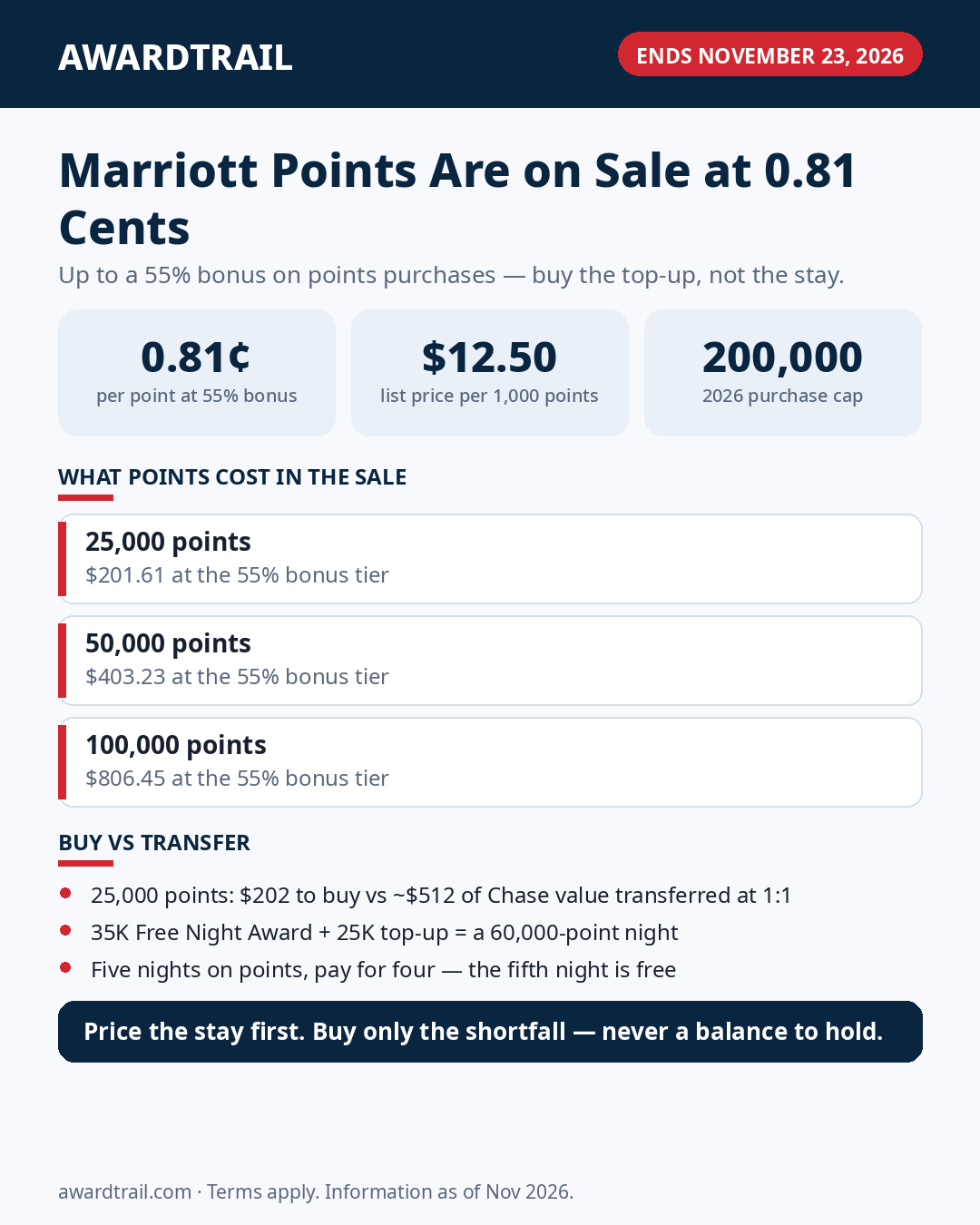
Marriott is selling its own currency at a discount, and the discount is real enough to change a decision. Through November 23, 2026, you can buy Marriott Bonvoy points with up to a 55% bonus. At the top of that range, a point costs about 0.81 cents. The list price is 1.25 cents. That is a steep discount on the currency, and the question it raises is not whether the points are cheap. It is whether buying them beats the other two ways of getting them: transferring flexible bank points, or earning them the slow way.
Start with the sale itself, because the terms have edges. Marriott sells points at $12.50 per 1,000. During this promotion, purchases of at least 2,000 points earn a bonus that starts at 55% and falls to 35% as the promotional inventory runs down — Marriott says so plainly on its own promotion page. The bonus you actually get is the one shown at checkout, so treat 0.81 cents as the best case and 0.93 cents, the cost at the 35% floor, as the number to plan around. Either way you are well under list price. Points post within 72 hours, purchases are non-refundable, and new members have to wait 30 days after joining before they can buy. The annual purchase cap is raised to 200,000 points for 2026, up from the usual 150,000. Buy through the Buy Points storefront; points bought while making a reservation do not qualify for the bonus.
The arithmetic is straightforward once you fix the bonus tier:
- At the 55% bonus, 10,000 points cost $80.65, 25,000 cost $201.61, 50,000 cost $403.23, and 100,000 cost $806.45.
- At the 35% floor, the same amounts cost $92.59, $231.48, $462.96, and $925.93.
- At list price with no bonus, 25,000 points cost $312.50 and 100,000 cost $1,250.
So the sale saves roughly $110 on 25,000 points at the top tier and more than $440 on 100,000. Those are the numbers to hold in your head. Everything else in this post is about whether spending them makes sense.
Buying against transferring
The comparison that matters is against a transfer, because that is how most people fill a Marriott shortfall today. Chase Ultimate Rewards points convert to Marriott Bonvoy at 1:1 — 1,000 Chase points become 1,000 Bonvoy points, in 1,000-point increments, and Marriott's own help pages state the ratio. Amex Membership Rewards is the other big source of Marriott points, and the same pricing question applies there — the ratio showing on your transfer screen is the one your transfer will actually use. A 1:1 ratio looks fair until you price each side. A Chase point sent to a good airline partner is worth roughly 2 cents; a Marriott point is worth roughly 0.75 cents on a typical redemption. Moving 25,000 Chase points to Marriott spends about $512 of flexible-point value to get about $188 of hotel value. Buying those same 25,000 points costs $201.61 at the top sale tier. Buying wins by more than $300, and it leaves the Chase points free for the airline booking they are actually good at.
The same logic holds against the cash-back floor. A thousand Chase points cashed out are worth $10. A thousand Marriott points bought in this sale cost $8.06 at the top tier and $9.26 at the floor. Even at the worst bonus tier in the promotion, buying the points is cheaper than the cash value of the flexible points you would otherwise transfer. That is the test to run on any top-off: if the points cost less in cash than the flexible points are worth, buy them and keep the flexible currency.
There is one check to run before you buy anything. Transfer bonuses come and go, and a live one changes the math. Open the transfer screen in your Amex or Chase account and look at the ratio actually showing for Marriott before you pay for points. At the standard 1:1 rate the sale wins for a top-off. If a bonus is live on your account, run the same comparison with that ratio instead of assuming the sale is the better deal.
The top-up is where bought points pay best
Bought points are worth the most when they unlock something a certificate alone cannot reach. Marriott lets you add up to 25,000 of your own points to a Free Night Award — that limit was raised from 15,000 earlier this year, and Marriott's own terms state it. A 35,000-point certificate from the $95-a-year Boundless card now reaches a night priced at up to 60,000 points. The 25,000 points that bridge the gap cost $201.61 in this sale. That is the cheapest way to turn a $95 card's annual certificate into a 60,000-point night, and it is a far better use of bought points than funding an entire stay from zero.
The same logic applies at the top of the card lineup. The Brilliant card, at $650 a year, carries an 85,000-point certificate; with a 25,000-point top-up it reaches a 110,000-point night. The Bountiful card, at $250 a year, carries a 50,000-point certificate after $15,000 in annual spend, and a top-up takes it to 75,000. In each case the bought points are doing the same job: converting a fixed-value certificate into a night it could not otherwise buy. Buy the top-up, not the stay.
The five-night multiplier
The second place bought points earn their keep is the five-night stay. Marriott's Stay for 5, Pay for 4 benefit means five consecutive nights on points under one reservation cost the points of four — the free night is the lowest-priced night of the five, and the benefit applies to standard rooms, not to stays paid with a Free Night Award or Cash + Points. On a 60,000-point-a-night stay, five nights cost 240,000 points instead of 300,000. Buying all 240,000 points in this sale costs $1,935 at the top tier, against $2,419 for the full 300,000 — the fifth night free saves about $484 of bought points. A five-night award stay is the one booking where buying a large block of points stops looking extravagant and starts looking like the plan.
When buying loses
None of this makes buying points a good idea in general. It makes it a good idea for a specific stay, priced, with a date attached. Buying without a stay in mind is how points end up stranded: Marriott points are forfeited after 24 months without qualifying activity, and a purchase counts as qualifying activity, which is useful for keeping a balance alive but is a poor reason to buy a large block. Dynamic pricing is the other risk. Marriott reprices award nights continuously, and a night that costs 60,000 points today can cost more by the time your purchased points post — up to 72 hours after you pay, with no refund if the price moves against you. Price the stay, buy only the exact shortfall, and book as soon as the points land. If the bonus showing at your checkout is the 35% floor rather than 55%, rerun the numbers at 0.93 cents before you pay; the answer is usually still yes for a top-off, and usually still no for a whole stay bought from scratch.
The other hotel programs run the same play with different numbers, and the lesson travels. IHG cardholders save at least 30% on points purchases when they pay with an IHG card, according to Chase's own card terms — the same buy-don't-transfer logic, just a different discount. Wyndham's award chart is fixed, with free nights starting at 5,000 points, which makes its currency the cheapest to price with certainty. The pattern is the same everywhere: the programs sell their own points cheapest during a sale, and the flexible bank points are worth more anywhere else.
The decision
Buy Marriott points in this sale if you have a stay already priced, you are short by a specific number of points, and the shortfall is a top-up on a certificate or the final nights of a five-night stay. Buy at the 55% tier if it is still showing; accept the 35% floor if that is what your account shows, and rerun the cost before paying. Do not buy a balance to hold, do not buy points for a trip you have not priced, and do not transfer Chase points at the standard 1:1 rate — or Amex points at whatever ratio your account shows — to cover a gap that $200 of bought points would close. The sale ends November 23. The stay you have already priced is the only reason to use it.
💡 Why This Matters for Your Strategy
News in the points-and-miles world moves fast, and promotional changes often have a short window. If this announcement affects a card or program you hold, log into your awardtrail dashboard to check your current benefit usage, bonus progress, and whether a transfer or redemption makes sense right now — before terms change.
As a general rule: transfer points only when you have a specific redemption in mind — transfers are almost always one-way and non-reversible. If you're unsure of the value, check our redemption guides before acting.
View Redemption Guides · Read Our In-Depth Analysis
Explore Related Tools
- 🎯 Sign-Up Bonus Tracker — Track your MSR progress and deadlines
- 💳 Benefit & Credit Tracker — See which card credits you haven't used yet
- 🔢 Chase 5/24 Calculator — Know exactly when slots open up
- ❓ Rewards FAQ — Answers to the most common questions
Written by Brian — Founder, awardtrail
Brian has been travel hacking for over 17 years and has personally completed 300+ credit card applications across Chase, Amex, Citi, Capital One, and more. He built awardtrail out of frustration with spreadsheet chaos, and writes from direct, first-hand experience — not marketing copy. All analysis and recommendations on this site reflect real-world strategy tested across hundreds of card applications and award bookings.
Continue Reading
Comments (0)
Join the Discussion
Sign in to share your thoughts and experiences with fellow award travelers.