


Disclosure: awardtrail earns revenue through display advertising and may earn commissions on some links at no cost to you. Commercial relationships never influence our editorial content or recommendations. Full disclosure →
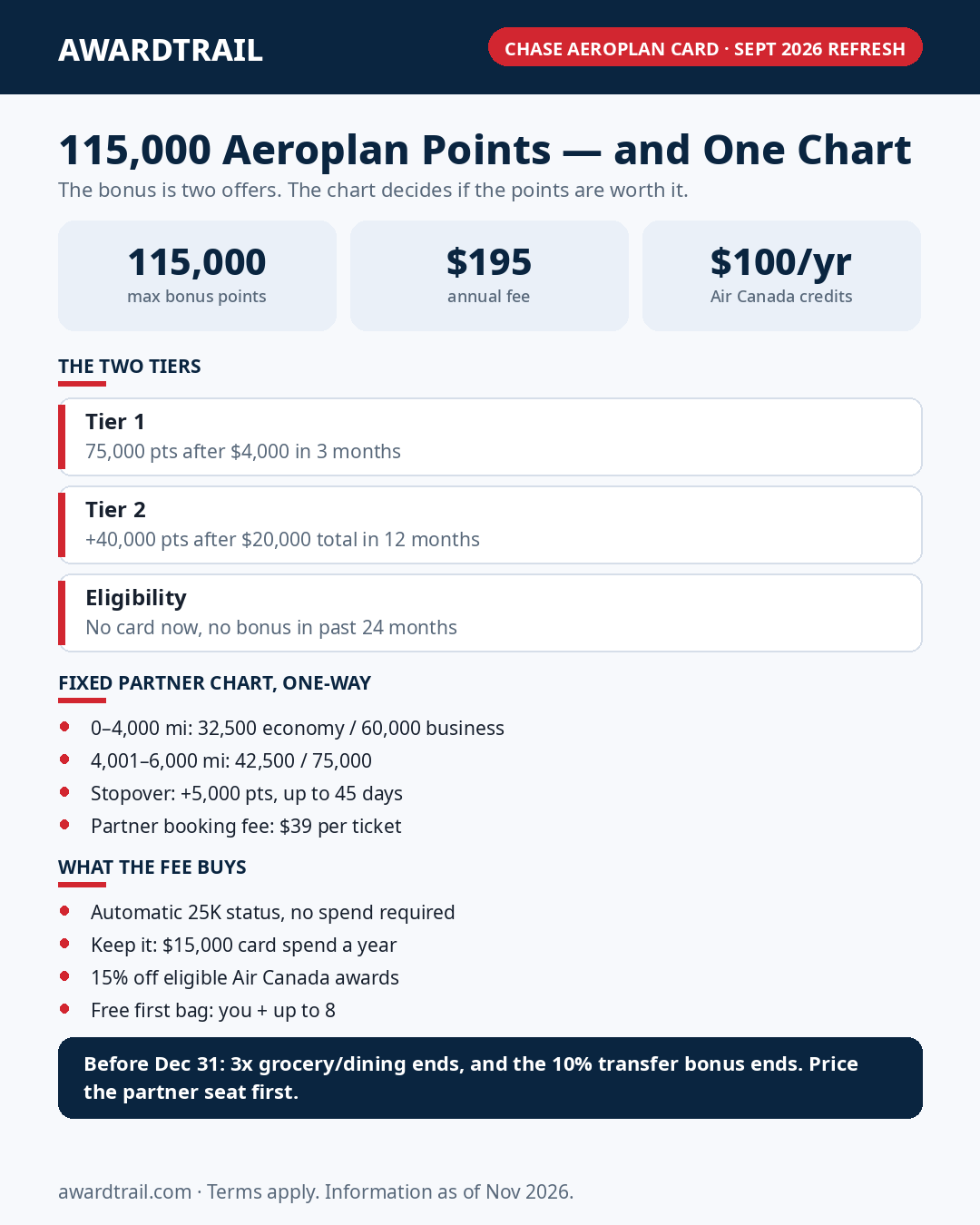
Chase did not just raise the bonus on its Aeroplan card. On September 10, 2026, it rebuilt the card: the annual fee is now $195, automatic Aeroplan 25K status arrived with no spending requirement, and the welcome offer became a two-tier deal worth up to 115,000 Aeroplan points. Chase calls it the card's best offer ever. That label is doing a lot of work, because the headline number is not one offer. It is two, with very different price tags, attached to a card whose value now depends almost entirely on how you redeem.
Start with the part most people will actually earn. The first tier pays 75,000 bonus points after $4,000 in purchases in the first three months. The second tier adds 40,000 points after $20,000 in total purchases in the first 12 months. Chase publishes no end date for the offer, describing it only as limited-time, and the card is available only if you do not already hold it and have not received a new cardmember bonus for it in the past 24 months. Treat the 75,000 as the offer. Treat the other 40,000 as a question about your next $16,000 of spending.
The second tier is the expensive one
That framing matters because the second tier is a poor rate of return on its own. The incremental $16,000 between the two thresholds earns the 40,000-point bonus plus whatever the card earns on that spending — at the 1x base rate, 16,000 more points, for 56,000 points on $16,000. That is 3.5 points per dollar before any category bonus, and it requires routing $20,000 through a card that earns 1x on everything outside its bonus categories. If that $16,000 would otherwise earn 2x or 3x somewhere else, or if you would not naturally spend it, the second tier is not free money. It is a year-long commitment to one card.
None of that makes the first tier weak. Seventy-five thousand Aeroplan points is a serious balance on its own, because of what Aeroplan charges for partner flights. Air Canada prices flight rewards on its own and select partner airlines dynamically, with the chart showing starting prices that can move. For all other partners, the price is fixed by the distance flown. That distinction is the whole ballgame, and it is where most Aeroplan points advice goes wrong: a search that surfaces an Air Canada-operated flight is not priced on the fixed chart at all.
The fixed chart is where the points earn their keep
Air Canada's current Flight Reward Chart prices one-way travel between North America and the Atlantic zone — Europe, Africa, the Middle East, and India — for all other partners as follows:
- 0–4,000 miles: 32,500 points in economy, 60,000 in business, 90,000 in first
- 4,001–6,000 miles: 42,500 in economy, 75,000 in business, 120,000 in first
- 6,001–8,000 miles: 60,000 in economy, 90,000 in business, 150,000 in first
- 8,001+ miles: 75,000 in economy, 110,000 in business, 165,000 in first
Those are fixed amounts, not starting prices, and the band is set by total distance flown — so routing matters, and a connection that pushes a trip over a band boundary reprices the whole award. The 75,000-point first tier covers a 60,000-point business-class seat in the shortest band with 15,000 points to spare. The full 115,000 covers that same seat plus a 5,000-point stopover, with 50,000 left over — close to, but not quite, a second 60,000-point seat. Add the stopover and the math gets better still: Aeroplan lets you add one stopover per direction on an international flight reward for 5,000 points, staying up to 45 days, in cities outside Canada and the United States. A 60,000-point business seat plus a 5,000-point stopover is two European cities on one ticket for 65,000 points.
There is a catch, and it is small but real. Partner awards carry a flat $39 partner booking fee per ticket, on top of taxes and fees. Air Canada-operated rewards carry no airline surcharges, only taxes and third-party fees, and those taxes can themselves be covered with points. So the cheapest Aeroplan redemption on paper is not always the cheapest all-in: price the partner award with its fee, and price the Air Canada award at its dynamic points level, before deciding which one the points should buy.
Status, credits, and the fee: only Air Canada flying pays for it
The refresh's other headline — automatic Aeroplan 25K status — is genuinely useful, but only in a specific way. New cardmembers get 25K for the rest of the calendar year plus the following calendar year, and keeping it after that takes $15,000 in card spending in a calendar year. It brings priority check-in, priority boarding in Zone 2, additional baggage allowance, Star Alliance recognition, and 5 eUpgrade credits a year. It does not bring lounge access. The card also gives a free first checked bag to the cardmember and up to eight people on the same reservation on Air Canada flights, which is where the family math quietly improves.
The fee math works the same way: conditionally. The card now offers up to $100 a year in Air Canada statement credits, delivered as up to $50 twice a year on eligible direct Air Canada purchases. Use both halves and the $195 fee is effectively $95 after the credits. Use one half and it is $145. Use neither and you paid $195 for a card whose best perks only work on one airline. The $120 Global Entry, TSA PreCheck, or NEXUS fee credit every four years helps — $30 a year if you spread it evenly — but it is a once-every-four-years benefit, not an annual offset. And the 15% saving on eligible Air Canada flight redemptions, under the FLY15OFF benefit, applies to Air Canada-operated awards, not to the fixed-price partner awards that make the chart above so attractive. Do not double-count the discount and the chart on the same ticket.
Earning follows the same pattern. From January 2027 the card earns 3x on Air Canada purchases and on travel purchases, 2x at grocery stores, on dining, and at gas stations, and 1x on everything else — with Air Canada purchases reaching up to 5x total when the 2x Air Canada flight earning for a 25K member is added. Through December 31, 2026, grocery and dining still earn 3x. That date is a cliff worth marking, because two other benefits end the same day: the 500 bonus points for each $2,000 spent in a calendar month, and the 10% bonus on Chase Ultimate Rewards transfers of 50,000 points or more in a single transaction to Aeroplan, capped at 25,000 bonus points per calendar year. The transfer bonus is the one that should change behavior now. Ultimate Rewards already transfer to Aeroplan at 1:1 in 1,000-point increments, so a 50,000-point transfer before the deadline lands 55,000 Aeroplan points — and it is the rare transfer bonus that rewards a transfer you were already planning, rather than inventing a reason to move points.
Who should actually get this card
The decision splits cleanly. If you fly Air Canada more than a couple of times a year, will use both $50 credit halves, and can put $4,000 through the card in three months without bending your spending, the first tier plus automatic 25K status plus the bag benefit is a strong package, and the fixed partner chart gives the points a clear, high-value job. If you already hold a Chase Sapphire card, you can reach the same Aeroplan points by transferring Ultimate Rewards at 1:1 without paying $195 — and until December 31, with the 10% bonus on large transfers, you can arguably reach them more cheaply. In that case the card has to justify itself on status, bags, credits, and the 15% Air Canada redemption discount alone, and for someone who rarely flies Air Canada, it does not.
The card also rewards a particular kind of patience. Aeroplan redemptions start at 6,000 points, and the program lets you combine points with cash if you fall short. But the partner chart only pays off when the partner actually releases the seat. Fixed pricing is not a guarantee of availability, and the best use of 115,000 points is a specific partner seat on a specific date, found before any points move. The worst use is 115,000 points sitting in an account while the card's $195 fee renews.
That is the real test the refresh sets. Chase built a card that pays you in Aeroplan points and then gave you the tools — status, a redemption discount, credits that only work on Air Canada — that push you toward spending them on Air Canada. The points themselves are at their best somewhere else entirely: on a partner airline, on the fixed chart, with a 5,000-point stopover turning one trip into two. Get the card for the chart, not for the headline. If the chart has no trip in it for you, the headline is not enough.
💡 Why This Matters for Your Strategy
News in the points-and-miles world moves fast, and promotional changes often have a short window. If this announcement affects a card or program you hold, log into your awardtrail dashboard to check your current benefit usage, bonus progress, and whether a transfer or redemption makes sense right now — before terms change.
As a general rule: transfer points only when you have a specific redemption in mind — transfers are almost always one-way and non-reversible. If you're unsure of the value, check our redemption guides before acting.
View Redemption Guides · Read Our In-Depth Analysis
Explore Related Tools
- 🎯 Sign-Up Bonus Tracker — Track your MSR progress and deadlines
- 💳 Benefit & Credit Tracker — See which card credits you haven't used yet
- 🔢 Chase 5/24 Calculator — Know exactly when slots open up
- ❓ Rewards FAQ — Answers to the most common questions
Written by Brian — Founder, awardtrail
Brian has been travel hacking for over 17 years and has personally completed 300+ credit card applications across Chase, Amex, Citi, Capital One, and more. He built awardtrail out of frustration with spreadsheet chaos, and writes from direct, first-hand experience — not marketing copy. All analysis and recommendations on this site reflect real-world strategy tested across hundreds of card applications and award bookings.
Continue Reading
Comments (0)
Join the Discussion
Sign in to share your thoughts and experiences with fellow award travelers.