


Disclosure: awardtrail earns revenue through display advertising and may earn commissions on some links at no cost to you. Commercial relationships never influence our editorial content or recommendations. Full disclosure →
The card nobody talks about, and the one reason it matters
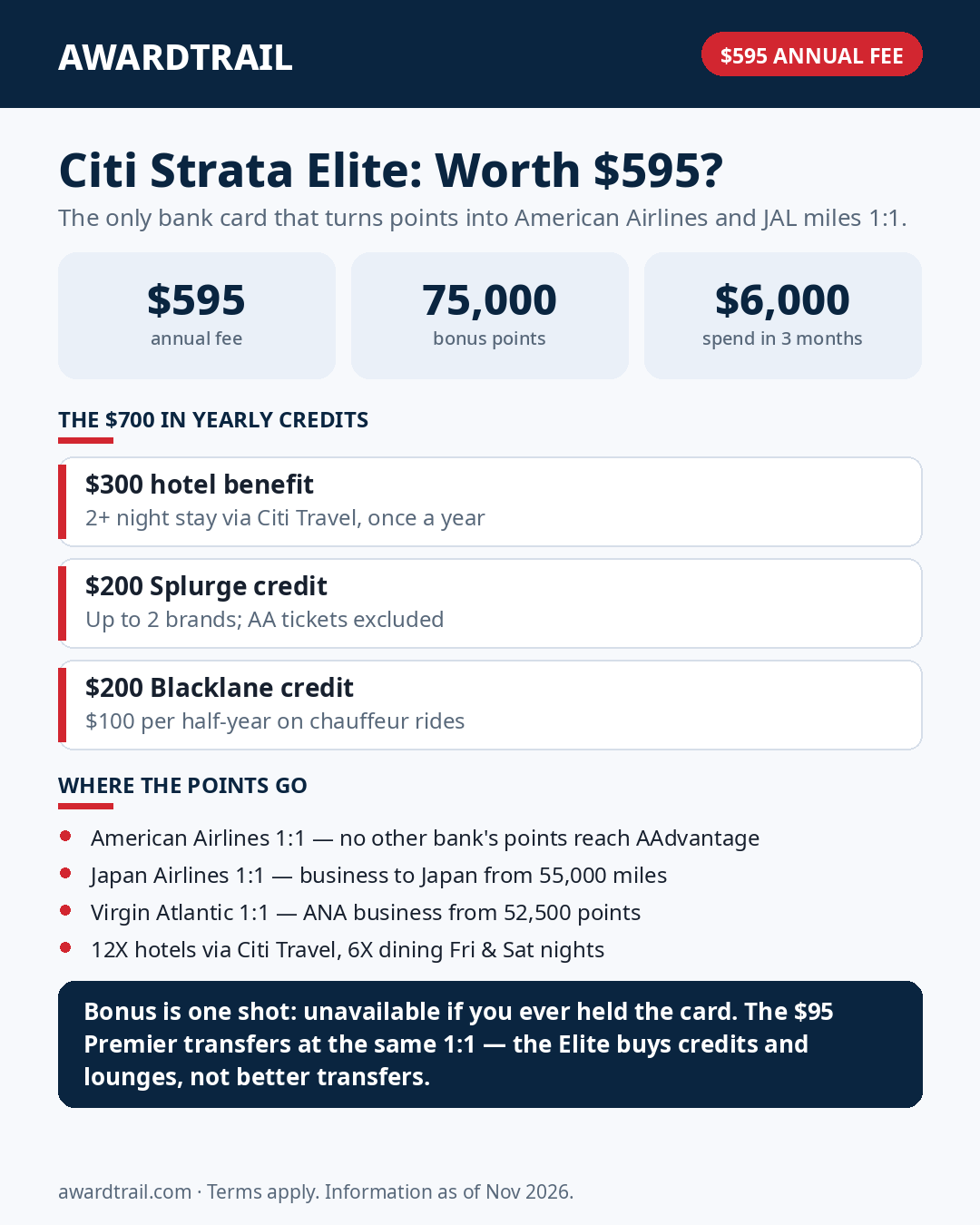
Citi launched the Strata Elite in July 2025 as its first real premium travel card in years, and it has spent the year since being overlooked. That is partly Citi's own doing: the card has no lounge network of its own, no airline of its own, and a $595 annual fee that sits in an awkward middle — $200 more than the Capital One Venture X, $300 less than the Amex Platinum. Shoppers compare the fee, shrug, and move on.
That comparison misses the point. The Strata Elite is not competing on lounges or credits. It is competing on where its points can go. Citi is the only major bank whose points transfer to American Airlines AAdvantage, at a 1:1 ratio from a premium card, and since September 20, 2026 it is also the only one of the big four banks with a 1:1 transfer to Japan Airlines Mileage Bank. Chase, Amex, and Capital One cannot reach either program directly. If you fly American, or you want JAL's own premium cabins to Japan, this card is the only flexible-points route in — and that changes the entire value calculation.
The question is not whether the card is good. It is whether you, specifically, will get $595 of value out of it. The answer splits cleanly, and the numbers are unusually honest about it.
The $595 fee, deconstructed: $700 in credits, each with a catch
Citi's pitch is that the credits alone cover the fee. Add them up and it looks true: up to $300 off a hotel stay, up to $200 in Splurge credits, up to $200 with Blacklane. That is $700 against a $595 fee, a $105 surplus before a single point is earned.
Each credit has a condition attached, and the conditions are where the surplus usually evaporates.
- The $300 Annual Hotel Benefit applies once per calendar year, to a hotel stay of two nights or more, booked through Citi Travel. The credit lands at booking, the unused portion is forfeited, and if you cancel the stay the credit is reversed. Use it on a trip you were taking anyway and it is real money. Forget it, or book direct for elite nights, and it is worth zero.
- The $200 Annual Splurge Credit covers up to $200 a year across up to two brands you choose: 1stDibs, American Airlines, Best Buy, Future Personal Training, and Live Nation. The American Airlines option sounds perfect for an AA flyer until you read the exclusion: airline ticket purchases do not count. Seat fees, bags, and in-flight spending do. Pick Best Buy or Live Nation if that is where your money already goes; do not invent $200 of spending to chase a $200 credit.
- The $200 Annual Blacklane Credit is split into two $100 halves, January through June and July through December. Blacklane is a premium chauffeur service, not a rideshare. Two airport rides a year at $100 each is a plausible use. One ride, or none, and half the credit or all of it is gone.
Run the realistic version: you use the full $300 hotel benefit, you spend $200 at a Splurge brand you already use, and you take one Blacklane ride for $100. That is $600 of value against a $595 fee — the card pays for itself and hands you $5. Use everything in full and you are $105 ahead. Use only the hotel benefit and you are $295 in the hole before earning enters the picture. The credits are not a coupon book you clip; they are a test of whether your existing spending already matches Citi's list.
One more line item softens the fee for a specific group. Qualifying Citigold clients receive a $145 banking relationship credit each year the fee is assessed, cutting the effective fee to $450. Qualifying Citigold Private Clients get a $595 credit in the first year — the fee, effectively waived — and $145 each year after. If you already bank with Citi at that level, the entire calculation shifts.
The 12X headline is real. It also has a leash.
The earning rates, as printed on Citi's own card page, are the most aggressive in the premium tier on paper:
- 12 points per $1 on hotels, car rentals, and attractions booked on cititravel.com
- 6 points per $1 on air travel booked on cititravel.com
- 6 points per $1 at restaurants on Citi Nights — Friday 6:00 p.m. to Saturday 6:00 a.m. ET, and Saturday 6:00 p.m. to Sunday 6:00 a.m. ET
- 3 points per $1 at restaurants at any other time
- 1.5 points per $1 on everything else
The 12X rate is the highest hotel earning rate of any premium card. It is also portal-locked. Book the same hotel direct and you earn 1.5X, not 12X — and a direct booking is usually the one that earns hotel elite nights and status credit, which a portal booking generally does not. Put numbers on it: $5,000 of hotel spend through Citi Travel earns 60,000 points; the same $5,000 booked direct earns 7,500. That 52,500-point gap is worth roughly $790 at a 1.5-cent transfer value. But if the portal's rate runs even 10% higher than the direct rate on the same room, you have paid $500 for the privilege, and you have given up the elite night. The 12X wins when the portal price matches the direct price. It loses when it does not, and you have to check both prices every time to know which one you are in.
The dining rate is the more honest win. Six points per dollar at restaurants on Friday and Saturday nights is a genuinely strong return with no portal involved — it covers the weekend dinners and delivery orders that are already happening. At 3X the rest of the week it is still competitive. A household that spends $400 a month at restaurants, half of it on weekend evenings, earns about 21,600 points a year from dining alone, worth roughly $324 in transfer value. That is the kind of quiet, repeatable earning that actually pays a fee over time.
The transfer roster is the whole argument
Strip away the credits and the earning rates and this is what remains: the partner list. Citi's own card page names American Airlines, JetBlue, Virgin Atlantic, Cathay Pacific, EVA Air, Choice Hotels, and The Leading Hotels of the World among its transfer partners. From a premium card, airline transfers run at 1:1 — 1,000 ThankYou points become 1,000 partner miles. No-fee Citi cards transfer at a discounted 1,000-to-700, so the premium card is doing real work here.
Two partners carry the argument. American Airlines is the first: no other bank's flexible points transfer to AAdvantage at all, which makes Citi the only way to manufacture AAdvantage miles from card spending without holding an AA co-branded card. AAdvantage miles book American's own flights, its oneworld partners, and the Web Specials that periodically discount awards — and transferred miles do not earn Loyalty Points, so this is a route to awards, not to status. Japan Airlines is the second: added September 20, 2026, it opens Mileage Bank directly, and JAL's own chart prices a one-way business class seat between the US and Japan from 55,000 miles — though fuel surcharges from about $316 and taxes from about $29 apply on top, so the miles are cheap and the cash is not. That single price reframes the welcome bonus. The current offer is 75,000 points after $6,000 of spending in the first three months. At 1:1, that bonus alone nearly covers a one-way JAL business class seat, with 20,000 points to spare — or 75,000 AAdvantage miles, which is most of a partner premium-cabin award on its own.
The rest of the roster fills the gaps the big four leave open. EVA Air at 1:1 is a route to Star Alliance business class to Asia that Amex and Chase cannot match directly. Virgin Atlantic at 1:1 is the ANA sweet spot: 52,500 points for business class from the US West Coast to Japan, 60,000 from the central and eastern US. Turkish Miles&Smiles and Qatar Airways Privilege Club cover the other two alliances. The point is not any single partner. It is that Citi's list is the most internationally tilted of any bank program, and it is the only list with American and Japan Airlines on it.
Lounges: solid, not spectacular, with one unique piece
The lounge package is where the Strata Elite looks most ordinary — until the Admirals Club passes enter the frame. Priority Pass Select membership is included, covering 1,500-plus lounges worldwide, with up to two guests per visit; Citi values the membership at $469 a year. Two caveats: restaurant, cafe, and market access is not included, and the membership is the standard Priority Pass product, not a better version of it. The Capital One Venture X, at $395, includes the same Priority Pass Select membership plus Capital One's own lounges. The Amex Platinum, at $895, adds the Centurion network. On lounges alone, the Strata Elite is third in its own price class.
Then there are the four Admirals Club passes, issued every calendar year, good at nearly 50 Admirals Club lounges, which Citi values at over $300. Each pass is valid for 24 hours and can be used at multiple locations in a day, and the primary cardholder redeems one pass for themselves and can bring up to three adult guests on the other three. Unused passes are forfeited at year end, and entry requires a same-day eligible flight. For an American flyer who does not hold an AA co-brand card, four lounge days a year is a real benefit with no other source. For someone who never flies American, it is worth nothing at all — the passes are the most airline-specific perk on the card, and the clearest test of fit.
A Global Entry or TSA PreCheck credit of up to $120 every four years rounds out the package. It is standard at this price point and worth counting at $30 a year, not more.
Who should get it, and who should walk away
The decision comes down to three questions, and the card only makes sense if the answers line up.
Get it if you fly American Airlines. The 1:1 AAdvantage transfer is unavailable anywhere else, the four Admirals Club passes have no substitute, and the Splurge credit can absorb AA spending that is not a ticket. Add a Citigold Private Client relationship and the first-year fee is effectively zero, which makes the argument close itself.
Get it if you book hotels through portals anyway and eat out on weekends. The 12X portal rate and 6X Citi Nights dining are the two earning rates that do genuine work, and together they can produce 50,000-plus points a year from ordinary spending. The $300 hotel benefit then lands on a stay you were booking through a portal regardless.
Walk away if you book direct for hotel status. A Marriott or Hyatt loyalist chasing elite nights will give up more in status progress than the 12X rate returns, and the card's best earning tier will sit unused. Walk away if you never use chauffeur services and your Splurge brands are not on the list — the credits will not cover the fee, and the lounge package alone is not worth $595 when the Venture X offers more of it for $395.
There is also the in-family question. The Strata Premier, at $95 a year, transfers to the same partners at the same 1:1 ratios. The extra $500 a year for the Elite buys the credits, the lounge access, and the higher earning rates — not better transfers. If your goal is purely to move points into American or JAL, the Premier does the job for one-sixth of the fee. The Elite is for the traveler who will use the credits and the lounges on top of the transfers.
The one-shot rule
One term deserves attention before anyone applies. Citi's page states that the new-account bonus is not available if you currently have or previously had a Citi Strata Elite account. In practice, that is one shot at the 75,000-point bonus. There is no waiting out a clock and trying again. That makes the timing of the application matter more than it does on most cards: apply when you can comfortably clear the $6,000 in three months, when you have a redemption in mind for the points, and when you are sure the card fits — because the bonus does not come back.
The bottom line
The Strata Elite is a specialist card wearing a generalist's price tag, and that is both its strength and its trap. At $595, it is $200 more than the Venture X and $300 less than the Amex Platinum, and on credits and lounges alone it loses to both. The $700 in credits only covers the fee if your spending already matches Citi's list, and the 12X earning rate only exists inside a portal that costs you hotel elite nights.
What the other two cards cannot do is move points into American Airlines or Japan Airlines at 1:1. For the traveler who flies American, wants JAL business class to Japan, eats out on Friday and Saturday nights, and books the occasional hotel through a portal, the Strata Elite is not just worth $595 — it is the only card that does the job at all. For everyone else, the $95 Premier holds the same transfer keys for far less money, and the honest answer is to take that one instead. The card is not overpriced. It is narrowly priced. Know which side of that line you are on before you apply.
💡 Why This Matters for Your Strategy
News in the points-and-miles world moves fast, and promotional changes often have a short window. If this announcement affects a card or program you hold, log into your awardtrail dashboard to check your current benefit usage, bonus progress, and whether a transfer or redemption makes sense right now — before terms change.
As a general rule: transfer points only when you have a specific redemption in mind — transfers are almost always one-way and non-reversible. If you're unsure of the value, check our redemption guides before acting.
View Redemption Guides · Read Our In-Depth Analysis
Explore Related Tools
- 🎯 Sign-Up Bonus Tracker — Track your MSR progress and deadlines
- 💳 Benefit & Credit Tracker — See which card credits you haven't used yet
- 🔢 Chase 5/24 Calculator — Know exactly when slots open up
- ❓ Rewards FAQ — Answers to the most common questions
Written by Brian — Founder, awardtrail
Brian has been travel hacking for over 17 years and has personally completed 300+ credit card applications across Chase, Amex, Citi, Capital One, and more. He built awardtrail out of frustration with spreadsheet chaos, and writes from direct, first-hand experience — not marketing copy. All analysis and recommendations on this site reflect real-world strategy tested across hundreds of card applications and award bookings.
Continue Reading
Comments (0)
Join the Discussion
Sign in to share your thoughts and experiences with fellow award travelers.