


Disclosure: awardtrail earns revenue through display advertising and may earn commissions on some links at no cost to you. Commercial relationships never influence our editorial content or recommendations. Full disclosure →
The question people actually ask about the Amex Gold Card is never "what are the benefits?" It's "is the Amex Gold card worth it?" — worth $325 a year, specifically, when the card has no lounge access and half its credits depend on you remembering to use them every single month. The honest answer is that the Gold is two different cards wearing one name: a coupon book worth up to $424 a year, and a 4X earning machine on the two categories most households spend the most on. Whether it pays depends on which of those two you actually use, and the math is less forgiving than the headline numbers suggest.
The $325 fee, minus $424 in credits
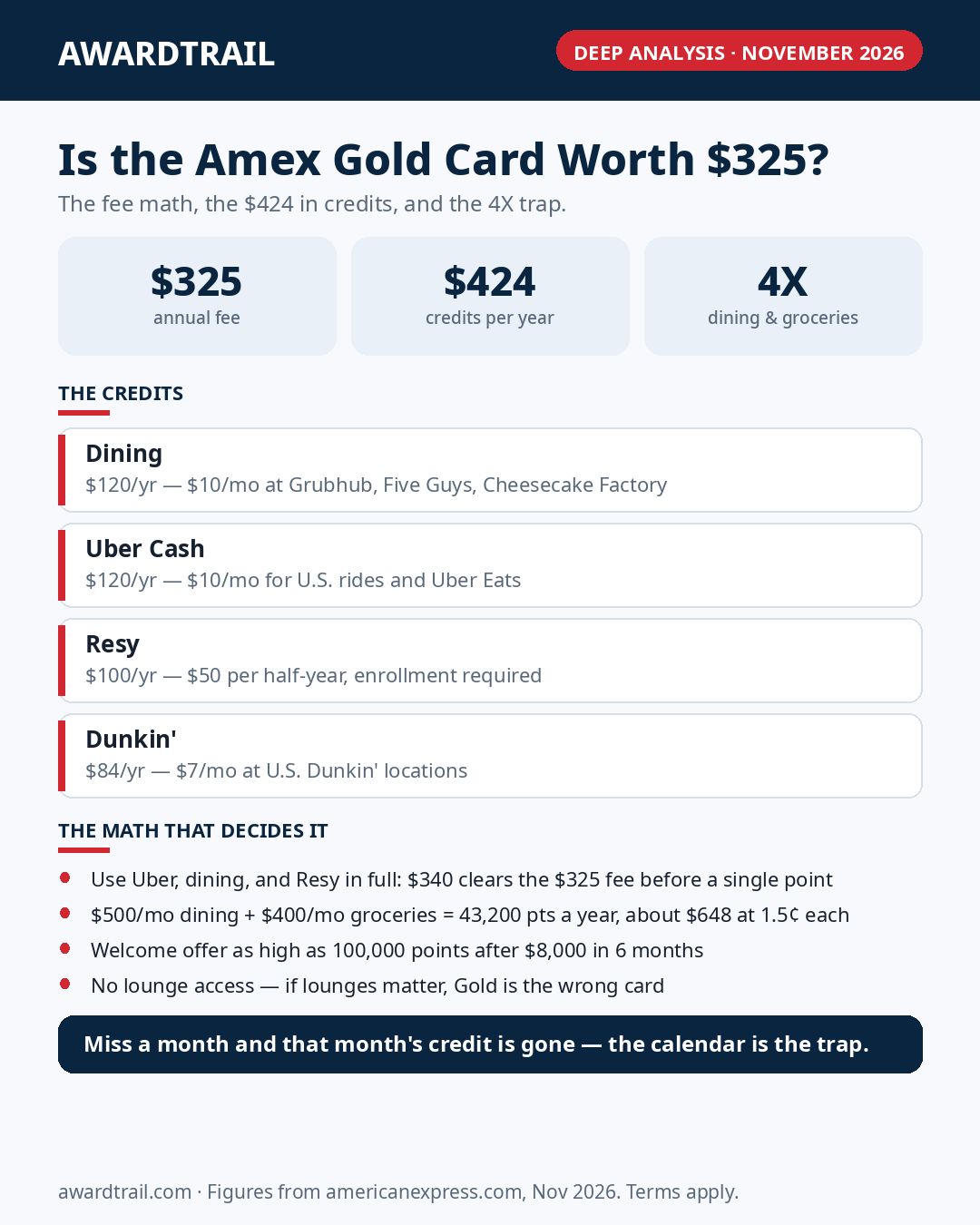
Start with the fee, because it's the only number on the card that isn't conditional. The annual fee is $325 for the basic card, and it isn't waived the first year. Against that, American Express lists four credits that add up to $424 a year: a $120 dining credit, $120 in Uber Cash, a $100 Resy credit, and an $84 Dunkin' credit. On paper, the credits alone clear the fee with $99 to spare, before you earn a single point. That is the pitch. The reality is in the delivery schedule.
The dining credit pays up to $10 a month at Grubhub (including Seamless), Buffalo Wild Wings, Five Guys, The Cheesecake Factory, and Wonder — enrollment required. The Uber Cash is $10 a month for U.S. rides and Uber Eats orders, once you've added the Gold Card to your Uber account. The Dunkin' credit is $7 a month at U.S. Dunkin' locations, also after enrollment. The Resy credit is the only one that isn't monthly: up to $50 from January through June and up to $50 from July through December at qualifying U.S. Resy restaurants, and since September 15, 2026 it also covers purchases on Tock. Enrollment is required for that one too.
The trap is the calendar. A missed month is gone — the dining credit, Uber Cash, and Dunkin' credit don't roll over, and an unused Resy half doesn't raise the next half's cap. So run the fee test on the credits you'll actually capture, not the $424 maximum. Use Uber, dining, and Resy in full and skip Dunkin' entirely, and you've still got $340 against a $325 fee: the card pays for itself before a single point. Use only Uber and dining and you've got $240, which leaves $85 of fee to earn back from points — about 5,700 points at a working value of 1.5 cents each, or roughly $1,425 of spending at 4X. Use only one credit and the card is a bad deal, full stop. Three of the four credits, used consistently, is the line.
The 4X engine is the actual product
The credits get the attention, but the earning rate is what makes the Gold worth carrying for years rather than one bonus cycle. The card earns 4X Membership Rewards points at restaurants worldwide, on up to $50,000 in purchases per calendar year, and 4X at U.S. supermarkets, on up to $25,000 per calendar year. After either cap, that category drops to 1X for the rest of the year. It also earns 5X on prepaid hotels booked through Amex Travel, 3X on flights booked through Amex Travel or directly with airlines, and 2X on prepaid car rentals and cruises booked through Amex Travel. Everything else earns 1X.
Put ordinary numbers on it. A household spending $500 a month on dining and $400 a month at U.S. supermarkets puts $10,800 a year through the 4X categories and earns 43,200 points. At a conservative working value of 1.5 cents per point when transferred to an airline partner, that's about $648 a year in travel value from everyday food spending alone — double the annual fee, before any credits. The effective return is the point: 4X at 1.5 cents a point is a 6% return on dining and groceries, against the 2% a flat cash-back card pays on the same spending. The gap is worth roughly $430 a year on that $10,800 of food spending.
The caps matter more than they look. The $25,000 supermarket cap covers $2,083 a month — a big grocery budget, but a family spending $2,500 a month at the supermarket hits the cap in ten months and earns 1X on the last two. The $50,000 restaurant cap is harder to hit at $4,166 a month, but a household that eats out heavily and puts business meals on the card can get there. And the supermarket rate only applies at merchants coded as U.S. supermarkets, so check your own statements rather than assuming every grocery run counts.
What the welcome offer is really worth
The current public offer is as high as 100,000 Membership Rewards points after you spend $8,000 in purchases on the card within the first 6 months of card membership. Two things about that sentence deserve attention. First, "as high as" — Amex says welcome offers vary and you may not be eligible for an offer, so the number you see when you apply is the number that counts, not the headline. Second, $8,000 in six months is $1,333 a month. If your natural spending doesn't reach that, chasing the bonus with manufactured spending is how a good offer turns into a bad decision.
Valued at that same working 1.5 cents a point, 100,000 points is about $1,500 in travel value — but only if you transfer them to a partner and redeem them well. Membership Rewards points transfer to airline and hotel partners, and the hotel side shows how the math works: every point becomes two Hilton Honors points, so the 43,200 points from the household example above become 86,400 Hilton points. The points are worth the most when they land in a program where you've already priced a specific trip, and the least when they sit in your Amex account waiting for a plan. Transfers are one-way, so the rule is simple: price the award first, then move the points.
There are two quieter perks worth knowing about. The Hotel Collection gives a $100 credit toward eligible charges at more than 1,300 upscale hotels worldwide every time you book through Amex Travel — but it requires a two-night minimum stay, so a single night doesn't trigger it. And the first five additional cards carry no annual fee (the sixth and beyond cost $35 each), which makes the Gold an easy card to hand to a partner or a college-age child so their dining and grocery spending earns at 4X too.
The three traps
The Gold has no lounge access. American Express says so plainly on the card's own page, and points you to the Platinum Card if lounges matter to you. If you fly often enough that lounge access is worth paying for, the Gold is the wrong card no matter how good the 4X rate is — you're buying a dining card and then paying for lounges separately.
The second trap is the monthly credit calendar, covered above: the card's economics quietly reset every month, and a cardholder who uses Uber twice a year and never enrolls in the dining credit is paying $325 for a 4X card and nothing else. That can still be worth it on earning alone if the food spending is heavy enough — $10,800 a year at 4X clears the fee on points value with room to spare — but the margin is thinner than the $424 headline suggests.
The third trap is the caps. The 4X rate is not unlimited, and the card never warns you when you've crossed from 4X to 1X. A household that blows through the $25,000 supermarket cap in October earns 1X on November and December groceries without any notification. If your grocery spending is that large, the Gold is still the best card for the first $25,000 — just don't assume the rate holds all year.
Gold vs. Platinum: the $570 question
The comparison everyone makes is with the Platinum Card, which costs $895 a year — $570 more than the Gold. What the extra $570 buys is mostly lounge access and travel credits, including the $600 Lodging Credit that replaced the old Hotel Credit. The Gold is the better earner on food: 4X on dining and groceries, the two categories where most households spend the most. The Platinum is the better traveler: lounges and credits built around trips rather than meals.
The decision is really about where your spending lives. If your biggest monthly categories are restaurants and supermarkets, the Gold earns more points per dollar and costs $570 less a year. If your biggest spending is travel and you value lounge access, the Gold's 4X doesn't compensate for what it lacks. Plenty of households carry both and split the spending — Gold for food, Platinum for travel — but that only works if you'll actually use both sets of credits. Two coupon books are twice the monthly admin, and the same missed-month math applies to both.
The verdict
The Amex Gold Card is worth $325 a year for one specific person: someone who spends at least a few hundred dollars a month on dining and groceries, uses Uber and at least one of the dining or Resy credits regularly, and will transfer the points to an airline partner for a trip they've actually priced. For that person, the credits alone roughly cover the fee, and the 4X earning is pure upside — hundreds of dollars a year in travel value from spending that was happening anyway.
It's not worth it for the person who rarely eats out, doesn't use Uber, and would let the monthly credits lapse. It's not worth it as a lounge card, because it isn't one. And it's not worth applying for on the strength of the 100,000-point headline alone if $8,000 in six months isn't your natural spending. The Gold rewards a specific, ordinary pattern — eating out, buying groceries, taking the occasional Uber — and it rewards it generously. If that pattern is yours, the fee is the cheapest part of the card. If it isn't, no credit stack will save it.
💡 Why This Matters for Your Strategy
News in the points-and-miles world moves fast, and promotional changes often have a short window. If this announcement affects a card or program you hold, log into your awardtrail dashboard to check your current benefit usage, bonus progress, and whether a transfer or redemption makes sense right now — before terms change.
As a general rule: transfer points only when you have a specific redemption in mind — transfers are almost always one-way and non-reversible. If you're unsure of the value, check our redemption guides before acting.
View Redemption Guides · Read Our In-Depth Analysis
Explore Related Tools
- 🎯 Sign-Up Bonus Tracker — Track your MSR progress and deadlines
- 💳 Benefit & Credit Tracker — See which card credits you haven't used yet
- 🔢 Chase 5/24 Calculator — Know exactly when slots open up
- ❓ Rewards FAQ — Answers to the most common questions
Written by Brian — Founder, awardtrail
Brian has been travel hacking for over 17 years and has personally completed 300+ credit card applications across Chase, Amex, Citi, Capital One, and more. He built awardtrail out of frustration with spreadsheet chaos, and writes from direct, first-hand experience — not marketing copy. All analysis and recommendations on this site reflect real-world strategy tested across hundreds of card applications and award bookings.
Continue Reading

Comments (0)
Join the Discussion
Sign in to share your thoughts and experiences with fellow award travelers.