


Disclosure: awardtrail earns revenue through display advertising and may earn commissions on some links at no cost to you. Commercial relationships never influence our editorial content or recommendations. Full disclosure →
The Chase Sapphire Reserve is the most-searched premium travel card in the country right now, and the question people are actually asking is not whether the card is good. It is whether $795 a year still works, five months after Chase rebuilt the card around a stack of credits. The answer is not a yes or a no. It is a short test you can run on your own spending in about two minutes, and the test has three parts: the credits you will really use, the points you send to Hyatt, and the way you already travel.
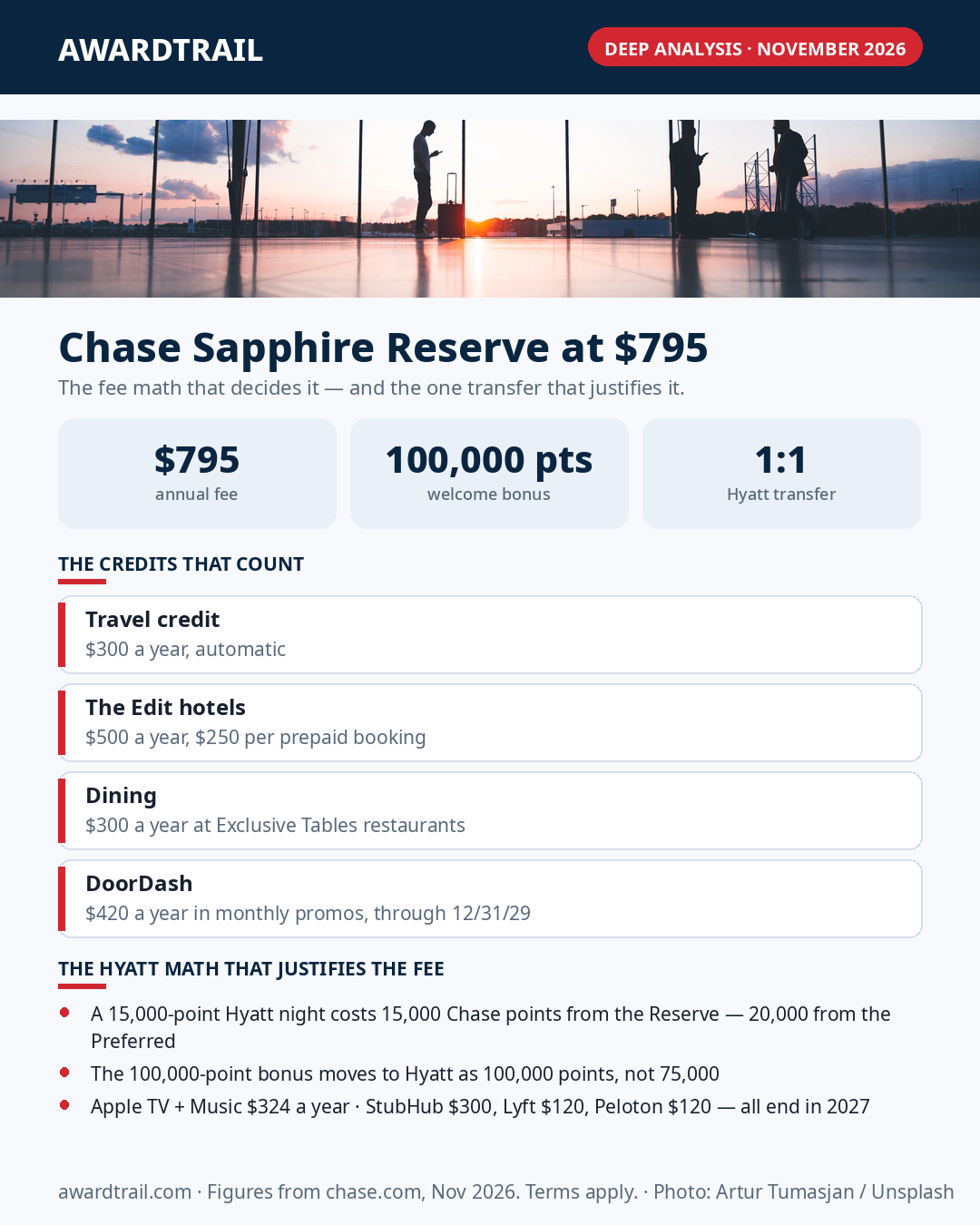
Start with year one, because it is the easy part. The card pays 100,000 Ultimate Rewards points after $6,000 of spending in the first three months. Chase's own page puts two values on that bonus: 1 cent per point for cash back or gift cards, which makes it $1,000 at the floor, and $2,000 of value for select flights and hotels booked through Chase Travel, which is 2 cents per point on the bookings Chase tags for its top redemption rate. Either number clears the $795 fee in the first year before a single credit is counted. The bonus is not the decision. It is the cushion that makes the decision worth taking seriously.
Year two is where the card is actually judged, because the bonus is gone and only the annual arithmetic remains. Chase markets "over $3,000 in annual value" from the benefit stack, and the page lists every piece of it. The honest way to read that stack is to sort it into credits you will use without changing your habits and credits that require you to change them.
The first group is small. The $300 annual travel credit is automatic: the first $300 of travel purchases each account anniversary year is credited back, no enrollment, no portal required. The catch, stated on Chase's own page, is that purchases covered by the credit earn no points. The $120 DashPass membership is a real $120 value for 12 months if you already pay for DoorDash delivery, and the DoorDash promos add up to $35 a month — a $15 promo on any qualifying order plus two $10 promos for groceries and daily essentials — through December 31, 2029. The $324 of Apple TV and Apple Music subscriptions is real money only if you would pay for both services anyway, and only if you activate by June 22, 2027. The $120 Lyft credit, $10 a month through September 30, 2027, is real money only if you ride Lyft. The $120 Peloton credit, $10 a month through December 31, 2027, is real money only if you hold a Peloton membership. The Global Entry, TSA PreCheck, or NEXUS credit is up to $120 every four years — $30 a year spread evenly, and only in the years you actually apply.
The credits that need a booking habit
The second group is where the fee is won or lost, because these credits only work if you book a specific way. The Edit credit is up to $500 a year, but it arrives as $250 per prepaid booking with a two-night minimum at hotels in Chase's Edit collection, and the credited purchases earn no points. One two-night prepaid stay uses $250 of it. The full $500 needs two such stays a year, at hotels expensive enough that $250 is a discount rather than the reason you chose the property. The dining credit is $300 a year, but it is $150 from January through June and $150 from July through December, and it only works at restaurants in the Sapphire Reserve Exclusive Tables program on OpenTable. If your city has few of those restaurants, or your dining is mostly takeout and neighborhood spots, that $300 is theoretical. The StubHub credit is the same shape: $150 per half-year, $300 a year, for StubHub and viagogo purchases, through December 31, 2027, with activation required. A concertgoer uses it without thinking. Anyone else does not.
Run the realistic version of the math. A traveler who uses the $300 travel credit, books one two-night Edit stay and uses $250 of that credit, eats at Exclusive Tables restaurants enough to collect $150 of the dining credit in a year, and uses the DoorDash promos at $35 a month has $1,120 of credits against a $795 fee — and that is before the Apple subscriptions, the Lyft credit, or the lounge. A traveler who uses only the automatic $300 travel credit and the DoorDash promos has $720 against the same $795 fee, and the card is underwater before the lounge is even considered. The gap between those two people is not how much they travel. It is whether their bookings already run through the channels the credits require.
There is a second clock running on this card that the fee math has to include. Several of the credits have hard end dates: the StubHub credit and the Peloton credit both end December 31, 2027, the Lyft credit ends September 30, 2027, and the Apple subscriptions require activation by June 22, 2027. The DoorDash promos run through December 31, 2029. Chase may renew the expiring ones, and it may not. A card whose value depends on credits that expire in thirteen months is a different proposition from a card whose value is structural, and anyone signing up now should count the 2027 expirations as real: if the StubHub, Peloton, and Lyft credits all lapse without renewal, $540 a year of face value disappears from the stack.
The Hyatt transfer is the structural part
The part of this card that does not expire, and the part that now matters more than it did a year ago, is the transfer to World of Hyatt. Chase's June 2026 announcement moved the Sapphire Preferred and the Ink Business Preferred to a 4:3 Hyatt transfer ratio — 1,000 Chase points become 750 Hyatt points — effective October 1, 2026 for existing cardholders. The Sapphire Reserve was not part of that change and still transfers to Hyatt at 1:1. It is now the only Chase consumer card that does, and with Bilt's Hyatt ratio also dropping to 4:3 on January 1, 2027, the Reserve is the last widely available 1:1 path to Hyatt points from a transferable currency.
The math is simple and it scales with volume. A Hyatt night priced at 15,000 points takes 15,000 Chase points from a Reserve account and 20,000 from a Preferred account — 5,000 more, a third more, for the same room. The full 100,000-point welcome bonus moves to Hyatt as 100,000 Hyatt points from the Reserve and 75,000 from the Preferred. A traveler who sends 100,000 Chase points a year to Hyatt keeps 25,000 extra Hyatt points by holding the Reserve instead of the Preferred. At a 1.5-cent illustrative value for a Hyatt point, that is $375 a year of transfer value the Preferred cannot match. At 150,000 points a year to Hyatt, the gap is 37,500 Hyatt points, about $560 at the same illustrative value. The fee gap between the two cards is $700 — $795 against the Preferred's $95. A heavy Hyatt traveler closes most of that gap on transfers alone, before any credit is counted. A traveler who rarely transfers to Hyatt closes none of it, and the rest of the card has to do all the work.
That is also the right frame for the earning rates. The Reserve pays 8x points on purchases through Chase Travel including The Edit, 4x on flights and hotels booked direct, 3x on dining worldwide, and 1x on everything else. The 8x and 4x rates are strong. The 1x rate on everything else is the hole in the card: every dollar of non-bonus spending earns one point, where a flat-rate card would earn two. The Reserve rewards a traveler whose spending concentrates in travel and dining booked the right way, and it quietly taxes everyone else a point per dollar on the rest of their life.
The travel side: lounges, The Edit, and a quiet status
The lounge access is the Reserve's clearest edge over the other premium cards, and it is worth reading carefully. The card includes Chase Sapphire Lounges by The Club and more than 1,300 Priority Pass lounges worldwide, with up to two guests. Two guests included, at no extra charge, is materially better than the guest fees that now apply on other premium cards, and it is the difference between a lounge benefit a couple actually uses and one they pay for at the door. The authorized-user fee is $195 per user, which is steep, and it is the price of extending that lounge access to a partner rather than paying guest fees trip by trip.
Two quieter benefits sit underneath the lounge. The Edit bookings come with a $100 property credit, daily breakfast for two, complimentary Wi-Fi, and a room upgrade and early check-in or late check-out when available — the kind of per-stay value that makes the $250-per-booking credit go further than its face amount, as long as the stay is one you would have booked anyway. And the card includes complimentary IHG One Rewards Platinum Elite status through December 31, 2027, which is a real status tier at a major hotel chain handed over without a single IHG night stayed. Neither benefit appears in the fee math, and both are worth more than the small credits in the stack for a traveler who actually stays at those hotels.
Reserve vs. Preferred: the $700 question
Put the two Sapphire cards side by side and the decision is a $700 question. The Preferred costs $95, pays 75,000 points after $5,000 in three months, earns 5x through Chase Travel and 3x on dining, gas, streaming, and online grocery, and returns up to $100 a year in hotel credits through Chase Travel. It transfers to Hyatt at 4:3. The Reserve costs $795, pays 100,000 points after $6,000 in three months, earns 8x through Chase Travel and 4x on direct flights and hotels, returns the $300 travel credit plus the Edit, dining, StubHub, DoorDash, Apple, Lyft, and Peloton stack, includes the lounges with two guests, and transfers to Hyatt at 1:1.
The Preferred wins for the traveler whose redemptions run through Chase Travel's portal rates or through airlines other than Hyatt, whose dining and grocery spend is concentrated in its 3x categories, and who does not need lounge access. The Reserve wins for the traveler who sends serious volume to Hyatt, who brings a guest into lounges, who books two-night stays through The Edit, and who already uses DoorDash and the Apple subscriptions. The middle ground — the traveler who wants the Reserve's lounge and Hyatt rate but will not use the portal credits — is where the card fails, because the fee is $795 and the only credits that fire automatically are the $300 travel credit and whatever DoorDash and Apple money they would have spent anyway.
Who should hold it
The card makes sense, at $795, for a specific person: someone who flies often enough that lounge access with two guests is a weekly habit rather than an aspiration, who sends at least 100,000 Chase points a year to Hyatt, who books at least one two-night prepaid stay through The Edit each year, and who already pays for DoorDash and Apple TV or Apple Music. For that person the credits, the transfer rate, and the lounge stack up past the fee with room to spare, and the welcome bonus is a genuine windfall on top.
It does not make sense for the traveler who books direct with airlines and hotels to keep elite status, who rarely transfers to Hyatt, who eats at restaurants outside the Exclusive Tables program, and who would have to rearrange their booking habits to use the credits. That traveler is paying $795 for a lounge they visit a few times a year and a 1:1 Hyatt rate they never use, and the Sapphire Preferred at $95 does most of the same work for $700 less. The 10th-anniversary spotlight is what put this card at the top of everyone's search results this fall, but the anniversary is not the reason to hold it. The reason to hold it is the transfer rate, the lounge, and the credits you were already going to use — and if those three do not add up to $795 in your life, the card is telling you so.
💡 Why This Matters for Your Strategy
News in the points-and-miles world moves fast, and promotional changes often have a short window. If this announcement affects a card or program you hold, log into your awardtrail dashboard to check your current benefit usage, bonus progress, and whether a transfer or redemption makes sense right now — before terms change.
As a general rule: transfer points only when you have a specific redemption in mind — transfers are almost always one-way and non-reversible. If you're unsure of the value, check our redemption guides before acting.
View Redemption Guides · Read Our In-Depth Analysis
Explore Related Tools
- 🎯 Sign-Up Bonus Tracker — Track your MSR progress and deadlines
- 💳 Benefit & Credit Tracker — See which card credits you haven't used yet
- 🔢 Chase 5/24 Calculator — Know exactly when slots open up
- ❓ Rewards FAQ — Answers to the most common questions
Written by Brian — Founder, awardtrail
Brian has been travel hacking for over 17 years and has personally completed 300+ credit card applications across Chase, Amex, Citi, Capital One, and more. He built awardtrail out of frustration with spreadsheet chaos, and writes from direct, first-hand experience — not marketing copy. All analysis and recommendations on this site reflect real-world strategy tested across hundreds of card applications and award bookings.
Continue Reading
Comments (0)
Join the Discussion
Sign in to share your thoughts and experiences with fellow award travelers.