

Disclosure: awardtrail earns revenue through display advertising and may earn commissions on some links at no cost to you. Commercial relationships never influence our editorial content or recommendations. Full disclosure →
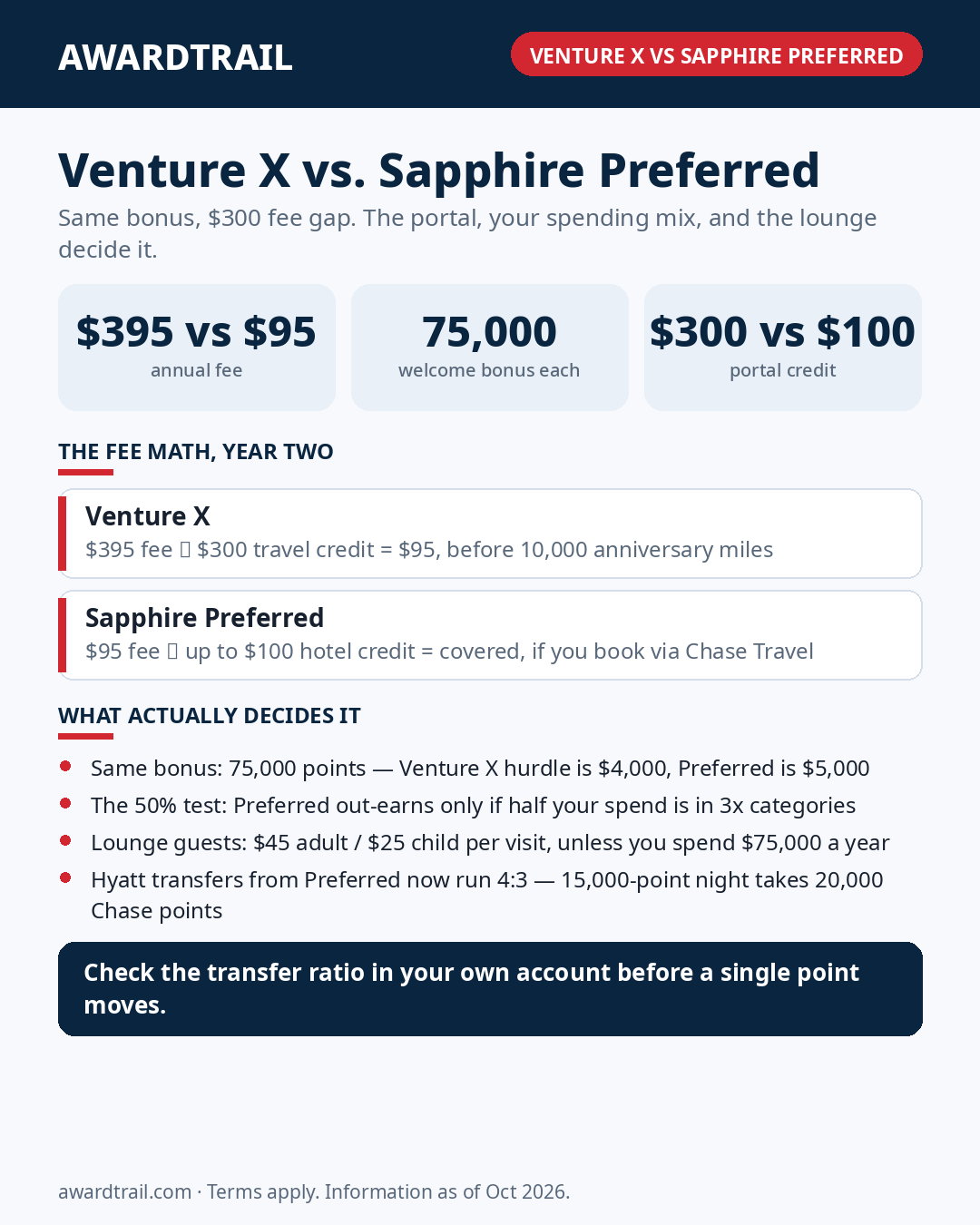
Ask which card wins — Capital One Venture X vs. Chase Sapphire Preferred — and the usual answer starts with the annual fees. The Venture X charges $395 a year. The Sapphire Preferred charges $95. That $300 gap looks like the whole argument, and it is not. Both cards currently offer the same headline welcome bonus, 75,000 points or miles, and both hand back a yearly travel credit that only works if you book through the issuer's own portal. The fee gap is the least interesting number in this comparison. What decides it is how you actually book travel, what you actually spend money on, and who is standing next to you at the lounge door.
Start with the bonuses, because they are closer than the fee gap suggests. The Venture X pays 75,000 bonus miles after $4,000 of spending in the first three months. The Sapphire Preferred pays 75,000 bonus points after $5,000 in the first three months. Same number of points, a $1,000 lower hurdle on the Venture X. On the Chase side, the dollar value is easy to pin down from Chase's own terms: points are worth 1 cent each for cash back or gift cards, so the bonus is $750 at the floor. Book a Points Boost stay or flight through Chase Travel and the same points can be worth up to 1.5 cents each, which puts the bonus at $1,125 on a boosted booking. Those are the only two portal values Chase guarantees in writing for this card — 1 cent everywhere in the portal, up to 1.5 cents where Chase has tagged a boost. Capital One does not publish a fixed cent value for its miles on the public Venture X page, so do not let anyone tell you the two 75,000 bonuses are worth the same dollars. What Capital One does publish, in the Venture X page's travel-redemption disclosure, is the formula: 100 miles per $1 of travel cost, which works out to 1 cent per mile when miles pay for travel, whether a new booking through Capital One Travel or covering a past travel purchase. By that formula the 75,000 miles are $750 of travel value. No conversion rate for cash back or statement credits was published on the pages checked, so the miles are worth an unknown number of dollars anywhere else. They are the same count. What they buy depends on where each currency is spent.
The fee math, done honestly
Year two is where these cards are actually judged, because the welcome bonus is gone and only the annual arithmetic remains. Run it with the credits the issuers publish, and keep the condition attached to each one.
The Venture X costs $395. It returns a $300 annual credit for bookings made through Capital One Travel, and 10,000 bonus miles on each account anniversary, starting with the first. Credits alone bring the net fee to $95 before the anniversary miles are counted. The Sapphire Preferred costs $95. It returns up to $100 in statement credits each account anniversary year for hotel stays booked through Chase Travel. Use the hotel credit once and the fee is covered, with $5 to spare. Both cards also carry a Global Entry, TSA PreCheck, or NEXUS application-fee credit of up to $120 every four years — $30 a year if you spread it evenly, and only in the years you actually apply.
That symmetry is the trap. Neither credit is cash. The Venture X credit only works through Capital One Travel. The Sapphire Preferred hotel credit only works on hotel stays through Chase Travel. If you book direct with airlines and hotels — to keep elite-night credit, to use a corporate rate, to stay somewhere the portal does not sell — both credits sit unused and the math collapses back to the headline fees: $395 against $95, with nothing coming back. A traveler who routes one hotel stay a year through the portal will use the credit without thinking about it. A traveler who never touches a portal should not own either card for its credit. The question is not whether the credit exists. It is whether your booking habit already runs through a portal, because changing how you book to chase a credit usually costs more than the credit is worth.
Earning: the 50% test
Strip out portal bookings and the earning comparison comes down to one variable: how much of your non-travel spending falls in the categories where the Sapphire Preferred pays 3x. The Venture X pays a flat 2x miles on all other purchases. The Sapphire Preferred pays 3x on dining and eligible delivery services, 3x on top streaming services, 3x on online grocery, and 3x on gas stations, EV charging, and vacation homes at top brands. Everything else earns 1x, and other travel earns 2x.
Take $30,000 of non-portal spending. Put $12,000 on dining, $6,000 on gas and EV charging, and $12,000 on everything else. The Sapphire Preferred earns 36,000 on dining, 18,000 on gas and charging, and 12,000 on the rest: 66,000 points. The Venture X earns 60,000 miles on the same $30,000. The Preferred wins by 6,000. Now move the same $30,000 entirely to non-bonus spending. The Preferred earns 30,000. The Venture X earns 60,000. The gap is 30,000 points, and it grows every month.
The break-even is clean. On non-portal, non-travel spend, the Preferred earns 1 point per dollar plus 2 extra points on each dollar in a 3x category, while the Venture X earns a flat 2. The two cards tie when half your spend sits in 3x categories. Above half, the Preferred out-earns. Below half, the Venture X does, and the further below half you fall, the wider the gap. That 50% line is the single most useful test in this comparison, because most people can estimate their dining and grocery share without a spreadsheet. If restaurants, delivery, streaming, and gas are genuinely half your card spend, the Preferred's earning structure is doing real work. If they are a quarter of it, the Venture X's flat 2x is quietly winning every month while the $95 fee looks like the bargain.
Portal spending flips the test. Book through Chase Travel and the Preferred earns 5x. Book through Capital One Travel and the Venture X earns 10x on hotels and rental cars and 5x on flights and vacation rentals. A $3,000 hotel stay booked through the portal earns 15,000 Chase points or 30,000 Capital One miles. The portal is not a side benefit on either card. It is where both cards earn at their best, and it is also where both cards' credits live. That concentration is deliberate, and it means the earning winner is decided by booking channel before it is decided by category.
The lounge is a solo benefit now
Here the cards stop being comparable at all, because the Sapphire Preferred includes no airport lounge access. The Venture X includes it for the primary cardholder: Capital One Lounges and Landings, plus more than 1,300 lounges worldwide through Priority Pass after enrollment. If you fly alone and you fly often, that access is the Venture X's strongest argument, and it is worth more than the fee gap on its own for a frequent traveler. If you fly with other people, read the current terms before you count it, because the terms changed what "access" means for everyone except the primary cardholder.
Additional cardholders — authorized users included — do not get complimentary lounge access. Adding it costs $125 a year per additional cardholder. Guests cost money too. A primary cardholder who has not spent at least $75,000 on the account in a calendar year pays $45 per adult guest and $25 per guest 17 and under at Capital One Lounges and Landings, with children under two free, and $35 per guest at Priority Pass lounges. Spend $75,000 in a calendar year and the cardholder can bring up to two complimentary guests to Capital One Lounges and one to Landings per visit. That guest benefit does not extend to Priority Pass lounges.
Do the family math before you apply. Two adults and two children visiting a Capital One Lounge once, without the $75,000 spend, costs $140 in guest passes for that one visit: $45 plus $45 plus $25 plus $25. Four such trips in a year cost $560 in guest passes on top of the $395 fee, before a single additional cardholder's $125 lounge fee. A solo traveler pays none of that. A couple that adds lounge access for a partner pays $125 a year plus guest fees for anyone else. The lounge is still a real benefit. It is just no longer a family benefit at the $395 price, and anyone choosing the Venture X because they remember bringing two guests in free is choosing a card that no longer exists in that form.
Transfers and the Hyatt cut
The transfer decision is where this comparison is usually settled in conversation, and it is the part that changed most in 2026. Chase points transfer to partner airline and hotel programs, and Chase says points are typically worth 1 cent each for cash back or gift cards but may have higher value when redeemed through Chase Travel with Points Boost or transferred to partners. The Sapphire Preferred's transfer to World of Hyatt now runs at 4:3: 1,000 Chase points become 750 Hyatt points. That rate applies to Sapphire Preferred cardmembers under the change Chase announced on June 15, 2026, effective October 1, 2026 for existing cardmembers, and it has been the rate for new applicants since June 15. Chase says points transfer to most other travel partners at 1:1, with Hyatt the exception.
The 4:3 math is simple and unforgiving. A Hyatt night priced at 15,000 points now takes 20,000 Chase points from a Sapphire Preferred account — 5,000 more, a third more, for the same room. The full 75,000-point welcome bonus moves to Hyatt as 56,250 Hyatt points. That does not make Hyatt transfers bad. It makes them 25% more expensive than they were, and it means a Hyatt-first traveler has to price the stay in Chase points, not Hyatt points, before deciding the transfer is worth it. The Points Boost alternative caps at 1.5 cents per point on select Chase Travel bookings for this card, with everything else in the portal at 1 cent. A boosted hotel booking at 1.5 cents can beat a mediocre transfer, and a strong transfer can beat any portal rate. Neither door is always right, and the card's own terms say the boost only applies to bookings Chase has tagged.
Capital One's side is now easier to settle from public pages than the product page alone suggests. Capital One's own transfer-partners guide names 22 partners — 18 airlines and 4 hotels — with the ratios: most airlines transfer at 1:1, while Emirates, EVA Air, and Japan Airlines run at 2:1.5, JetBlue at 5:3, Choice and Wyndham at 1:1, I Prefer at 1:2, and Accor at 2:1, with a 1,000-mile minimum and partners subject to change. One tension to note: the Venture X product page itself says "15+" programs and names none, so the public guide is the fuller list and the product page the vaguer one. The caution still stands: confirm the ratio shown in your own account for the transfer you are about to make, and confirm the award exists in the partner program before you move anything. Transfers go one way. The right order is award first, transfer second, and it is the same order on the Chase side: price the Hyatt night, price the Points Boost booking, and only then decide which door the points go through.
The extras that should not decide it
One category in the tail deserves more than a passing mention, because the numbers are confirmed on Chase's own page: the Sapphire Preferred's trip cancellation and interruption coverage pays up to $10,000 per covered traveler and $20,000 per trip, and its trip delay coverage pays up to $500 per covered traveler when a delay runs over 12 hours or forces an overnight stay. The Venture X page confirms trip cancellation and interruption coverage exists but states no dollar limit on the public page, so no figure is asserted for it here. Protections like these are real insurance value if you travel often, and they still should not pick the card for you: a limit you never claim is worth nothing, and the earning and lounge math above is what you feel every month.
Both cards carry a tail of smaller benefits that look decisive in a comparison chart and rarely decide anything in real life. The Sapphire Preferred adds a year of complimentary Apple TV when activated by December 31, 2026, a DashPass membership valued at $120 for 12 months with a $10 monthly promo, 5x on Lyft rides through September 30, 2027, and 5x on eligible Peloton purchases over $150 through December 31, 2027. The Venture X adds Premier Collection stays with a $100 experience credit and daily breakfast for two, Lifestyle Collection stays with a $50 experience credit, complimentary Hertz President's Circle status through a Gold Plus upgrade, and cell phone protection up to $800 when the bill is paid with the card, subject to a deductible and terms. Each of these is real. None of them is worth picking the wrong card for. An Apple TV subscription you would not have bought is not $180 of value. A $100 experience credit on a hotel you booked through the portal at a higher rate than direct is not $100 saved. Count only the extras you would have paid for anyway, at the price you would have paid.
Who should pick which
The decision sorts itself once the four tests are answered honestly.
Pick the Venture X if you book through Capital One Travel already, you fly alone or mostly alone, and your non-portal spending is spread across categories rather than concentrated in dining and groceries. The $300 credit and the anniversary miles cover the fee for a portal booker, the flat 2x wins on mixed spend, and the lounge access is yours at every airport where Capital One or Priority Pass has a room. The card pays you to hold it only if the portal is already your habit. If it is not, the fee is $395 with no credit coming back.
Pick the Sapphire Preferred if dining, delivery, streaming, online grocery, and gas are half or more of your card spend, if you book hotels through Chase Travel at least once a year to use the $100 credit, and if your redemptions run through transfers or Points Boost bookings rather than lounge visits. The fee is $95, the hotel credit covers it for a portal hotel booker, and the earning structure rewards the spending pattern it was built for. The Hyatt transfer at 4:3 is a real cost for a Hyatt traveler, and it should be priced into every stay — but the card's case does not rest on Hyatt alone.
Pick neither on lounge access alone if you travel as a family. Run the guest-pass math for your actual party size and trip count first. Two adults and two children, four lounge visits a year, is $560 in guest passes without the $75,000 spend threshold, and the Sapphire Preferred offers no lounge access to compare against. That is not an argument for the Preferred. It is an argument against choosing the Venture X for a benefit its current terms have repriced.
The two cards share a bonus, a portal, and a credit structure, and they diverge on everything that happens after the first year. The Venture X is the better card for a solo, portal-booking, mixed-spend traveler who will actually use a lounge. The Sapphire Preferred is the better card for a dining-heavy, category-concentrated traveler who books a hotel through Chase Travel and redeems through transfers or boosted portal bookings. Choose by your booking habit and your spending mix, not by the fee on the application page, and check the transfer ratio in your own account before a single point moves.
💡 Why This Matters for Your Strategy
News in the points-and-miles world moves fast, and promotional changes often have a short window. If this announcement affects a card or program you hold, log into your awardtrail dashboard to check your current benefit usage, bonus progress, and whether a transfer or redemption makes sense right now — before terms change.
As a general rule: transfer points only when you have a specific redemption in mind — transfers are almost always one-way and non-reversible. If you're unsure of the value, check our redemption guides before acting.
View Redemption Guides · Read Our In-Depth Analysis
Explore Related Tools
- 🎯 Sign-Up Bonus Tracker — Track your MSR progress and deadlines
- 💳 Benefit & Credit Tracker — See which card credits you haven't used yet
- 🔢 Chase 5/24 Calculator — Know exactly when slots open up
- ❓ Rewards FAQ — Answers to the most common questions
Written by Brian — Founder, awardtrail
Brian has been travel hacking for over 17 years and has personally completed 300+ credit card applications across Chase, Amex, Citi, Capital One, and more. He built awardtrail out of frustration with spreadsheet chaos, and writes from direct, first-hand experience — not marketing copy. All analysis and recommendations on this site reflect real-world strategy tested across hundreds of card applications and award bookings.
Continue Reading
Comments (0)
Join the Discussion
Sign in to share your thoughts and experiences with fellow award travelers.