


Disclosure: awardtrail earns revenue through display advertising and may earn commissions on some links at no cost to you. Commercial relationships never influence our editorial content or recommendations. Full disclosure →
The decision isn't $95 versus $395
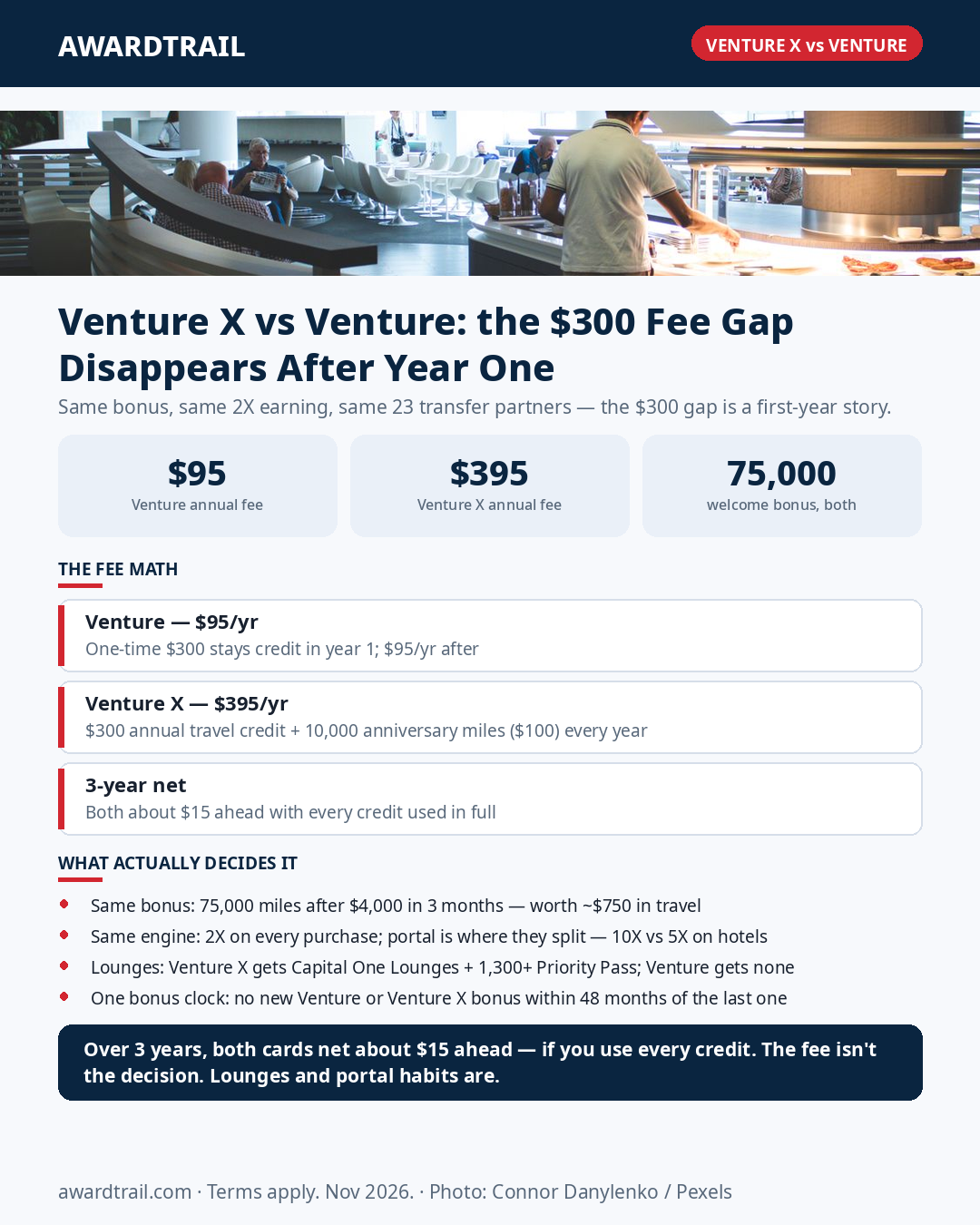
Capital One sells two cards that look like a simple good-better choice. The Venture costs $95 a year. The Venture X costs $395. Same bank, same miles, same transfer partners. Most comparisons stop there and declare the Venture X the obvious winner for anyone who travels, because its $300 travel credit and 10,000 anniversary miles appear to erase the fee.
That conclusion is mostly right, but the reasoning most people use to get there is sloppy — and the sloppy version leads to the wrong card for a specific kind of traveler. Run the numbers properly, year by year, and something surprising shows up: over three years, the two cards cost exactly the same, provided you use every credit at full value. The fee gap is real in year one and gone by year three. What actually separates them is lounge access and how you book travel.
The fee math, year by year
Start with what Capital One states on its own pages. Both cards currently offer the same welcome bonus: 75,000 bonus miles after spending $4,000 in the first three months. At Capital One's own valuation — 10,000 miles equals $100 toward travel, stated on the Venture X page — that bonus is worth $750 toward travel booked through Capital One Travel. The $4,000 of spending itself earns another 8,000 miles at the flat 2X rate, another $80. So the bonus package is worth roughly $830 in travel, identical on either card.
Now the fees. The Venture X charges $395 a year and hands back a $300 annual credit for bookings made through Capital One Travel, plus 10,000 bonus miles every year starting on the first anniversary. Count both at full value and the Venture X nets out at $395 minus $300 minus $100 — five dollars in your favor, every year, before you count a single mile earned from spending.
The Venture charges $95 a year and offers no annual credit. But it does offer a one-time $300 Capital One Travel Stays credit in the first year, usable toward hotel and vacation rental bookings through Capital One Travel, expiring one year after account opening. Use it in full and the Venture's first year nets out at $95 minus $300 — $205 in your favor.
So year one actually favors the cheaper card by $200, if you use the stays credit. From year two onward, the picture flips: the Venture costs $95 a year with nothing coming back, while the Venture X nets $5 a year in your favor. Add it up over three years and both cards land at exactly the same place — about $15 ahead, before spending rewards. The $300 fee gap is a first-year story, not a permanent one. Which means the money argument for either card is weaker than it looks, and the perks argument is doing all the real work.
Same engine, different portal rates
Strip away the credits and the two cards earn identically on everyday spending: unlimited 2X miles on every purchase, miles that never expire for the life of the account. On $30,000 of ordinary annual spending, both cards put 60,000 miles in your account. Neither card is a better daily spender. The earning difference lives entirely inside Capital One Travel.
Book a hotel or rental car through the portal and the Venture pays 5X while the Venture X pays 10X. Book a flight through the portal and the Venture X pays 5X while the Venture pays just 2X — flights aren't in the Venture's 5X category at all. Both pay 5X on Capital One Entertainment purchases.
Take a traveler who books $3,000 of hotels and $2,000 of flights a year through the portal. On the Venture that's 15,000 miles on the hotels and 4,000 on the flights: 19,000 miles. On the Venture X it's 30,000 plus 10,000: 40,000 miles. The gap is 21,000 miles a year, worth about $210 at the 1-cent floor. That is real money, but notice the condition attached to it: every dollar of it depends on booking through Capital One's portal. If you book direct with the airline and the hotel — for status, for elite nights, for the rate you actually want — the earning gap collapses to zero, and so does much of the Venture X's case.
The $300 credit has fine print worth reading
The Venture X's $300 annual credit looks automatic, and mostly it is: the account is enrolled automatically, the credit applies at checkout in Capital One Travel, and it can be split across multiple purchases. But it expires on your next account anniversary, it covers only bookings made through Capital One Travel — hotels, flights, vacation rentals, rental cars, activities — and it is not refunded if you cancel the booking. An unused credit is $300 of value evaporating on your anniversary date, and a cancelled trip can burn it too.
The Venture's one-time $300 stays credit is narrower — hotels and vacation rentals only, first year only, expiring one year after opening — but more forgiving in one respect: if you cancel a purchase made with it, the credit is restored as long as it hasn't expired. Neither credit is cash. Both are only worth their face value if you were going to spend that money through the portal anyway. A $300 credit you use on a $300 hotel night you would have booked regardless is $300 saved. A $300 credit that nudges you into a portal booking you wouldn't otherwise have made is worth considerably less.
Lounges are the real reason to pay $395
This is where the Venture X earns its keep, and where the comparison stops being a math problem. The Venture X gives the primary cardholder access to Capital One Lounges and Landings plus more than 1,300 participating Priority Pass lounges worldwide. The Venture offers no lounge access at all.
Two things about that access deserve a closer look than most comparisons give them. First, Capital One states the lounge benefit for the primary cardholder. The Venture X page does not promise lounge access for authorized users, and it does not state a free-guest allowance or a guest fee on the card page. If you usually travel with a partner, the lounge math changes: one card gets one person in. The second person's entry is a separate problem the card doesn't solve on its face, and you should confirm the guest terms for the lounge you actually use before counting on bringing someone along.
Second, the value of lounge access depends entirely on where you fly. Capital One's own lounges are a small network — a handful of locations — so for most travelers the benefit is really the Priority Pass network: 1,300-plus lounges, useful in many airports, mediocre in others, and subject to capacity limits. If your home airport has a Priority Pass lounge you like and you fly through it regularly, the access is worth real money — a single visit with food and drinks can run $50 or more at airport prices. If your home airport's Priority Pass options are a crowded restaurant credit or nothing at all, the headline number means very little.
The smaller perks still split the two cards
Both cards carry a Global Entry or TSA PreCheck application fee credit of up to $120, once per account every four years, and neither charges foreign transaction fees. The differences show up in the travel perks that get less attention. The Venture X includes complimentary Hertz President's Circle status on enrollment; the Venture includes Hertz Five Star, a tier below. Book through Capital One Travel and the Venture X adds a $100 experience credit on every Premier Collection stay and a $50 credit on Lifestyle Collection stays; the Venture offers the $50 Lifestyle Collection credit only. None of these is decisive on its own, but together they widen the gap for travelers who actually use them — and they are all portal-dependent, which is the running theme of this card.
The miles go to the same 23 places
Whichever card you hold, the miles are the same currency, and they transfer to the same partners. Capital One lists more than 15 travel loyalty programs; its own transfer guide counts 23 — 19 airlines and 4 hotel programs. Most transfer at 1:1 in increments of 1,000 miles, with a 1,000-mile minimum: Aeroplan, Flying Blue, British Airways, Qatar Airways, Singapore KrisFlyer, Turkish Miles&Smiles, Virgin Red, and Wyndham and Choice on the hotel side, among others.
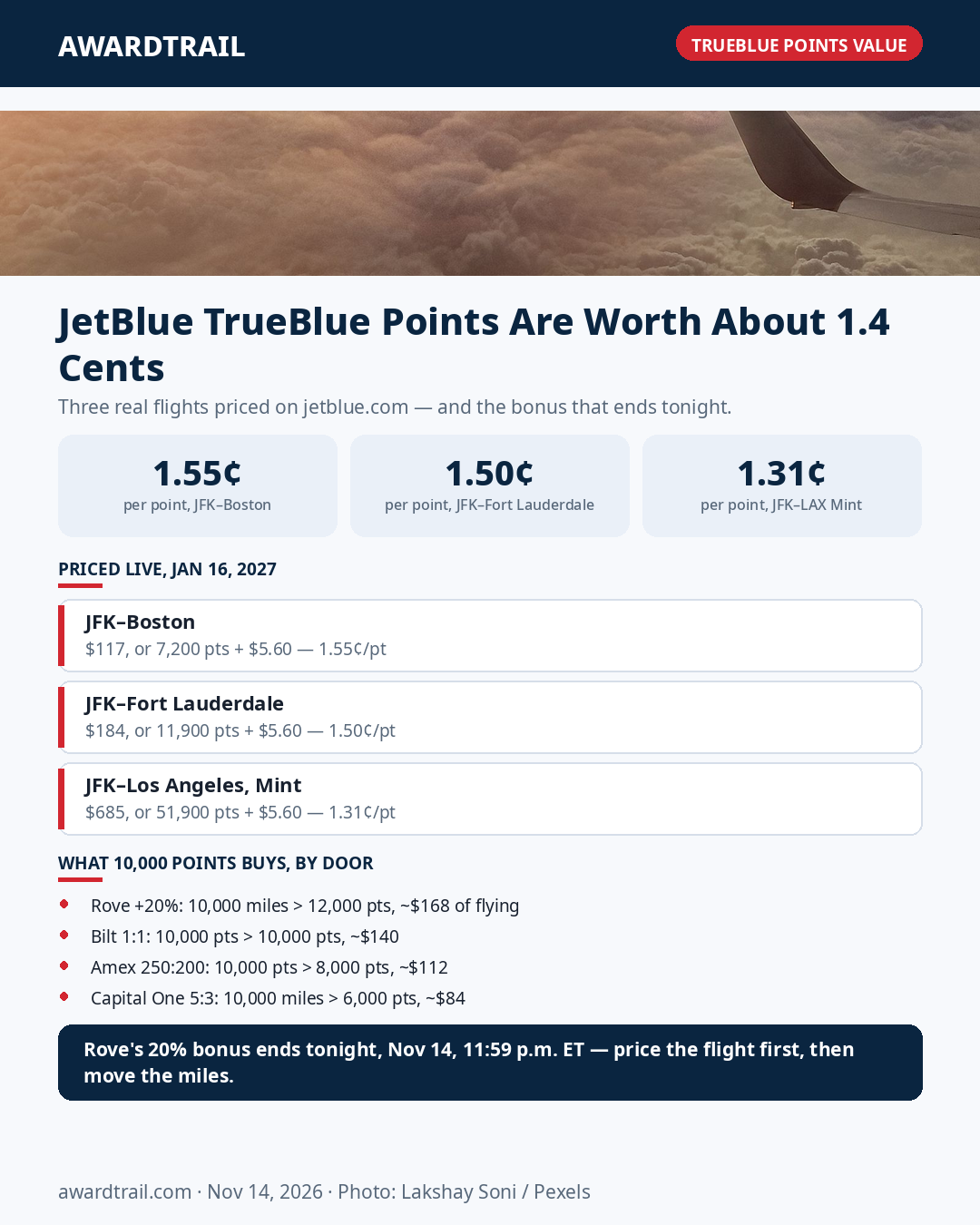
The exceptions matter when you price a specific trip. JetBlue TrueBlue transfers at 5:3, so 75,000 Capital One miles become 45,000 TrueBlue points. Japan Airlines, Emirates, EVA Air, and Copa transfer at 2:1.5, so 75,000 miles become 56,250 partner points. I Prefer Hotel Rewards transfers at 1:2 — 75,000 miles become 150,000 points — while Accor Live Limitless goes the other way at 2:1. The transfer door is the same on both cards, so it never decides between them. It does decide how much the 75,000-mile bonus is worth to you: transferred well, to a partner whose award chart undercuts cash prices, it can be worth far more than the $750 portal floor. Transferred carelessly, to a weak ratio with no trip in mind, it can be worth less. Transfers are final, so the rule is the same as ever: find the seat first, then move the miles.
The trap: you can't collect both bonuses
One more number shapes the strategy. Capital One's terms state that you aren't eligible for the welcome bonus if you received a new cardmember bonus for the Venture or the Venture X in the past 48 months. The two cards share a single bonus clock. You cannot take the Venture's 75,000 miles this year and the Venture X's 75,000 miles next year — not with the bonus attached. That kills the most tempting play in this comparison: start cheap, grab one bonus, then grab the other. Pick the card you actually want to hold, because the bonus comes once per four years across both.
Who should pick which
The Venture is the right card for the traveler who wants a simple 2X card, books travel wherever it's cheapest rather than through a portal, and won't use lounge access. Its first year is genuinely the cheaper one — $95 against a $300 stays credit — and from year two it costs $95 a year for the same earning and the same transfer partners. If you will never set foot in a lounge and never book through Capital One Travel, the Venture X's extra $300 a year buys you nothing.
The Venture X is the right card for the traveler who flies a few times a year through airports with lounges worth using, and who books at least $300 of travel a year through Capital One Travel. For that person the fee effectively disappears — the credit and the anniversary miles cover it — and the lounges, the higher portal earning, and the better Hertz status are all upside. The break-even is honest and easy to test: one $300 portal booking a year, and the card costs you nothing more than the Venture. Miss that booking and you're paying $300 for lounge access alone, which may still be worth it if you lounge often, but you should know that's what you're paying for.
There is also a middle case worth naming: the traveler who books through the portal and uses lounges, but travels as a couple. The Venture X covers one person's lounge entry, and the guest terms aren't stated on the card page. Before choosing it for two-person travel, check what guest access actually costs at the lounges you use — that answer, not the annual fee, is what decides whether one Venture X is enough or whether the household needs a second card.
The bottom line
Over three years, with every credit used at full value, the Venture and the Venture X cost exactly the same. That is the finding that matters, because it strips the fee out of the decision and leaves the real question exposed: do you book through Capital One Travel, and do you want lounge access? Answer yes to both and the Venture X is the better card, often the cheaper one to actually hold. Answer no to both and the Venture is the smarter $95. The $300 gap between them was never the decision. It was the distraction.
💡 Why This Matters for Your Strategy
News in the points-and-miles world moves fast, and promotional changes often have a short window. If this announcement affects a card or program you hold, log into your awardtrail dashboard to check your current benefit usage, bonus progress, and whether a transfer or redemption makes sense right now — before terms change.
As a general rule: transfer points only when you have a specific redemption in mind — transfers are almost always one-way and non-reversible. If you're unsure of the value, check our redemption guides before acting.
View Redemption Guides · Read Our In-Depth Analysis
Explore Related Tools
- 🎯 Sign-Up Bonus Tracker — Track your MSR progress and deadlines
- 💳 Benefit & Credit Tracker — See which card credits you haven't used yet
- 🔢 Chase 5/24 Calculator — Know exactly when slots open up
- ❓ Rewards FAQ — Answers to the most common questions
Written by Brian — Founder, awardtrail
Brian has been travel hacking for over 17 years and has personally completed 300+ credit card applications across Chase, Amex, Citi, Capital One, and more. He built awardtrail out of frustration with spreadsheet chaos, and writes from direct, first-hand experience — not marketing copy. All analysis and recommendations on this site reflect real-world strategy tested across hundreds of card applications and award bookings.
Continue Reading
Comments (0)
Join the Discussion
Sign in to share your thoughts and experiences with fellow award travelers.