


Disclosure: awardtrail earns revenue through display advertising and may earn commissions on some links at no cost to you. Commercial relationships never influence our editorial content or recommendations. Full disclosure →
The reset happened while nobody was watching
On November 5, the day after the old Delta SkyMiles American Express offers expired, a new set went up on American Express's own pages. No announcement, no fanfare. The personal cards got better in almost every line, and the business cards paid for it. If you were waiting out the November 4 deadline from the last round, the board has changed — and the card you should pick has changed with it.
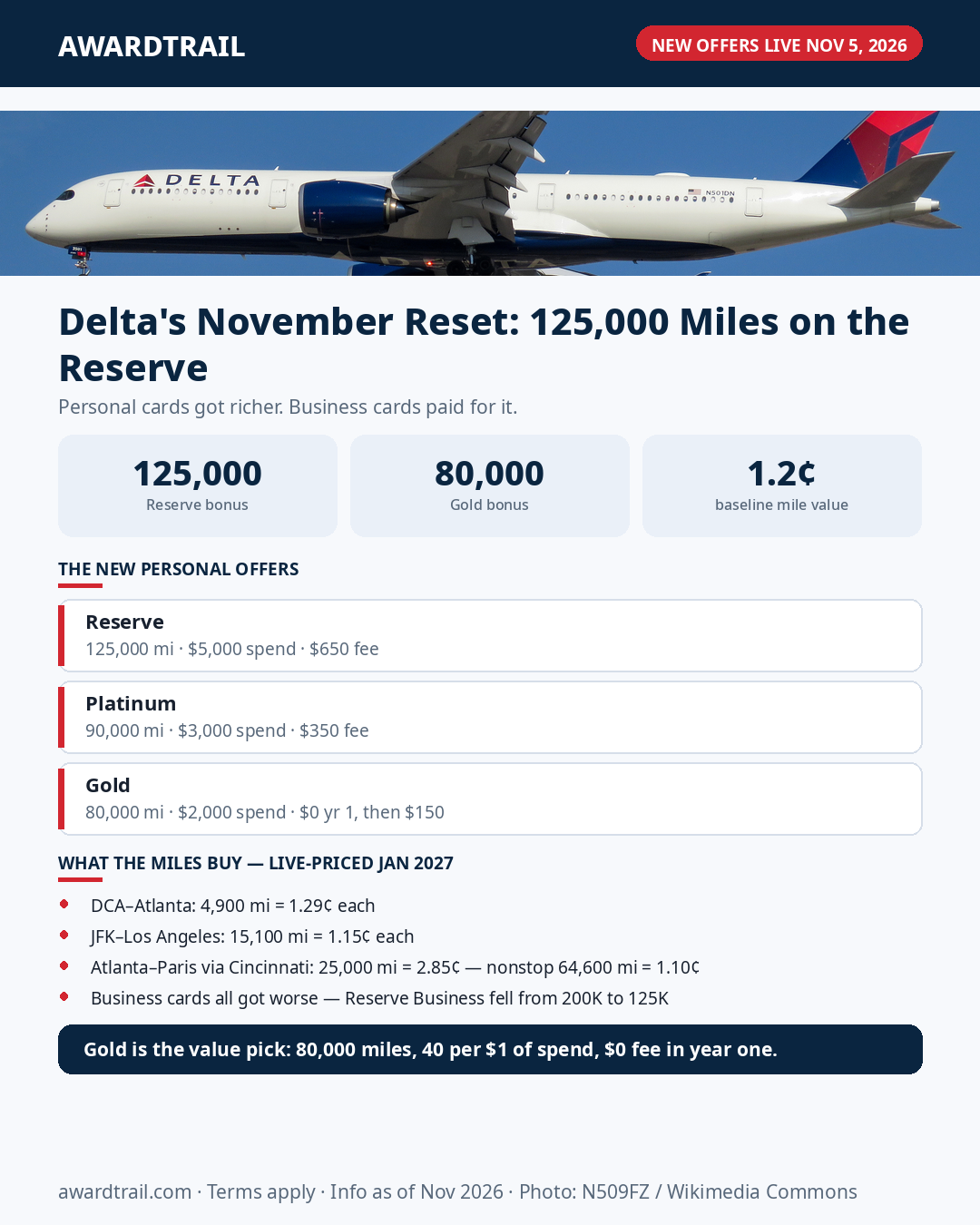
The headline is the Delta SkyMiles Reserve: as high as 125,000 bonus miles after $5,000 in purchases in the first six months, against a $650 annual fee. The offer it replaces asked for $10,000 in spend, paid 50,000 miles, and made up the difference with two round-trip Delta Comfort flight certificates. The certificates are gone. The miles more than doubled, at half the spend.
The rest of the personal lineup moved the same direction. The Platinum now offers as high as 90,000 miles after $3,000 in purchases in six months, down from $4,000 of spend, with a $350 annual fee — but the $300 statement credit from the last round is gone. The Gold offers as high as 80,000 miles after $2,000 in purchases, down from $3,000, with no annual fee the first year and then $150 — and the $250 statement credit is gone too. The no-annual-fee Blue sits at 10,000 bonus miles.
The business cards went the other way. Reserve Business fell from 200,000 miles after $20,000 in spend to as high as 125,000 after $15,000. Platinum Business kept its 100,000 miles but raised the spend from $8,000 to $10,000. Gold Business slipped from 90,000 miles to 85,000 at the same $6,000 spend. Every business card is flat or worse on miles, and one asks for more spend to get the same number.
Two warnings before the numbers. First, every one of these is advertised as "as high as" — American Express says welcome offers vary and you may not be eligible for the full offer, so the ceiling is not a promise. Second, none of the card pages I checked carries a published end date. The last round had one, November 4. This round does not, which means it can change without notice. If one of these fits you, that is a reason to decide soon, not a reason to assume it runs forever.
What the bonuses are worth in dollars
A bonus number is meaningless until you price the miles. The honest baseline for a SkyMile, drawn from the way Delta actually prices awards, is about 1.2 cents — and I will show the work for that number below rather than ask you to take it on faith. At 1.2 cents, the new offers translate like this:
- Reserve, 125,000 miles: about $1,500 in Delta flights, after $5,000 of spend. That is 25 miles per dollar of required spend.
- Platinum, 90,000 miles: about $1,080 in flights, after $3,000 of spend. Thirty miles per dollar.
- Gold, 80,000 miles: about $960 in flights, after $2,000 of spend. Forty miles per dollar — the richest rate in the family, on a card with no fee in year one.
- Reserve Business, 125,000 miles: about $1,500, after $15,000 of spend. About 8 miles per dollar.
- Platinum Business, 100,000 miles: about $1,200, after $10,000 of spend.
- Gold Business, 85,000 miles: about $1,020, after $6,000 of spend.
Read that list again and the shape of the reset is obvious. The personal Gold is the value play: the most miles per dollar of required spend, no first-year fee, and the same 15% award discount as the $650 card. The Reserve is the biggest pile of miles, but you pay for it twice — $5,000 of spend and a $650 fee — and the Reserve Business is the worst deal of the six on a per-dollar basis, which is exactly the card that lost the most in the reset.
I priced three real flights. The spread is the story.
Delta publishes no award chart. Every SkyMiles price is generated dynamically, which means the mileage cost of a seat moves with the cash fare for that same seat. So instead of quoting a valuation, I went to delta.com and priced three real one-way Main Cabin awards for January 2027, then compared each against the cash fare for the same flight. All prices below were checked on November 15, 2026, logged out, in the Shop with Miles view. Cash fares include taxes and fees; award prices carry a $6 cash component on top of the miles.
Washington DCA to Atlanta, Tuesday January 19. The lowest Main Cabin award was 4,900 miles plus $6, on DL410 departing 6:00 am — and the same 4,900-mile price showed on eight departures across the day. The cash fare for that flight was $69. That works out to ($69 − $6) ÷ 4,900 miles, or about 1.29 cents per mile. Evening flights the same day were 9,500 miles, which would have been about 0.66 cents — the same route, the same day, half the value after 6 pm.
New York JFK to Los Angeles, Wednesday January 20. The lowest Main Cabin award was 15,100 miles plus $6, on DL742 departing 7:00 am, with the same price on five departures through the day. The cash fare was $179. That is ($179 − $6) ÷ 15,100, or about 1.15 cents per mile. Other nonstops that day were 17,800 miles, worth about 0.97 cents. Transcontinental is where SkyMiles look most ordinary: a solid, unexciting 1.1 to 1.2 cents, with the clock deciding which side of it you land on.
Atlanta to Paris, Thursday January 21. This is where the program shows both faces at once. The lowest Main Cabin award was 25,000 miles plus $6 on a connecting itinerary through Cincinnati, against a $718 cash fare — ($718 − $6) ÷ 25,000, or about 2.85 cents per mile, the best value of the three by a wide margin. But the lowest nonstop award that day was 64,600 miles, against a $714 cash fare — about 1.10 cents. And an Air France-operated nonstop was 39,500 miles, sitting between the two. Same city pair, same day: 2.85 cents if you will connect, 1.10 cents if you will not. That 2.6x gap is the whole game with SkyMiles. The program rewards flexibility and punishes the nonstop at peak times, and no published chart will ever tell you which day is which.
Put the three together and the 1.2-cent baseline holds up as a planning number, not a promise. Short-haul off-peak runs a little above it. Transcontinental runs right on it. International runs anywhere from below it to nearly triple it, depending on whether you accept a connection. Anyone who tells you a SkyMile is worth a single fixed number is selling a simpler program than the one Delta runs.
TakeOff 15 is the quiet multiplier
Every Delta Gold, Platinum, and Reserve card — personal and business — carries TakeOff 15: a 15% discount on the mileage portion of Delta-operated award flights booked on delta.com or the Fly Delta app. It does not apply to partner-operated flights or to taxes and fees, and you need the card linked to your SkyMiles account. But within those limits it applies every time, with no cap, and it changes the math on every example above.
Run the same three flights through the discount. The DCA–Atlanta award drops from 4,900 miles to about 4,165, lifting the value from 1.29 to about 1.51 cents per mile. JFK–Los Angeles drops from 15,100 to about 12,835 miles, lifting the value from 1.15 to about 1.35 cents. The Atlanta–Paris connecting award drops from 25,000 to 21,250 miles, lifting an already strong 2.85 cents to about 3.35. The 15% discount is worth roughly 0.2 cents on every mile you redeem, which is why the cheapest way into it matters: the Gold card, at no fee in year one, buys the same discount as the $650 Reserve.
There is a second, subtler point. TakeOff 15 only works on Delta-operated flights. The Air France nonstop to Paris at 39,500 miles gets no discount, while the Delta connecting itinerary at 25,000 miles gets the full 15% off. The gap between the partner price and the Delta-operated price is bigger than it looks on the results page, and it is bigger still once the discount applies.
The transfer door is a single lane
If you hold American Express Membership Rewards points, Delta is the one airline in the program where the transfer math is simple: Membership Rewards transfer to SkyMiles at 1:1, in 1,000-point increments. That makes the 125,000-mile Reserve bonus directly comparable to 125,000 Membership Rewards points — and it makes the Gold's 80,000 miles directly comparable to an 80,000-point transfer.
What you cannot do is shop around. Chase points, Capital One miles, Citi points, and Bilt points do not transfer to Delta. American Express is the only transferable-points partner that feeds SkyMiles, which means the value of a SkyMile is also the value of a Membership Rewards point that has only one airline home. That is a real constraint on the points, and it is the reason the transfer decision deserves more thought than the card decision. A Membership Rewards point that can go to a dozen airlines is worth more in option value than the same point locked into Delta's dynamic pricing — unless Delta is the airline you actually fly.
The traps, in order of cost
Pay with Miles is the floor, not a redemption. American Express's own card pages describe it plainly: up to $50 off a flight for every 5,000 miles, which is 1 cent per mile, fixed. Any award that prices above 1 cent per mile beats Pay with Miles, and all three of the flights I priced did. Use Pay with Miles only when the award price is worse than 1 cent — which happens, mostly on peak-day evening departures — and never as the default.
The Companion Certificate is a second-year benefit, not a welcome perk. Both the Reserve and the Platinum include a Companion Certificate each year after renewal — a domestic, Caribbean, or Central American round trip in Main Cabin (or higher cabins on the Reserve) for a companion, with taxes and fees from $22 to $250. It is real value if you fly Delta with a partner every year, and it is worth nothing in year one. Do not let it tip a first-year decision.
SkyMiles never expire, which removes the urgency and creates a different risk. Delta's program rules carry no expiration on miles, so there is no deadline forcing you to redeem. The risk runs the other way: dynamic pricing means the award you are saving for can cost more next year than it costs today, with no chart to anchor it. Miles that never expire are still miles that can quietly lose value. Redeem them on the good days — the 4,900-mile short hops and the 25,000-mile connecting internationals — rather than stockpiling them for a perfect trip.
The lounge math on the Reserve is tighter than it looks. The Reserve gives 15 Delta Sky Club visits per Medallion year, with unlimited visits after $75,000 in card spend in a calendar year, plus four one-time guest passes. American Express values that at up to $950 a year if you use every visit and every pass. Fifteen visits is generous; $75,000 of spend to unlock unlimited is a number most cardholders will never touch. If you fly Delta twice a month and use the club every time, the Reserve earns its fee. If you fly four times a year, the Platinum's lower fee and the same TakeOff 15 discount are the better buy, and the Gold is better still.
Who should take which offer
Most Delta flyers should take the Gold. Eighty thousand miles for $2,000 of spend, no fee in year one, the full TakeOff 15 discount, a free first checked bag, and $100 a year in Delta Stays credit against a $150 fee from year two. At 1.2 cents the bonus alone is about $960 of flights, and the 40-miles-per-dollar spend ratio is the best in the lineup. The missing piece is lounge access and the companion certificate — if neither matters to you, the Gold is the answer and the rest of this post is academic.
Frequent Delta flyers who want the lounge should take the Reserve. The 125,000-mile bonus is the largest pile on the table, the $650 fee is offset by the club visits and the companion certificate if you actually use them, and the 3X earning on Delta purchases is the best in the family. But do the honest count: fifteen club visits and one companion trip a year, or the fee does not pay.
The Platinum is the middle card for people who fly Delta enough to want the certificate and the credits, but not enough to live in the lounge. Ninety thousand miles, a $350 fee, a Main Cabin companion certificate after renewal, $150 a year in Delta Stays credit, and $120 a year each in Resy and rideshare credits. It is a reasonable card that the Gold undercuts on value and the Reserve outclasses on perks — which is exactly what a middle card is supposed to be.
Business owners should wait. The business cards are the one place in this reset where the direction is unambiguously down: the Reserve Business lost 75,000 miles, the Platinum Business asks for $2,000 more spend for the same 100,000, and the Gold Business lost 5,000 miles. Nothing in the business lineup improved, and with no published end date on any offer, there is no deadline forcing a decision. If you need a Delta business card now, the Gold Business at 85,000 miles for $6,000 of spend is the least-bad option. Otherwise, the personal Gold does the same job for most of the same miles at a third of the spend.
The decision, in one paragraph
Delta's November reset is a genuinely better set of personal offers — more miles, less spend, no statement-credit sleight of hand to untangle — wrapped around a program whose miles are worth about 1.2 cents on a normal day, 1.5 cents with a card in your pocket, and nearly 3 cents when you are flexible enough to connect. Take the Gold if you want the best return on the least commitment. Take the Reserve if you will use the lounge fifteen times and fly with a companion. Skip the business cards until the offers improve, and whatever you take, spend the miles on the days they price well. The bonus is a one-time event. The pricing is forever.
💡 Why This Matters for Your Strategy
News in the points-and-miles world moves fast, and promotional changes often have a short window. If this announcement affects a card or program you hold, log into your awardtrail dashboard to check your current benefit usage, bonus progress, and whether a transfer or redemption makes sense right now — before terms change.
As a general rule: transfer points only when you have a specific redemption in mind — transfers are almost always one-way and non-reversible. If you're unsure of the value, check our redemption guides before acting.
View Redemption Guides · Read Our In-Depth Analysis
Explore Related Tools
- 🎯 Sign-Up Bonus Tracker — Track your MSR progress and deadlines
- 💳 Benefit & Credit Tracker — See which card credits you haven't used yet
- 🔢 Chase 5/24 Calculator — Know exactly when slots open up
- ❓ Rewards FAQ — Answers to the most common questions
Written by Brian — Founder, awardtrail
Brian has been travel hacking for over 17 years and has personally completed 300+ credit card applications across Chase, Amex, Citi, Capital One, and more. He built awardtrail out of frustration with spreadsheet chaos, and writes from direct, first-hand experience — not marketing copy. All analysis and recommendations on this site reflect real-world strategy tested across hundreds of card applications and award bookings.
Continue Reading
Comments (0)
Join the Discussion
Sign in to share your thoughts and experiences with fellow award travelers.