


Disclosure: awardtrail earns revenue through display advertising and may earn commissions on some links at no cost to you. Commercial relationships never influence our editorial content or recommendations. Full disclosure →
The short answer, and why it misleads
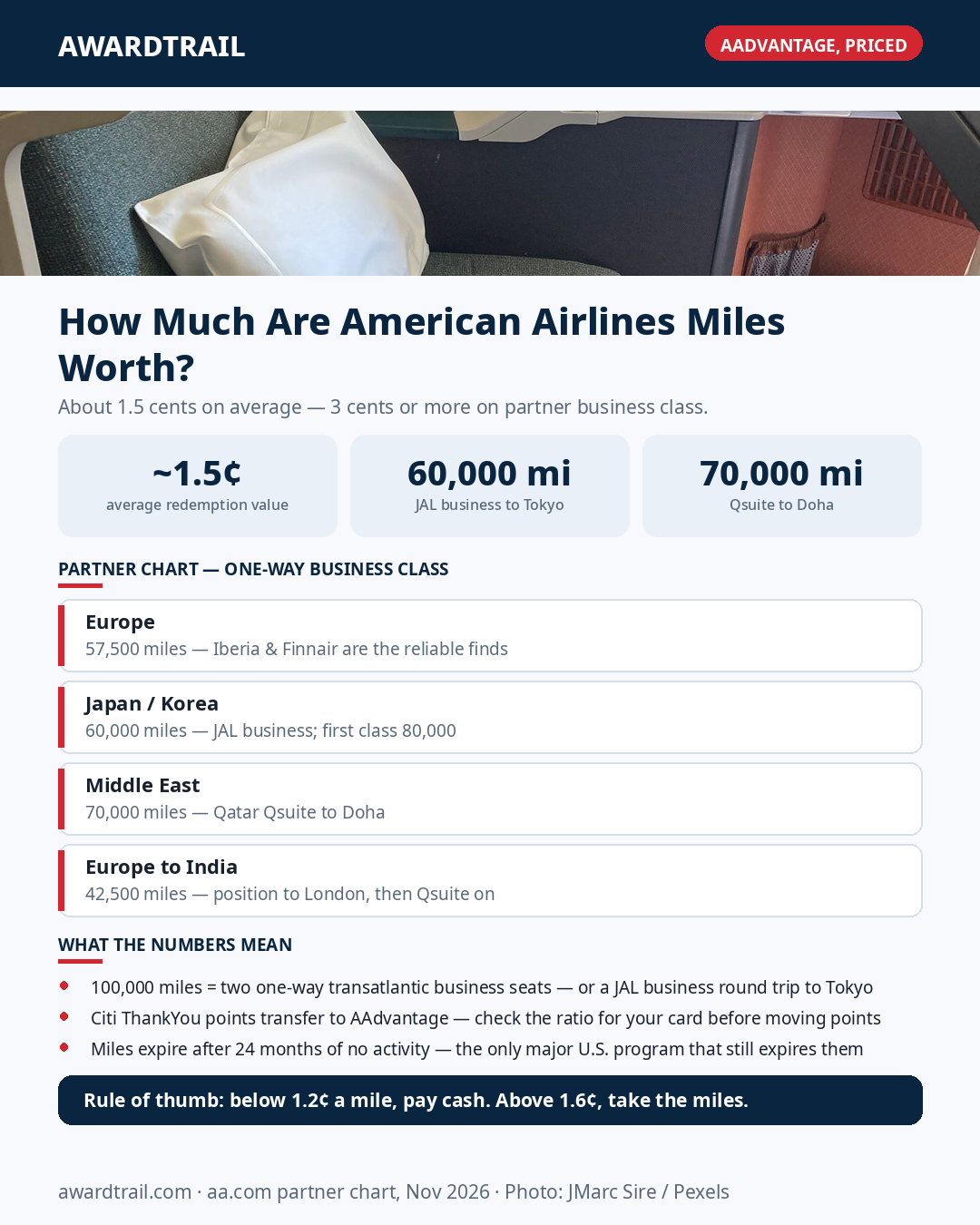
Ask how much American Airlines miles are worth and you will get a single number, somewhere around 1.5 cents each. That number is useful the way an average temperature is useful: it tells you the climate and nothing about the day you are actually flying. The same 100,000 AAdvantage miles can be worth $1,500 or $800 or $3,000, and the difference has almost nothing to do with how many miles you hold. It comes down to which of American's two pricing systems your booking runs through.
American prices its own flights dynamically. The miles for a seat on American metal rise and fall with the cash fare, the date, and the load factor, and on a peak Friday or a last-minute booking the rate can sink below a cent a mile. Partner flights are different. Awards on oneworld and partner airlines still follow a published regional chart, and that chart has barely moved since American went dynamic on its own metal in 2023. The chart is where the value lives, and it is also where most AAdvantage members never look, because American's own search defaults to showing you American-operated flights first.
So the honest answer to "how much are American Airlines miles worth" is two answers. On an ordinary domestic redemption, plan on about 1.3 to 1.6 cents a mile. On a partner premium cabin booked at chart prices, 3 cents a mile is routine and 5 cents is in reach. Everything that follows is about steering your balance toward the second number.
Two pricing systems under one program
The split is the single most important thing to understand about AAdvantage in 2026. Book a seat on an American-operated flight and you are in a dynamic market: American's own award chart starts at 7,500 miles each way for the cheapest domestic seats, but the price you actually see depends on the day. A Tuesday in February might price at 9,000 miles; the Sunday after Thanksgiving might price at 35,000 for the same seat. There is no ceiling and no published table to argue with.
Book the same trip on a partner and you are in a different world. American publishes estimated starting values for one-way partner awards by region, and those numbers are fixed regardless of the cash fare. Main Cabin to Europe starts at 30,000 miles, or 22,500 in the off-peak window of January 10 to March 14 and November 1 to December 14. Business class to Europe starts at 57,500 miles. Business to Japan and Korea starts at 60,000, first class at 80,000. Business to the Middle East and the Indian Subcontinent starts at 70,000, first at 115,000. Those are starting values, not guarantees — the seat has to exist at the partner's saver level — but when the seat exists, the price is the chart price, and the chart price does not care that the cash fare is $5,000.
That asymmetry is the whole game. Dynamic pricing caps your upside on American metal and leaves your downside open. The partner chart caps your cost and leaves your upside open. Every strategy in this post is a version of the same move: get your miles onto partner metal.
The three partner awards that set the ceiling
Japan Airlines business class to Tokyo, 60,000 miles. This is the cleanest sweet spot in the program. One-way business class from the contiguous United States to Japan or Korea prices at 60,000 miles on the chart, and first class at 80,000. JAL's business product is a proper long-haul seat, and cash fares on the route commonly run $2,800 to $6,000 one-way, which puts a 60,000-mile redemption at roughly 4.7 to 10 cents a mile before taxes. The catch is availability: JAL releases a small number of partner seats, they go early, and you should search aa.com for the JAL-operated nonstop rather than a mixed itinerary, since itineraries that connect onto American metal can price higher than the pure-partner chart rate.
Qatar Airways Qsuite to Doha, 70,000 miles. Business class from the United States to the Middle East prices at 70,000 miles on the chart, and that is the price of one of the best business class seats flying. Cash fares for the same nonstop commonly run past $2,500 one-way and often far higher, so the redemption clears 3.5 cents a mile without trying. The same chart prices business class from Europe to the Middle East or the Indian Subcontinent at just 42,500 miles — a positioning flight to London or Paris plus a Qsuite onward can be the cheapest business class ticket to India or the Maldives in the entire points world, if you are willing to build the trip in two tickets.
Business class to Europe, 57,500 miles. Iberia and Finnair are the reliable ways to actually find this price, since their saver space shows up on aa.com more often than the alternatives. The number to hold in your head is the comparison: 57,500 miles for a lie-flat seat across the Atlantic against a cash fare that routinely runs $2,000 to $4,000 one-way. That is 3.5 to 7 cents a mile, and it is available on dates when American's own dynamically priced business seat on the same route can cost 120,000 miles or more. One warning: British Airways flights carry carrier-imposed surcharges that can run hundreds of dollars on top of the miles. The chart price is the same, but the cash out of pocket is not. Book Iberia or Finnair when you can, and check the taxes before you celebrate the mileage price.
What 100,000 miles actually buys
The question people really ask is not about cents per mile. It is "how much is 100,000 American Airlines miles worth," and the rising search interest behind that exact question tells you it is the number most people are sitting on. Here is the honest version, priced three ways.
Spend 100,000 miles on partner business class and you are most of the way to two one-way transatlantic business seats, or one round trip to Tokyo in JAL business with 40,000 miles to spare toward the next trip, or a one-way Qsuite to Doha plus a one-way business seat back from Europe. At the cash fares those seats carry, that is $3,000 to $6,000 of flying.
Spend the same 100,000 miles on American-operated domestic economy and you will get somewhere between four and ten one-way tickets, depending on the dates, worth roughly $150 to $400 each. That is the 1.5-cent world, and it is perfectly fine flying — it is just not the reason to hoard AAdvantage miles.
Spend 100,000 miles on anything that is not a flight — gift cards, merchandise, the shopping portal's cash-out options — and you will get roughly $500 to $800 of value. That is the floor, and it is the only use of AAdvantage miles that is clearly wrong. If you are ever tempted, book a domestic flight you would otherwise pay cash for instead; even a mediocre award beats the gift card rate by roughly double.
Domestic economy: the 1.5-cent world, played well
Most AAdvantage miles will still be spent inside the United States, so the domestic game deserves its own honest accounting. The floor American publishes is 7,500 miles each way, and short hops on off-peak dates do price there. The realistic band for a domestic round trip is 15,000 to 50,000 miles, and the value lands near 1.3 to 1.6 cents a mile when you book ahead and avoid peak dates.
Two habits keep you at the top of that band. First, watch for Web Specials, American's reduced-mileage fares on select routes and dates, which regularly undercut standard award pricing. They are not announced with fanfare; they show up in search results as the lowest price on the calendar. Second, compare the miles price against the cash price every single time, because dynamic pricing means the same route can be a bargain on Tuesday and a rip-off on Friday. A simple rule covers most cases: if the redemption is clearing less than 1.2 cents a mile, pay cash and save the miles for a partner award. If it is clearing more than 1.6, take the miles.
Should you buy miles? Almost never — with one exception
American sells miles year-round, and the price per mile shows only after you sign in to the purchase flow — check it there before you buy anything. The annual cap across buying and gifting is 300,000 miles. The rule that governs the decision is simple: a purchase only makes sense as a top-off for a specific partner premium award you can already see on aa.com — the last 20,000 miles for a JAL business seat, for example — where the redemption value clears the price you are paying by a wide margin. Buy exactly the miles you need and nothing more, and never buy speculatively. Miles bought on speculation are the most expensive miles in the program, because they sit in an account with a 24-month expiry clock while their value depends entirely on award space you have not found yet.
How to actually get the miles
The other doors are the ones American controls directly, plus one bank. Flying earns 5 miles per dollar of ticket price for members without status — base fare plus carrier-imposed fees, before government taxes — more with status, and AAdvantage co-brand cards from Barclays and Citi earn miles on everyday spending. The bank door belongs to Citi: ThankYou Points transfer to American Airlines. The ratio depends on which card you hold — Strata Premier, Strata Elite and Prestige transfer 1:1, while ThankYou Preferred, Strata, Double Cash and Custom Cash transfer 1,000 points to 700 miles (1:0.7), in 1,000-point increments. Never transfer until the award seat is confirmed bookable.
The expiry clock is the one rule you cannot ignore
American is the only major US airline whose miles still expire. If your account shows no qualifying activity for 24 months, the entire balance goes. Any qualifying activity resets the clock for the whole balance — a flight, an award redemption, a shopping portal purchase, a dining program meal, even a small miles purchase. Two groups are exempt: members under 21, and primary holders of an AAdvantage co-brand credit card while the card stays open.
For most people the fix is trivial: one small activity every two years. But the rule is the reason you should never sit on a large AAdvantage balance with no trip in mind. Check the expiration date American shows in your account after each activity posts, and do not assume a sign-in counts. It does not.
The traps, stated plainly
A few things that turn a good AAdvantage redemption into a bad one. First, phantom availability: partner seats sometimes show as available on aa.com and then fail at ticketing. If a partner award will not ticket, try the same flight on a different date or call American — and never transfer points until the seat is confirmed bookable. Second, surcharges: British Airways and, to a lesser extent, other partners add carrier-imposed fees that can dwarf the $5.60 starting taxes on a clean partner award. Always read the taxes and fees line before transferring. Third, mixed itineraries: American's own chart notes that two flight awards are needed if a one-way trip includes two long-haul international flights, so a partner long-haul paired with another long-haul can cost more than a single chart price — search for the partner nonstop first and add positioning flights as separate tickets when the math favors it. Fourth, the off-peak Europe economy rate of 22,500 miles applies to Main Cabin only, on the published dates — it does not discount business class.
The decision
AAdvantage miles are worth about 1.5 cents each if you spend them the way most people spend them, and that is a fair planning number for valuing a welcome bonus or deciding whether to pay cash or miles on a domestic flight. But the program's real value is not the average. It is the partner chart: a fixed-price menu inside a dynamic-pricing program, with lie-flat seats to Tokyo at 60,000 miles, to Doha at 70,000, and across the Atlantic at 57,500, all bookable with miles that a Citi ThankYou transfer can supply.
That is also the discipline the program demands. Earn with the chart in mind, not the balance in mind. Transfer only when the seat is in front of you. Price every redemption in cents per mile, and let 1.2 cents be the line below which you pay cash. And never let the balance sit idle for two years. Do that, and 100,000 AAdvantage miles is not $1,500 of travel. It is a lie-flat seat to somewhere you actually want to go, with miles left over for the next one.
💡 Why This Matters for Your Strategy
News in the points-and-miles world moves fast, and promotional changes often have a short window. If this announcement affects a card or program you hold, log into your awardtrail dashboard to check your current benefit usage, bonus progress, and whether a transfer or redemption makes sense right now — before terms change.
As a general rule: transfer points only when you have a specific redemption in mind — transfers are almost always one-way and non-reversible. If you're unsure of the value, check our redemption guides before acting.
View Redemption Guides · Read Our In-Depth Analysis
Explore Related Tools
- 🎯 Sign-Up Bonus Tracker — Track your MSR progress and deadlines
- 💳 Benefit & Credit Tracker — See which card credits you haven't used yet
- 🔢 Chase 5/24 Calculator — Know exactly when slots open up
- ❓ Rewards FAQ — Answers to the most common questions
Written by Brian — Founder, awardtrail
Brian has been travel hacking for over 17 years and has personally completed 300+ credit card applications across Chase, Amex, Citi, Capital One, and more. He built awardtrail out of frustration with spreadsheet chaos, and writes from direct, first-hand experience — not marketing copy. All analysis and recommendations on this site reflect real-world strategy tested across hundreds of card applications and award bookings.
Continue Reading
Comments (0)
Join the Discussion
Sign in to share your thoughts and experiences with fellow award travelers.