


Disclosure: awardtrail earns revenue through display advertising and may earn commissions on some links at no cost to you. Commercial relationships never influence our editorial content or recommendations. Full disclosure →
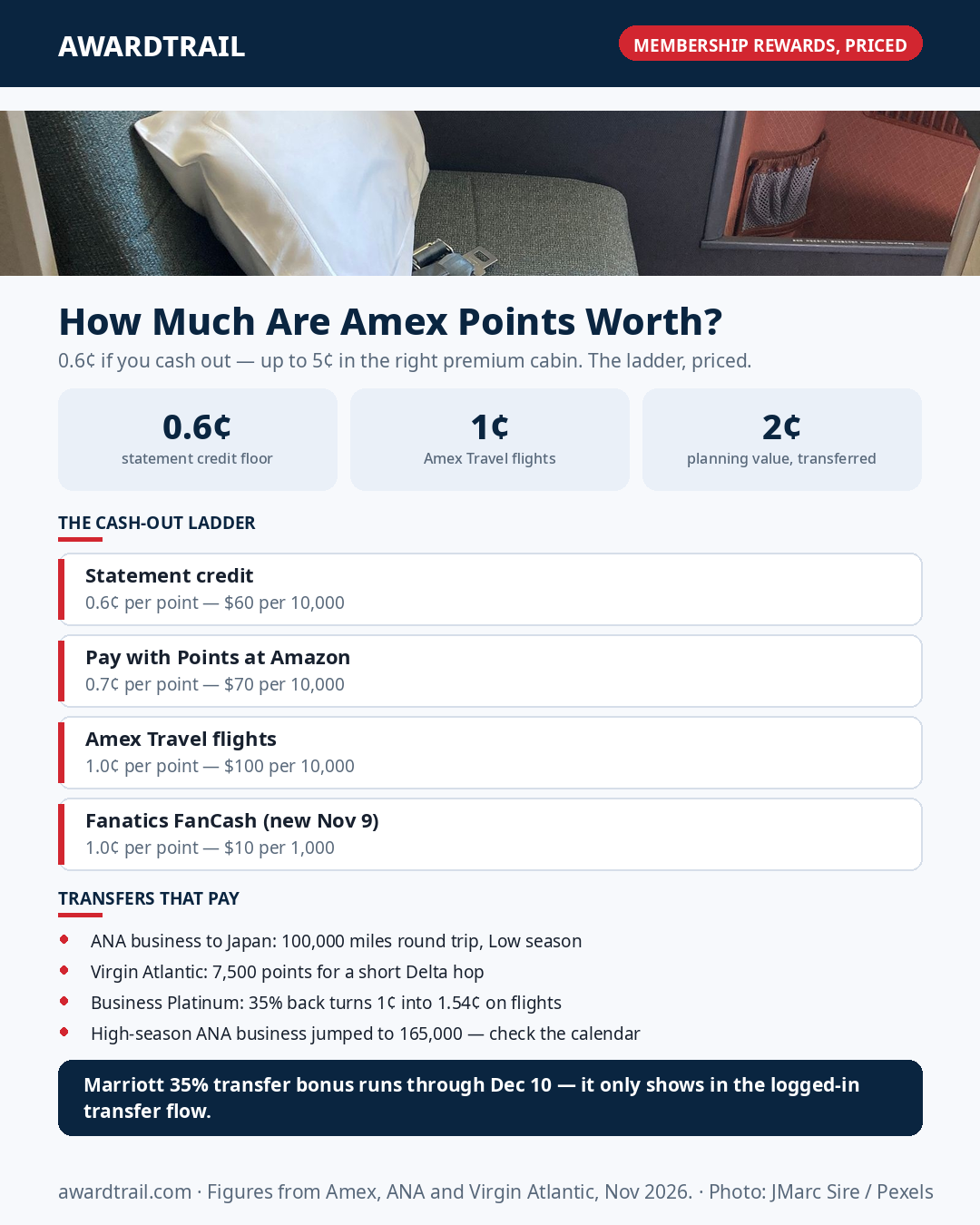
Ask ten people how much Amex points are worth and you will get ten numbers, from 0.6 cents to 6 cents, and every one of them is right about a different redemption. That is the whole problem with valuing Membership Rewards points. There is no single value. There is a floor, a ceiling, and a long ladder between them — and where you land on it depends entirely on what you do with the points, not on how many you have.
So let's price the ladder properly, using American Express's own numbers. Everything below comes from Amex's public transfer page, its points calculator, and the partner programs' own award charts — not from anyone else's valuation table.
The floor is 0.6 cents, and it's lower than most people think
The worst way to use Membership Rewards points is also the most obvious one: turn them into a statement credit. Amex's own points calculator puts it in plain numbers — 10,000 points are worth $60.00 as a statement credit. That is 0.6 cents per point. A 100,000-point balance, the kind of number a big welcome offer produces, becomes $600. The same balance, used well, is worth three times that.
Pay with Points at checkout is barely better. Amex values 10,000 points at $70.00 at Amazon, Apple Pay, Best Buy, Dell, Grubhub, PayPal, and Seamless — 0.7 cents per point. It feels convenient, and it is. It is also a 30% haircut against booking travel, and a 65% haircut against a good transfer.
These two options matter because they are the default. Points sitting in an account with no plan drift toward the statement credit button. The first decision in valuing your balance is simply refusing the floor.
One cent is the honest travel floor
Book a flight through Amex Travel with Pay with Points and Amex values 10,000 points at $100.00 — a full cent each. Fine Hotels + Resorts bookings price the same way. Prepaid hotels, cars, and cruises price lower, at $70.00 per 10,000 points, so the one-cent rate is specifically a flights-and-FHR rate.
That makes 1 cent the number to carry in your head. Any redemption below it is a bad deal unless you have a specific reason. Any transfer partner that returns less than a cent per point after the transfer is not worth the effort. And a 100,000-point balance is worth at least $1,000 of flights — a clean, defensible floor for anyone who travels at all.
The new Fanatics option is a better floor, not a good redemption
On November 9, 2026, Amex added its first sports transfer partner: Fanatics. Eligible U.S. Membership Rewards card members with American Express-issued cards can now transfer points into FanCash at 1,000 points for $10 in FanCash — one cent per point, the same rate as booking flights through Amex Travel, and well ahead of the 0.6-cent statement credit or the 0.7-cent Amazon rate.
It is worth understanding exactly what it is and is not. FanCash is store credit for Fanatics' stores, not cash and not travel. If you were going to spend $500 at Fanatics anyway, moving 50,000 points there beats cashing out by $200. If you were not going to spend at Fanatics, you have just converted flexible travel points into a single retailer's credit at the same rate Amex Travel would have paid you in flights. The new option raises the floor for sports fans. It does not raise the ceiling for anyone else. And like every transfer, it moves in 1,000-point increments with a 48-hour estimated transfer time, per Amex's transfer page.
Transfers are where the value lives — and 1:1 is the rule
Amex lists 21 transfer partners: 16 airlines, 4 hotel programs, and Fanatics. For most airlines the standard ratio is 1,000 Membership Rewards points for 1,000 partner miles or points — ANA, Air France-KLM Flying Blue, Virgin Atlantic Flying Club, British Airways, Singapore KrisFlyer, and Delta all transfer 1:1. The exceptions matter: Aeromexico pays 1,600 miles per 1,000 points, Cathay Pacific and Emirates pay 800, JetBlue pays 200 TrueBlue points per 250 Membership Rewards points, and Qantas pays 500 per 500. On the hotel side, Marriott Bonvoy is 1:1 and Hilton Honors is 1,000 points for 2,000 Hilton points.
Every transfer moves in 1,000-point increments, with a 1,000-point minimum and a 999,000-point maximum (3,000,000 for Hilton). Transfer times vary by partner and they are not instant across the board: ANA takes an estimated 4 days, while Virgin Atlantic, Delta, Singapore, British Airways, Flying Blue, Marriott, and Fanatics are estimated at 48 hours, and Hilton at 24 hours. The four-day ANA wait is the one to plan around — never transfer to ANA the morning you need to book.
That 1:1 ratio is what makes the whole program work. A Membership Rewards point is not worth 2 cents because Amex says so. It is worth about 2 cents because 1,000 of them become 1,000 miles in a program where a good award regularly returns 2 cents a mile.
The ANA sweet spot — and the price increase nobody should miss
The single best use of Membership Rewards points for most people is still ANA Mileage Club, and the math is straightforward. ANA's own award chart, for tickets issued on or after June 24, 2025, prices a round trip between Japan and North America at 40,000 miles in economy in Low season, 50,000 in Regular season, and 72,000 in High season. Business class is 100,000 miles in Low season, 105,000 in Regular, and 165,000 in High.
Read that High-season business number twice. Before the June 2025 revision it was 110,000 miles. It is now 165,000 — a 50% increase, and it applies to the dates most people actually want to fly: July 16 through August 23 and December 19 through 31, plus the Golden Week stretch from April 29 to May 9. The Low-season price did not move at all. The lesson is not that ANA got expensive. It is that ANA got seasonal, and the gap between a good date and a bad date is now 65,000 miles on a single round trip.
At 1:1, a 100,000-point Membership Rewards balance is exactly one Low-season business-class round trip to Japan. Put a $4,000 cash fare on that seat and the return is 4 cents a point. Put a $5,000 fare on it and it is 5 cents. Even if you price the seat conservatively, this is the redemption that justifies holding Membership Rewards points instead of cashing them out — and it is the redemption that punishes anyone who transfers in High season without checking the calendar first.
The Virgin Atlantic shortcut for short domestic flights
Not every good transfer needs a long-haul cabin. Virgin Atlantic Flying Club charges 7,500 Virgin Points for a one-way Delta economy flight of up to 500 miles, 11,000 points for 501 to 1,000 miles, and 16,500 for 1,001 to 1,500 miles — and Amex transfers to Virgin Atlantic 1:1 with a 48-hour estimated transfer time. That means 7,500 Membership Rewards points can cover a Delta hop that would otherwise cost real money, and on a $150 fare that is 2 cents a point on a flight most people would never think to use miles for.
The fine print matters here. The Virgin Atlantic page prices these as one-way awards excluding taxes and fees, blackout dates may apply, and the flight has to be operated by Delta or Delta Connection — a Delta-marketed flight operated by another carrier does not qualify. And the usual rule applies with extra force at this price: check that the seat exists before you transfer, because 7,500 points moved to the wrong program is still 7,500 points gone.
The Hilton door is worth exactly one cent — and that tells you something
Hilton Honors takes Membership Rewards points at 1,000 for 2,000. Hilton points are worth roughly half a cent each, so the transfer works out to about a cent per Membership Rewards point — the same as booking flights through Amex Travel, with more flexibility on where you stay. It is not a great transfer. It is a useful one, because it sets a benchmark: any airline transfer that returns less than a cent a point is worse than the Hilton door and worse than the Amex Travel portal, and should not happen.
The Marriott side is the more interesting door right now. Amex is running a 35% bonus on transfers to Marriott Bonvoy through December 10, 2026 — 1,000 points become 1,350 Bonvoy points — and that bonus only appears inside the logged-in transfer flow, not on Amex's public transfer page. At the bonus rate, the Marriott door beats the Hilton door and beats the portal for the right stay, which is exactly the kind of narrow, time-limited exception that rewards checking the transfer page before every move rather than once a year.
The Business Platinum rebate turns 1 cent into 1.54 cents
The most underrated value in the program is not a transfer at all. Business Platinum card members who use Pay with Points for a flight on their selected qualifying airline through Amex Travel get 35% of the points back — 3.5 points back for every 10 redeemed — up to 1,000,000 points back per calendar year, with a 5,000-point minimum per redemption.
Run the math. Book $1,000 of flights with 100,000 points and 35,000 points come back, typically within 48 hours. The net cost is 65,000 points for $1,000 of travel: about 1.54 cents per point, on a plain economy ticket, with no award availability to hunt and no partner chart to read. That is a better return than most transfers deliver on economy flights, and it is available on any flight your selected airline operates. The catch is the usual one: the airline has to be the one you selected for the year, from Alaska, American, Delta, JetBlue, Southwest, or United, and the selection can only change once a year in January.
How to actually value your own balance
Forget the valuation tables. Price your own points with three questions. First, what would you pay cash for the trip you actually want? Second, how many points does the award cost in the partner program — checked on that program's own chart, not from memory? Third, is the award seat actually there on your dates?
If the answer to the third question is no, your points are worth 1 cent — the Amex Travel rate — until a seat appears. If the answer is yes and the math clears 2 cents, transfer. If the math lands between 1 and 2 cents, the Business Platinum rebate or the Hilton door is probably the better play than a mediocre airline award. And if you are staring at the statement credit button, stop: 0.6 cents is the price of giving up, and the Fanatics option now pays a full cent for anyone who shops there.
A reasonable planning value for Membership Rewards points is 2 cents each. That is not a promise — it is a target. It is what the points are worth when you transfer them to a good partner, on a good date, for a seat you can see. The floor is 0.6 cents and the ceiling is 4 or 5 cents on the right premium cabin. Everything between those numbers is a decision, and now you know the price of each one.
The bottom line
Membership Rewards points are the most flexible currency in American credit cards because they convert 1:1 into sixteen airlines and hold their value across all of them — and because Amex keeps adding ways to spend them at a full cent, from flights to FanCash. The points do not expire, per Amex's own FAQ, though they can be forfeited in certain circumstances, so there is no clock forcing a bad redemption. The mistake is not holding the points. The mistake is spending them at 0.6 cents when a one-cent option is one click away, or transferring them at 1:1 into a program whose High-season chart you never read. Price the award first, check the seat second, transfer third — in that order, every time.
💡 Why This Matters for Your Strategy
News in the points-and-miles world moves fast, and promotional changes often have a short window. If this announcement affects a card or program you hold, log into your awardtrail dashboard to check your current benefit usage, bonus progress, and whether a transfer or redemption makes sense right now — before terms change.
As a general rule: transfer points only when you have a specific redemption in mind — transfers are almost always one-way and non-reversible. If you're unsure of the value, check our redemption guides before acting.
View Redemption Guides · Read Our In-Depth Analysis
Explore Related Tools
- 🎯 Sign-Up Bonus Tracker — Track your MSR progress and deadlines
- 💳 Benefit & Credit Tracker — See which card credits you haven't used yet
- 🔢 Chase 5/24 Calculator — Know exactly when slots open up
- ❓ Rewards FAQ — Answers to the most common questions
Written by Brian — Founder, awardtrail
Brian has been travel hacking for over 17 years and has personally completed 300+ credit card applications across Chase, Amex, Citi, Capital One, and more. He built awardtrail out of frustration with spreadsheet chaos, and writes from direct, first-hand experience — not marketing copy. All analysis and recommendations on this site reflect real-world strategy tested across hundreds of card applications and award bookings.
Continue Reading
Comments (0)
Join the Discussion
Sign in to share your thoughts and experiences with fellow award travelers.