

Disclosure: awardtrail earns revenue through display advertising and may earn commissions on some links at no cost to you. Commercial relationships never influence our editorial content or recommendations. Full disclosure →
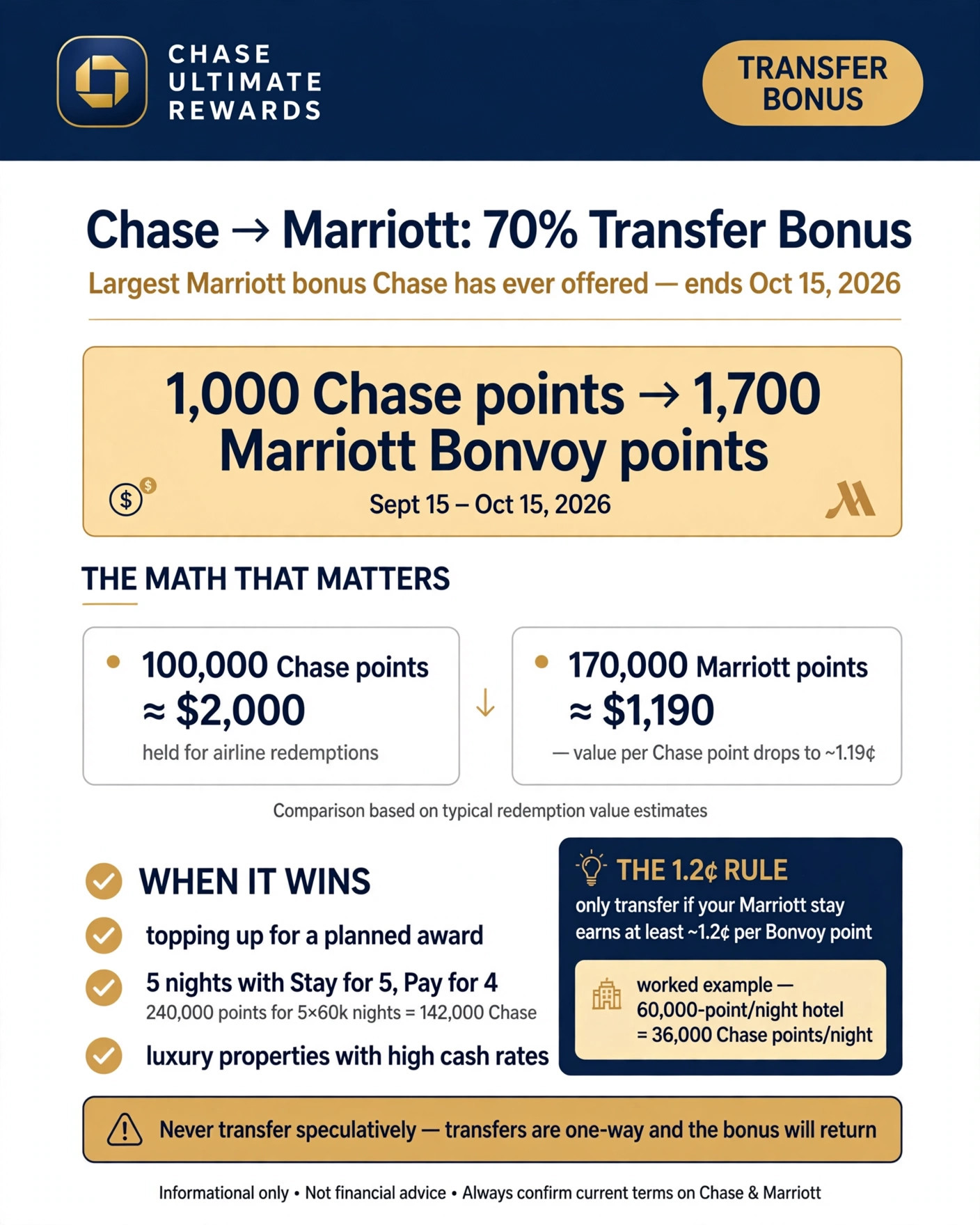
Chase is running its largest Marriott transfer bonus on record: 70% extra when you move Ultimate Rewards points to Marriott Bonvoy. The offer expires October 15 at 11:59 p.m. Eastern, which means you have about a week left to decide.
Seventy percent is a genuinely big number. It's the kind of bonus that would be an instant "yes, move everything" for almost any airline partner Chase has. But Marriott is not an airline partner, and Marriott Bonvoy points are worth roughly a third of what Chase points are worth. That gap is the entire story of this offer.
So let's do what the bonus percentage doesn't do: the actual math.
The offer, precisely
Between September 15 and October 15, 2026, Ultimate Rewards points transfer to Marriott Bonvoy at 1,000 to 1,700 instead of the normal 1:1. Move 100,000 Chase points and you land 170,000 Bonvoy points. You can use the offer as many times as you want before the deadline.
One mechanic to know before you touch anything: this bonus is paid by Marriott, not Chase. The base transfer (1,000 for 1,000) moves quickly — often the same day, occasionally a day or two — but the 70% bonus posts separately, up to seven days after the base points land. That matters because if you're transferring against a specific award night, you cannot book until the bonus points actually arrive. Move the points, watch the account for a week, then book. Don't plan a redemption around points that haven't posted.
Transfers require a Chase card with transfer partners — Sapphire Preferred, Sapphire Reserve, or Ink Business Preferred — they move in 1,000-point blocks, and they are one way. If your balance sits on a Freedom Flex or an Ink Cash, combine it into a premium card first; Chase lets you do that at no cost. The names on the two accounts must match.
The value problem nobody's bonus can fix
Here's the honest baseline. A reasonable working value is about 1.7 to 2.0 cents per Chase Ultimate Rewards point, and about 0.7 cents per Marriott Bonvoy point. Those numbers are doing all the work in this decision.
At the standard 1:1 ratio, moving points to Marriott means converting ~1.9 cents of value into ~0.7 cents — a catastrophic trade, one of the worst in the entire transferable-currency landscape. The 70% bonus improves the equation materially: 1 Chase point becomes 1.7 Marriott points, and 1.7 × 0.7 cents is about 1.19 cents per Chase point. That beats cashing out at a flat penny, and it beats the old 1:1 transfer by a mile.
But it still loses to almost every good airline use of Chase points. United, Flying Blue, Virgin Atlantic, Aeroplan — the entire reason Chase points are valuable is that a long-haul business class seat routinely extracts 3, 5, even 8 cents per point. At 1.19 cents, Marriott is a liquidation sale of your most flexible currency. The bonus doesn't change that; it just makes the liquidation less painful.
The 1.2-cent rule
This gives you a single, clean decision rule: only take the 70% bonus if the specific Marriott stay you're booking returns at least ~1.2 cents per Bonvoy point. If it does, you've made yourself whole — you got more per Chase point than you could by holding, and roughly what the currency is worth on its best day. If it doesn't, you've paid a flexibility tax for no reason, and you should either pay cash, buy Marriott points during one of their regular sales (typically around 0.9 to 1.0 cents each), or hold your Chase points for an airline redemption.
Running the rule is simple. Take the hotel's cash price for your dates (before taxes and resort fees — points stays still get hit with resort and destination fees at many Marriott properties, so add those to the points side of the ledger), divide by the points price, and compare against 1.2 cents.
A worked example: say the property you want costs 60,000 Bonvoy points a night. At 1.7 Bonvoy per Chase point, each night costs 35,294 Chase points — and since transfers move in 1,000-point blocks, 36,000 per night. That's the conversion that matters: your 60,000-point night really costs 36,000 Chase points. Now divide the cash rate by 60,000. A $720 cash rate gets you 1.2 cents per point — take the bonus. A $420 cash rate gets you 0.7 cents — don't.
Where this bonus actually wins
Scenario one: topping up. You already hold a Bonvoy balance and you're 20,000 or 30,000 points short of a stay you've actually planned. Topping up at a 70% bonus is the best topping-up rate Chase has ever offered for Marriott, and it's strictly better than buying points or transferring at the old 1:1. This is the scenario this bonus was made for, and it's the most common way smart travelers will use it.
Scenario two: Stay for 5, Pay for 4. Marriott's standing award perk — book five consecutive award nights and the cheapest night is free — stacks beautifully with a big transfer bonus. Five nights at 60,000 points each normally costs 300,000 Bonvoy points; the free night drops it to 240,000. At the 70% bonus, that's 141,177 Chase points, or 142,000 in 1,000-point blocks. Run the 1.2-cent test on the blended rate and longer, pricier stays start to clear the bar — especially at luxury properties where cash rates run high and award pricing doesn't scale linearly.
Scenario three: the luxury exception. Marriott's dynamic award pricing is most forgiving at the top end, where cash rates of $800, $1,000, or more collide with award prices that haven't fully caught up. Properties like The London EDITION have historically been the poster children for this. You won't find this at a Fairfield by the highway — but you weren't transferring Chase points for a Fairfield anyway.
The Hyatt comparison you should make before deciding
There's a wrinkle this month that makes the comparison interesting. Chase's transfer ratio to Hyatt changed on October 1: Sapphire Preferred and Ink Business Preferred cardholders now move points to Hyatt at 4:3 instead of 1:1 (only Sapphire Reserve holders kept the even rate).
So for the first time in years, Marriott is the hotel partner with the better conversion ratio. And the 70% bonus nearly — but not quite — closes the value gap the devaluation opened. Compare directly: 40,000 Chase points now become 30,000 Hyatt points (worth roughly $495 at typical Hyatt values) or 68,000 Marriott points (worth roughly $476 at typical Bonvoy values). Hyatt still edges it, because a Hyatt point is simply a better point. The Marriott bonus is big enough to make it a real comparison for the first time since the devaluation. It's still the runner-up.
What not to do
Do not transfer speculatively. Bonvoy points devalue on a schedule that Marriott never announces in advance, award pricing is dynamic, and this bonus recurs — Chase has run 40–70% Marriott bonuses multiple times a year. Points sitting in a Bonvoy account earn nothing and buy less every year. If you don't have a stay and a number that clears the 1.2-cent bar, the deadline passing is not a loss. The bonus will be back.
One more timing note: if you're shopping hotel currencies this week, Amex's 30% bonus to Hilton Honors expires October 14, one day before this one. Same analysis, different math — Hilton's fifth-night-free perk (with Silver status or higher) is the same kind of stack that makes these bonuses work.
The bottom line
Seven days left. Here's the entire decision in one sentence: take the 70% bonus only for a specific Marriott booking that returns at least ~1.2 cents per Bonvoy point — ideally a top-up or a five-night stay where Stay for 5, Pay for 4 does the heavy lifting — and let the deadline pass for everything else.
Chase's biggest Marriott bonus ever is still, for most people, a trap dressed as a deal. The 70% isn't the gift. Knowing when 1.2 cents makes it one is.
💡 Why This Matters for Your Strategy
News in the points-and-miles world moves fast, and promotional changes often have a short window. If this announcement affects a card or program you hold, log into your awardtrail dashboard to check your current benefit usage, bonus progress, and whether a transfer or redemption makes sense right now — before terms change.
As a general rule: transfer points only when you have a specific redemption in mind — transfers are almost always one-way and non-reversible. If you're unsure of the value, check our redemption guides before acting.
View Redemption Guides · Read Our In-Depth Analysis
Explore Related Tools
- 🎯 Sign-Up Bonus Tracker — Track your MSR progress and deadlines
- 💳 Benefit & Credit Tracker — See which card credits you haven't used yet
- 🔢 Chase 5/24 Calculator — Know exactly when slots open up
- ❓ Rewards FAQ — Answers to the most common questions
Written by Brian — Founder, awardtrail
Brian has been travel hacking for over 17 years and has personally completed 300+ credit card applications across Chase, Amex, Citi, Capital One, and more. He built awardtrail out of frustration with spreadsheet chaos, and writes from direct, first-hand experience — not marketing copy. All analysis and recommendations on this site reflect real-world strategy tested across hundreds of card applications and award bookings.
Continue Reading
Comments (0)
Join the Discussion
Sign in to share your thoughts and experiences with fellow award travelers.