

Disclosure: awardtrail earns revenue through display advertising and may earn commissions on some links at no cost to you. Commercial relationships never influence our editorial content or recommendations. Full disclosure →
The full board just got richer
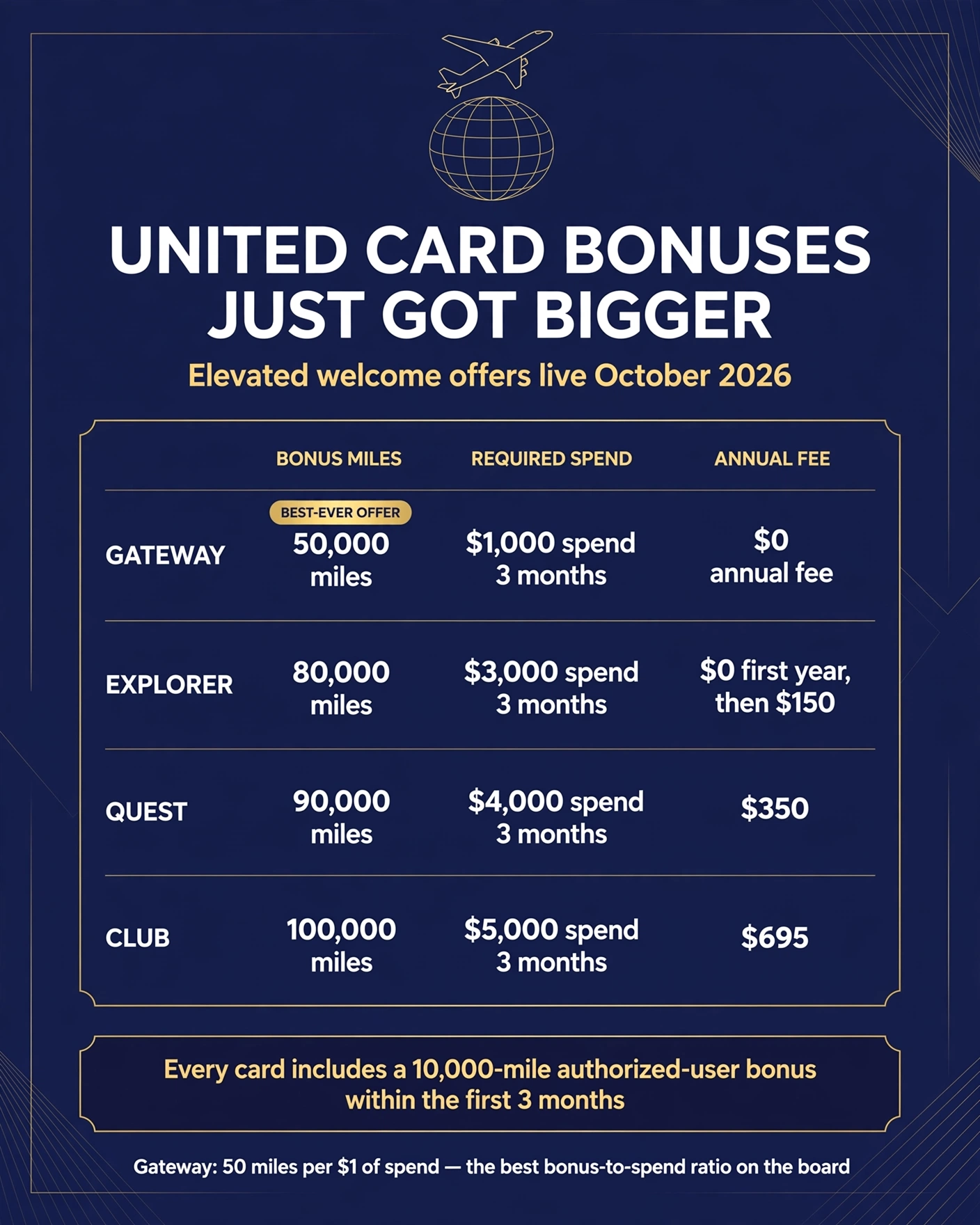
On October 1, 2026, Chase quietly pushed elevated welcome offers live across the entire consumer United MileagePlus card lineup. All four cards — Gateway, Explorer, Quest, and Club — are now offering higher bonuses than their recent standard levels. The offers are advertised as limited-time, and notably, Chase has not published a public end date. When a bank won't tell you when the deal dies, assume it can die at any time.
Here is exactly what's on the table:
- United Gateway Card: up to 50,000 miles — 40,000 after spending $1,000 on purchases in the first 3 months, plus 10,000 after adding an authorized user in the first 3 months. No annual fee.
- United Explorer Card: up to 80,000 miles — 70,000 after spending $3,000 in the first 3 months, plus 10,000 for an authorized user in that window. $0 annual fee the first year, then $150.
- United Quest Card: up to 90,000 miles — 80,000 after spending $4,000 in the first 3 months, plus 10,000 for an authorized user. Higher annual fee territory.
- United Club Card: up to 100,000 miles — 90,000 after spending $5,000 in the first 3 months, plus 10,000 for an authorized user.
Every offer follows the same two-part structure: a spend-based core bonus and a flat 10,000-mile authorized-user kicker. That uniformity is the tell — this is a coordinated campaign, not four separate product refreshes.
The Gateway offer is the real headline
The Club card's six-figure number grabs attention, but the Gateway is the story. The Gateway historically oscillates between 20,000 and 30,000 miles, with a previous ceiling of up to 40,000 (30,000 base plus the authorized-user tranche). This new up-to-50,000 offer is the best the card has ever carried — and it comes attached to a $0 annual fee.
Do the acquisition math. You spend $1,000 in three months — normal household spending, essentially — add an authorized user, and walk away with 50,000 MileagePlus miles. MileagePlus miles currently value at roughly 1.2 cents apiece, so that's about $600 in travel value for essentially zero cost of entry. No other card in the United lineup delivers anything close to that ratio of bonus to spend: the Gateway yields 50 miles per dollar of required spend, while the Club's six-figure offer demands $5,000 to produce its 100,000 miles — just 20 miles per dollar of spend.
The Gateway also earns 2 miles per dollar on United purchases, at gas stations, and on local transit and commuting, plus 1 mile per dollar everywhere else. It won't replace a 2%-everywhere card as your daily driver, but as a bonus play it's carrying the best miles-per-dollar-of-spend ratio of any United card bonus right now.
The Explorer matches its ceiling
The Explorer's up-to-80,000 offer matches the card's previous high. Seventy thousand miles on $3,000 of spend is the number to watch — that tranche alone is worth roughly $840 at standard valuations, and the $150 annual fee is waived the first year, so the first-year math is as clean as the Gateway's.
Where the Explorer earns its keep is the perks floor. First checked bag free for you and a companion is worth up to $80 per round trip on domestic itineraries. Two travelers checking bags on two round trips per year have already covered the fee twice over. Add priority boarding, the inflight discount, and the Global Entry or TSA PreCheck application fee credit, and the Explorer is the obvious answer for anyone who flies United a few times a year but can't justify premium-card territory. The bonus is back at its peak; the value proposition underneath it hasn't changed.
The authorized-user tranche is free money with a timer
Every one of these offers includes the same 10,000-mile sweetener for adding an authorized user within the first three months. Ten thousand MileagePlus miles are worth roughly $120 — for adding a person to your account. That's the cheapest 10,000 miles you'll ever earn.
But the mechanics deserve attention. The authorized user must be added within the first 90 days, and you should keep them on the account through bonus fulfillment. Bonus miles generally take six to eight weeks to post after you complete the requirements. Plan accordingly: add the authorized user early, hit the spend requirement, and then wait for the miles before you make any account changes. Closing the account or making aggressive changes before the bonus posts gives the bank room to claw it back.
One more consideration that too many people discover late: some authorized users have their own concerns about credit exposure, since the account can appear on their credit report. Have that conversation before you add someone, not after.
Who gets what: the eligibility reality check
The standard Chase and United rules apply across all four offers. Chase's 5/24 rule is in effect — if you've opened five or more cards in the past 24 months, expect a denial. And the bonus is not available if you currently hold that same card or received that card's new-cardmember bonus in the past 24 months.
The flip side is good news: eligibility for one United card's bonus is independent of the others. Holding the Gateway doesn't block you from the Explorer's bonus, and vice versa. Each card is a separate product with a separate 24-month clock. If you've never held a United card, the whole board is open — but you can only apply for one at a time, so sequence them by bonus deadline and your spend capacity, not by fee.
The MileagePlus caveat you can't skip
United MileagePlus has no fixed award chart, which means redemption prices float with demand and the program can move the goalposts without notice. The miles you're earning are worth roughly 1.2 cents each today; nothing guarantees that valuation holds for the two years you sit on them.
The practical takeaway: earn with a redemption in mind, even a rough one. Fifty thousand miles covers a lot of domestic flying — several round trips at off-peak pricing — and 100,000 puts international partner awards within reach. But don't bank 100,000 miles from the Club card, watch the program shift pricing, and discover your target award now costs 120,000. MileagePlus miles are a spend-it currency, not a save-it currency. Earn them, then use them within the year.
Also worth noting: MileagePlus miles don't expire, which is comforting but also the reason to be disciplined — there's no forcing function, so make your own. Put a reminder on the calendar for six months after the miles post: use them or lose purchasing power.
The Quest's quiet superpower
The Quest card's up-to-90,000 offer is strong but not historic, so why mention it at all? Because of the 500 Premier Qualifying Points. Quest cardholders can move up a level within United's MileagePlus elite program for just 500 PQPs after making a purchase with the card — a materially easier path than the standard elite-qualification thresholds.
If you're a frequent United flyer who finishes every year one tier short, the Quest isn't really about the 90,000 miles. It's about the status shortcut wrapped in a bonus. Run the numbers on what your current tier gap costs you in upgrades and flexibility before you dismiss this card as the awkward middle child of the lineup.
The Club card: run the lounge math honestly
One hundred thousand miles is the biggest number on this board, and it will tempt people who shouldn't be tempted. The Club card exists for one reason: United Club access. If you don't already know, with receipts, that you visit United Clubs often enough to justify a premium annual fee, the bonus alone is not the reason to apply.
Here's the honest comparison. The Gateway gets you 50,000 miles for $1,000 in spend and no fee. The Club gets you 100,000 miles for $5,000 in spend plus a substantial annual fee. You're paying $4,000 of additional spend requirement and hundreds in fees for 50,000 incremental miles worth roughly $600. Unless lounge access is already a line item in your travel budget, the Club is the worst value on this board despite having the biggest headline number.
The bottom line
This is one of the cleanest United bonus windows in recent memory, and the play is straightforward. If you've never held the Gateway, its best-ever 50,000-mile offer is the single best no-fee airline bonus available right now — apply for that first. If you fly United a handful of times per year, the Explorer at its previous high of 80,000 miles is the sweet spot, with the first-year fee waiver removing all downside. Sequence around the 24-month rule, add the authorized user early on whichever card you pick, and spend the miles within the year before dynamic pricing moves against you. Chase hasn't said when these offers end, which is exactly why you shouldn't wait to find out.
💡 Why This Matters for Your Strategy
News in the points-and-miles world moves fast, and promotional changes often have a short window. If this announcement affects a card or program you hold, log into your awardtrail dashboard to check your current benefit usage, bonus progress, and whether a transfer or redemption makes sense right now — before terms change.
As a general rule: transfer points only when you have a specific redemption in mind — transfers are almost always one-way and non-reversible. If you're unsure of the value, check our redemption guides before acting.
View Redemption Guides · Read Our In-Depth Analysis
Explore Related Tools
- 🎯 Sign-Up Bonus Tracker — Track your MSR progress and deadlines
- 💳 Benefit & Credit Tracker — See which card credits you haven't used yet
- 🔢 Chase 5/24 Calculator — Know exactly when slots open up
- ❓ Rewards FAQ — Answers to the most common questions
Written by Brian — Founder, awardtrail
Brian has been travel hacking for over 17 years and has personally completed 300+ credit card applications across Chase, Amex, Citi, Capital One, and more. He built awardtrail out of frustration with spreadsheet chaos, and writes from direct, first-hand experience — not marketing copy. All analysis and recommendations on this site reflect real-world strategy tested across hundreds of card applications and award bookings.
Continue Reading


Comments (0)
Join the Discussion
Sign in to share your thoughts and experiences with fellow award travelers.