

Disclosure: awardtrail earns revenue through display advertising and may earn commissions on some links at no cost to you. Commercial relationships never influence our editorial content or recommendations. Full disclosure →
The full board, in one look
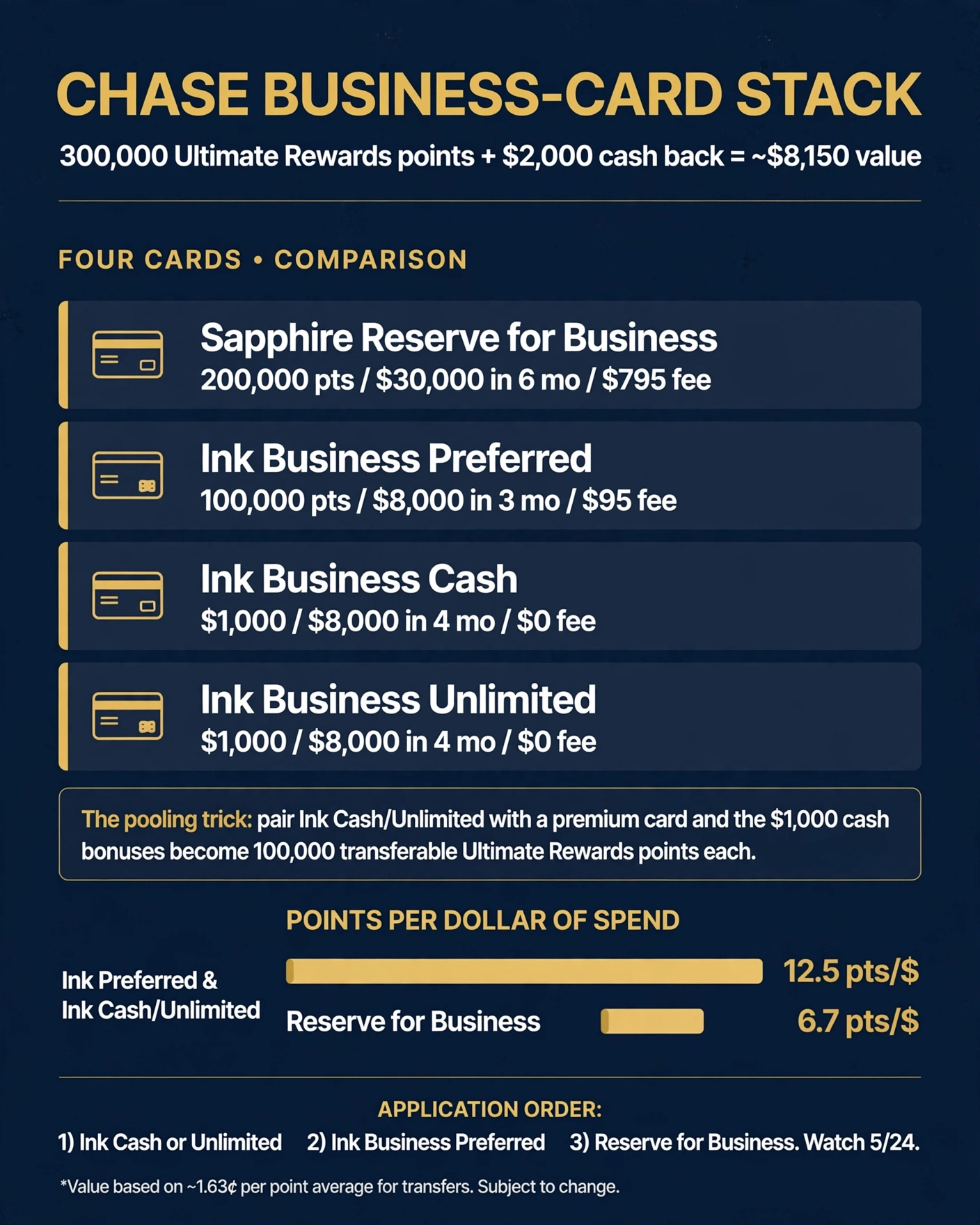
Chase doesn't usually hand out this much free money at once. All four of its business cards are running welcome offers that sit at or near their historical highs — and three of the four are no-published-end-date offers that can disappear the way Chase limited-time offers usually do: without warning.
- Sapphire Reserve for Business: 200,000 bonus points after spending $30,000 on purchases in the first 6 months. $795 annual fee.
- Ink Business Preferred: 100,000 bonus points after spending $8,000 in the first 3 months. $95 annual fee.
- Ink Business Cash: $1,000 bonus cash back after spending $8,000 in the first 4 months. No annual fee.
- Ink Business Unlimited: $1,000 bonus cash back after spending $8,000 in the first 4 months. No annual fee.
The combined haul for someone who works through the stack: 300,000 Ultimate Rewards points plus $2,000 in cash back, worth roughly $8,150 at current valuations — on $54,000 of business spending spread over six months. That's an effective rebate of about 15% on money you were going to spend anyway.
The $1,000 no-fee offers are the real headline
The six-figure point totals get the attention, but the Ink Cash and Ink Unlimited offers are the ones worth acting on first. No-annual-fee business cards almost never carry four-figure bonuses. Chase has spent most of the past two years holding these two cards at $750 after $6,000 in spending. The $1,000 tier has appeared, vanished, and reappeared — the offer history reads like a revolving door, with the $750 level snapping back into place within weeks each time.
The math is unusually clean: $1,000 back on $8,000 of spending is a 12.5% return on every dollar you're already spending. At roughly $2,000 a month over four months — office supplies, software subscriptions, phone and internet bills — most real businesses clear that bar without trying. And both cards carry a 0% introductory APR on purchases for the first 12 months, so if your business front-loads big buys in year one, you can spread the cost interest-free.
The pooling trick that makes "cash back" a misnomer
Here's what Chase doesn't advertise loudly: the "cash back" on the Ink Cash and Unlimited posts to your account as Chase Ultimate Rewards points — 100,000 points for each $1,000 bonus. On their own, those points redeem at 1 cent apiece for cash, hence the "cash back" branding. But hold a Sapphire Preferred, Sapphire Reserve, or Ink Business Preferred, and you can pool the points and unlock the full Ultimate Rewards redemption menu: transfers to airline and hotel partners, and 25% more value through the Chase Travel portal.
In practical terms, a small business with an Ink Preferred already in the drawer isn't earning two $1,000 cash bonuses. It's earning two 100,000-point bonuses — 200,000 transferable Ultimate Rewards points, worth around $4,100 at current valuations, for $16,000 of combined spending and zero dollars in annual fees. The Cash and Unlimited bonuses are only "cash back" if you never pair them with a premium card.
The Reserve for Business: 200,000 points with a clock on the fine print
The biggest single number on the board is the Sapphire Reserve for Business: 200,000 points after $30,000 in six months. That's $5,000 a month — serious money, but for an established business running payroll, ad spend, or inventory, it's six months of ordinary operations. At 2.05 cents per point, the bonus alone is worth roughly $4,100 against the $795 annual fee.
The fee demands respect, and Chase has stacked credits to offset it: up to $500 in annual hotel credits, up to $400 in annual ZipRecruiter credits, up to $300 in annual travel credits, and up to $200 in annual Google Workspace credits — plus complimentary IHG One Rewards Platinum Elite status, Chase Sapphire Lounge access, and a Priority Pass membership. Chase has also announced that The Edit hotel credit expands to up to $1,000 annually starting in 2027.
But read the fine print with a calendar in hand. Starting November 15, 2026, the card's 3x earning on social media and search engine advertising gets capped at $1 million in spend per cardholder anniversary year — previously uncapped. If your business is a serious ad spender, the earning ceiling matters more than the welcome bonus. Apply with the cap in place, and factor the reduced long-term earning into the first-year value equation.
The Ink Business Preferred: the value anchor of the stack
The Ink Preferred's 100,000-point offer after $8,000 in three months is the workhorse of this stack. The $95 annual fee is trivially covered by the bonus, and the card earns 3 points per dollar on the first $150,000 each year across travel, shipping, internet, cable, phone, and social/search advertising — the categories where small-business money actually goes. That's a 12.5-point return per dollar of required spend (100,000 points on $8,000), nearly double the Reserve for Business's 6.7 points per dollar.
It also quietly carries two of the best insurance perks in the business-card market: cell phone protection up to $1,000 per claim (three claims per 12 months, $100 deductible — just pay the phone bill with the card) and primary rental-car collision coverage when renting for business. For a $95 card, the Ink Preferred is the single best long-term earner in Chase's business lineup, bonus aside.
The Ink Cash vs. Ink Unlimited decision
Same bonus, same spend requirement, same zero fee — so pick on earning, not the welcome offer. The Ink Cash pays 5% back at office supply stores and on internet, cable, and phone services (first $25,000 in combined purchases each year) and 2% at gas stations and restaurants (first $25,000). The Ink Unlimited pays a flat 1.5% on everything. If your spending clusters in the 5% categories, the Cash earns its keep for years; if it's scattered across dozens of vendors, the Unlimited's simplicity wins. Either way, the $1,000 bonus is identical — the choice is about year two, not month one.
The application sequence matters
Chase's 5/24 rule applies to every card on this board: five or more new cards in 24 months across all issuers, and you'll be denied. Chase business cards count toward your 5/24 total, so each application consumes one slot. And each bonus is available only if you haven't held that specific card before — but holding one Ink card doesn't block you from another's bonus.
The smart sequence: Ink Cash or Ink Unlimited first. They cost nothing annually, the $1,000 offer has the most volatile history (it's the one that reverts without warning), and they consume one 5/24 slot for the highest return per dollar of spend. Then the Ink Business Preferred — $95, 100,000 points, and it unlocks the pooling trick that upgrades the Cash/Unlimited bonuses into transferable points. The Reserve for Business comes last: it needs $30,000 in six months, so time it for a period when your business can comfortably clear $5,000 a month.
You also need a real business — but the bar is lower than people think. Freelance work, consulting gigs, and sole proprietorships all qualify. The application asks about business income; Chase has been known to request documentation, so be prepared to substantiate what you claim.
The one comparison you should make before applying
The Reserve for Business's 200,000-point headline isn't the biggest business-card bonus on the market — American Express's Business Platinum has been floating offers as high as 300,000 Membership Rewards points for $20,000 in three months. But the Amex bonus is targeted and varies by applicant, while Chase's 200,000 is publicly available to anyone who qualifies. Certainty has value: a guaranteed 200,000 points beats a theoretical 300,000 you may not be offered.
The bottom line
Chase has all four business cards loaded at once — 300,000 Ultimate Rewards points plus $2,000 in cash back, roughly $8,150 in value, on spend most established businesses will hit in the normal course of operations. Start with the no-fee Ink Cash or Ink Unlimited while the $1,000 tier is live, add the Ink Business Preferred to unlock transferable points, and time the Reserve for Business for a high-spend stretch — keeping the November 15 advertising cap in mind. As always with Chase's un-dated offers, confirm the current terms on Chase's site before you apply; the bank owes you no warning before the numbers change.
💡 Why This Matters for Your Strategy
News in the points-and-miles world moves fast, and promotional changes often have a short window. If this announcement affects a card or program you hold, log into your awardtrail dashboard to check your current benefit usage, bonus progress, and whether a transfer or redemption makes sense right now — before terms change.
As a general rule: transfer points only when you have a specific redemption in mind — transfers are almost always one-way and non-reversible. If you're unsure of the value, check our redemption guides before acting.
View Redemption Guides · Read Our In-Depth Analysis
Explore Related Tools
- 🎯 Sign-Up Bonus Tracker — Track your MSR progress and deadlines
- 💳 Benefit & Credit Tracker — See which card credits you haven't used yet
- 🔢 Chase 5/24 Calculator — Know exactly when slots open up
- ❓ Rewards FAQ — Answers to the most common questions
Written by Brian — Founder, awardtrail
Brian has been travel hacking for over 17 years and has personally completed 300+ credit card applications across Chase, Amex, Citi, Capital One, and more. He built awardtrail out of frustration with spreadsheet chaos, and writes from direct, first-hand experience — not marketing copy. All analysis and recommendations on this site reflect real-world strategy tested across hundreds of card applications and award bookings.
Continue Reading

Comments (0)
Join the Discussion
Sign in to share your thoughts and experiences with fellow award travelers.