

Disclosure: awardtrail earns revenue through display advertising and may earn commissions on some links at no cost to you. Commercial relationships never influence our editorial content or recommendations. Full disclosure →
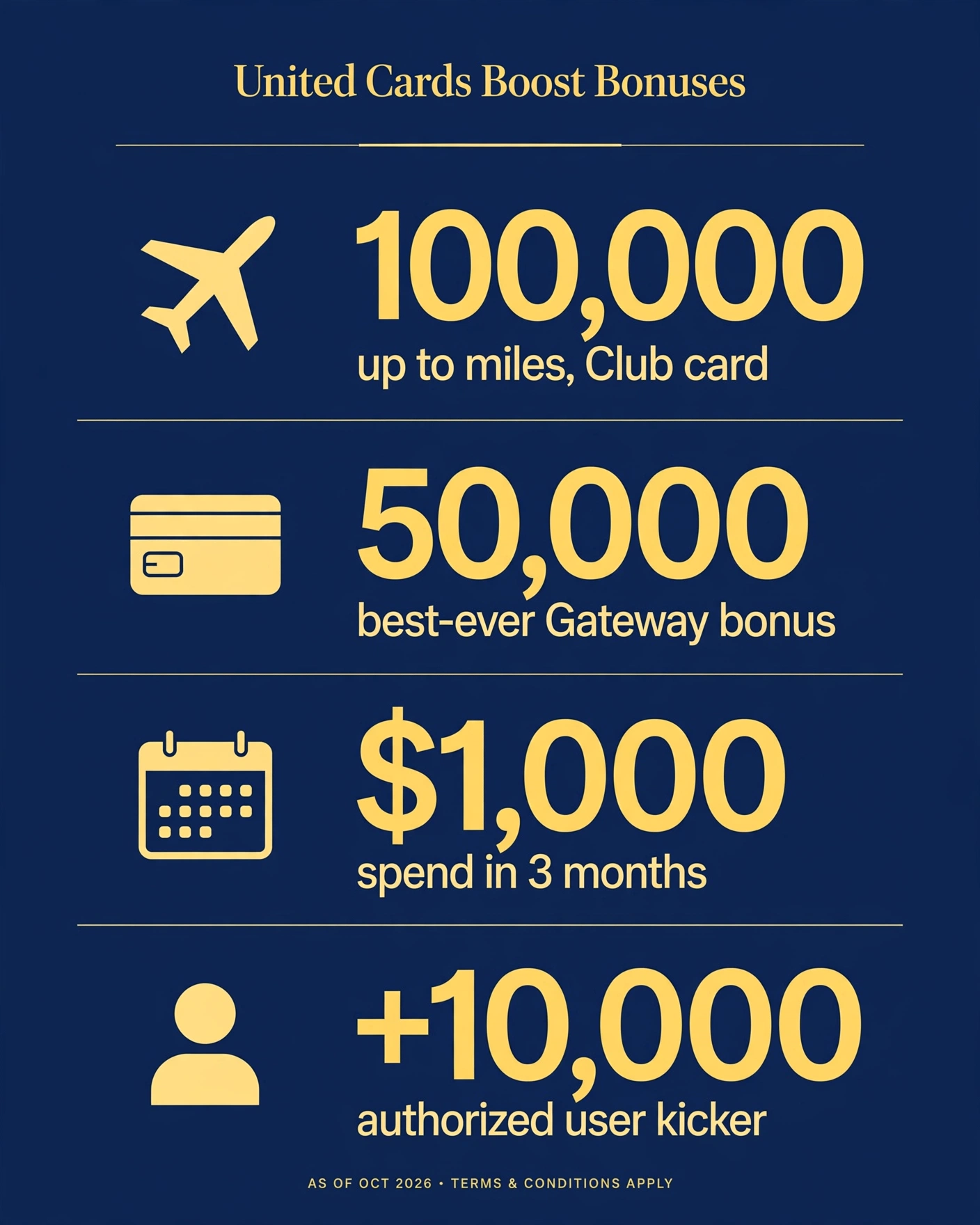
On October 1, Chase refreshed the welcome offers across all four consumer United credit cards, and the numbers moved in every traveler's favor. The no-fee United Gateway card now carries its highest bonus ever — up to 50,000 miles — while the United Explorer returns to its previous best of up to 80,000 miles. The premium Quest and Club cards climbed too, to up to 90,000 and 100,000 miles respectively.
The offers are billed as limited-time, but Chase has not published an end date. These are Chase United cards: earned miles land in United MileagePlus, the standard transfers, award redemptions and dynamic pricing rules all apply, and the bonuses are per-card products — holding one United card does not make you ineligible for another one's bonus.
Read the fine print before you celebrate, because every headline number is built the same way: the advertised total includes a 10,000-mile authorized-user kicker. The actual miles you earn from spending are 10,000 less than the banner figure, and you forfeit that slice unless you add an authorized user within the first three months and keep them on the account through fulfillment.
Exact offer and eligibility
- United Gateway Card: earn up to 50,000 bonus miles — 40,000 after spending $1,000 in the first 3 months, plus 10,000 after adding an authorized user in the first 3 months. No annual fee. Chase labels it "our best offer ever."
- United Explorer Card: earn up to 80,000 bonus miles — 70,000 after spending $3,000 in the first 3 months, plus 10,000 after adding an authorized user in the first 3 months. $0 annual fee for the first year, then $150.
- United Quest Card: earn up to 90,000 bonus miles — 80,000 after spending $4,000 in the first 3 months, plus 10,000 after adding an authorized user in the first 3 months; earn 500 Premier qualifying points after your first purchase. $350 annual fee.
- United Club Card: earn up to 100,000 bonus miles — 90,000 after spending $5,000 in the first 3 months, plus 10,000 after adding an authorized user in the first 3 months. $695 annual fee.
- Eligibility: you are ineligible for a card's bonus if you currently hold that same card or if you received that card's new-cardmember bonus within the past 24 months. Holding a different United cobranded card does not block a bonus on another. Standard Chase application rules, including 5/24, apply.
- Fulfillment: bonus miles take six to eight weeks to post after the spend requirement is met. The account must be open and not in default at fulfillment; if you close within six months, Chase and United can claw the miles back.
- Timing: the elevated offers began October 1, 2026. Chase has not posted a public end date and notes that offers can vary by application channel and change over time — the bonus on the application page you submit is the one you get.
Doing the math: the authorized-user kicker inflates every headline
At 1.2 cents per United mile, the full advertised packages are worth roughly $600 (Gateway), $960 (Explorer), $1,080 (Quest), and $1,200 (Club). Strip out the 10,000-mile authorized-user slice and the honest spend-earned values are $480, $840, $960, and $1,080 — a fifth of every headline disappears unless you complete the AU step.
Gateway is the best value-per-dollar story here: $480 to $600 in miles for $1,000 in spending on a card with no annual fee and no foreign transaction fees is a 48–60% return, and its 50,000 headline is genuinely the highest ever offered on the card. The catch is absolute scale: 50,000 miles covers one domestic coach award, maybe two if pricing cooperates.
Explorer's return to 80,000 is the strongest offer in the family for the typical United flyer. The first-year $0 fee makes the first twelve months essentially risk-free: you pay nothing, the 70,000-mile spend bonus is $840 in miles for $3,000 in spend, and the free first checked bag for you and a companion can be worth $80 or more on a single trip. The $150 fee in year two is where you need to re-evaluate.
Quest and Club are where the headlines outrun history. Quest's new 90,000-mile package with 500 PQP is 20,000 miles above its summer offer — but earlier in 2026 the same card went as high as 100,000 miles plus 3,000 PQP. The 500 PQP here posts after your first purchase, which is a real nudge toward Premier status if you already fly United, but it's a consolation prize for anyone comparing against the spring offer. Club's 100,000 is the biggest number in the lineup but the weakest net value on paper: $1,080 in miles against a $695 annual fee leaves $385 before you count any lounge or benefit usage.
One structural note: welcome miles do not count toward United Premier status. Only the 500 PQP on the Quest moves the status needle, and United's award prices are dynamic, so the 1.2-cent valuation is a benchmark, not a guarantee.
Who benefits—and who should skip it
Apply if: you fly United regularly from a United hub or focus city and don't yet hold these cards. The Explorer is the default pick for checked-bag checkers and occasional flyers who want a nearly free first year. The Gateway suits the budget United flyer who just wants the cheapest public path to 50,000 miles. The Quest fits the traveler who will use the $200 United travel credit and anniversary benefits to offset the $350 fee; the Club only makes sense if the United Club membership would be in your wallet anyway.
Skip if: you earned a bonus on the same card within the past 24 months — you're ineligible, and a duplicate application risks a hard pull for nothing. Skip if you won't add an authorized user, because you'll earn 10,000 fewer miles than the headline on every card. Skip if you don't fly United: miles are far less flexible than transferable Chase Ultimate Rewards points, and a transferable-points card bonus of similar size would be usable across airlines. And skip the Quest and Club if the fee-funded benefit stacks don't fit your travel — a $1,200 headline at a $695 fee is a worse deal than an 80,000-mile Explorer at $0 year one.
Awardtrail analysis
This is a legitimate elevation on Gateway and Explorer — the two cards where it matters most — but the universal "up to" structure is deliberate headline inflation, and the two premium cards sit below their 2026 highs. Before applying, pull up the live Chase application page and confirm the bonus language matches the figures above, because Chase says offers vary by channel. Add the authorized user inside the first three months and leave them on the account until the bonus posts; the terms award the 10,000 miles for adding the user, not for the user spending, but the account must remain open through the six-to-eight-week fulfillment window. Plan to keep the card open at least six months to avoid a clawback.
The sharper comparison for flexible-points collectors: Chase Ultimate Rewards points transfer to United at 1:1, so weigh whether a transferable bonus of comparable size serves you better than miles locked to one airline's dynamic pricing. If you already fly United enough to want the perks — the free bag, the priority boarding, the Club access — these elevated offers are the right time to pick up the card you were going to get anyway. The worst outcome here is applying for the headline and leaving the 10,000-mile kicker on the table.
Primary source: Chase United credit cards
Verified: October 3, 2026
Why This Matters for Your Strategy
News in the points-and-miles world moves fast, and promotional changes often have a short window. If this announcement affects a card or program you hold, log into your awardtrail dashboard to check your current benefit usage, bonus progress, and whether a transfer or redemption makes sense right now — before terms change.
As a general rule: transfer points only when you have a specific redemption in mind — transfers are almost always one-way and non-reversible. If you're unsure of the value, check our redemption guides before acting.
Explore Related Tools
- 🎯 Sign-Up Bonus Tracker
Track your MSR progress and deadlines
- 💳 Benefit & Credit Tracker
See which card credits you haven't used yet
- 🔢 Chase 5/24 Calculator
Know exactly when slots open up
- ❓ Rewards FAQ
Answers to the most common questions
More Recent News
October 3, 2026, 3:42 AM

October 2, 2026, 8:52 PM


Comments (0)
Community Discussion
Sign in to share your experiences and insights with fellow award travelers.