


Disclosure: awardtrail earns revenue through display advertising and may earn commissions on some links at no cost to you. Commercial relationships never influence our editorial content or recommendations. Full disclosure →
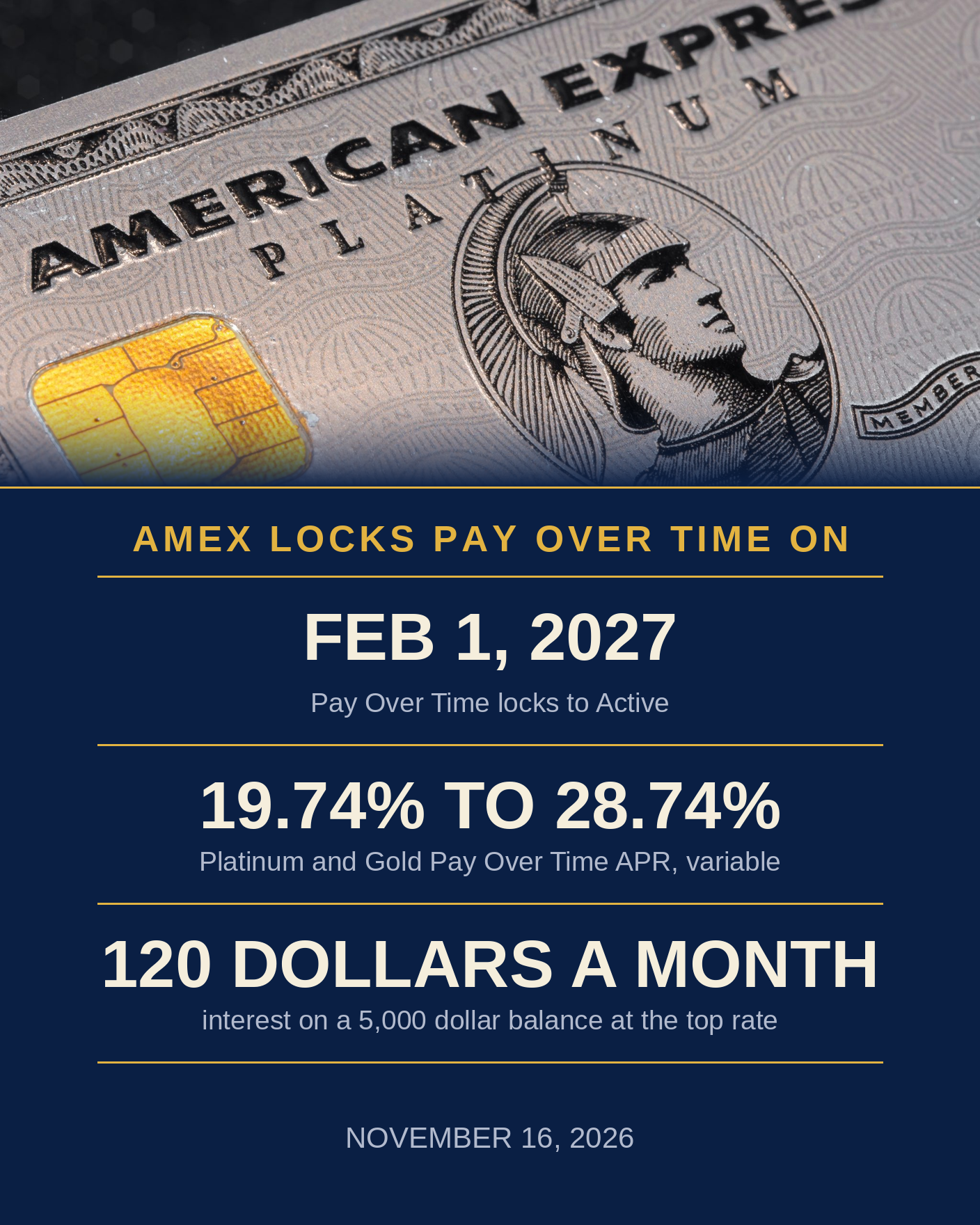
American Express is taking away the off switch on one of its charge cards' oldest features. On February 1, 2027, Pay Over Time will be permanently set to Active on eligible U.S. personal charge cards, and the option to turn it off will disappear. From that date, every eligible purchase — plus foreign transaction fees and the annual fee — goes into an interest-bearing Pay Over Time balance automatically, up to the account's Pay Over Time Limit.
For cardholders who pay their statement in full every month, nothing changes: Amex charges no interest on Pay Over Time balances paid in full by the due date. The change bites a specific group instead — people who deliberately kept Pay Over Time off and set AutoPay to Minimum Payment Due. Amex's own guidance warns that combination is the trap: after February 1, AutoPay keeps paying only the Minimum Payment Due, the minimum covers only part of the balance, and the rest starts accruing interest at 19.74% to 28.74% variable APR.
The affected cards are the ones built around Pay Over Time: the Platinum Card ($895 annual fee) and the Gold Card ($325). Amex has been emailing cardholders about the change since early November, and its Pay Over Time page now carries the replacement terms that take effect February 1, 2027. Business cards show the same replacement terms on Amex's flexible payment options page, so business cardholders should check their own account notice rather than assume they are exempt.
Exact change and who it affects
- Effective date: February 1, 2027. Until January 31, 2027, Pay Over Time can still be set to Active or Inactive, and the setting can be changed at any time through the online account or by calling the number on the back of the card.
- What changes: From February 1, 2027, Pay Over Time will be permanently set to Active and the option to change the setting will be disabled. Eligible charges are automatically added to the Pay Over Time balance on the transaction date, subject to the Pay Over Time Limit.
- Eligible charges: Purchases by the cardmember or any additional cardmember, along with associated foreign transaction fees, and annual membership fees. Cash advances, certain insurance premiums, and any other fees owed to American Express are not eligible.
- Cards affected: U.S. personal charge cards with the Pay Over Time feature — the Platinum Card and the Gold Card, the two cards Amex's Pay Over Time page lists. Amex's business flexible payment options page shows the same replacement terms effective February 1, 2027.
- Interest: No interest is charged on Pay Over Time balances if the Account Total New Balance is paid in full by the payment due date each month. Otherwise, interest runs from the transaction date for charges added automatically, or from the day after they are added for charges moved to the balance on the closing date.
- Pay Over Time APR: 19.74% to 28.74%, variable with the Prime Rate, on the Platinum Card and the Gold Card (Amex's own terms pages, accurate as of November 14, 2026). Variable APRs will not exceed 29.99%.
- Pay Over Time Limit: A separate limit Amex assigns to each account, covering the combined Pay Over Time, cash advance, and Plan balances. It is not a spending limit — Amex can approve charges beyond it — and Amex can raise or lower it at any time, even if the account is paid on time. Charges that would push the balance over the limit go to the Pay In Full balance instead.
- Plan It is untouched: Plan It plans of $100 or more, up to 10 active plans, remain available with a plan fee of up to 1.33% per month.
- What does not change: Paying the full statement balance still costs nothing in interest, and using Pay Over Time does not change how Membership Rewards points are earned or redeemed.
The math: the AutoPay trap is the real cost
The headline change — losing the off switch — sounds cosmetic. The money is in the interaction with AutoPay, and Amex spells it out in its own guidance. Today, a cardholder with Pay Over Time set to Inactive and AutoPay set to Minimum Payment Due has a minimum payment that covers the whole balance, because every charge sits in the Pay In Full balance and is due in full each month. After February 1, that same cardholder's charges land in the Pay Over Time balance instead, and the Minimum Payment Due covers only a portion of it: the Pay In Full balance plus a portion of the Pay Over Time balance, any interest accrued, and any Plan Payment Due.
Amex says that if the setting is Inactive before February 1 and AutoPay is set to Minimum Payment Due, the AutoPay payment amount will change starting with the next billing statement after February 1, 2027 — the Minimum Payment Due will include the new Pay Over Time balance — and interest will be charged on the remaining Pay Over Time balance and on new eligible charges. Amex's own advice is to switch AutoPay to Statement Balance, or to Adjusted Balance for cardholders with active Plan It plans, before the change, and to pay the Statement Balance in full before February 1 to avoid interest on new charges in the billing period when the switch happens. AutoPay can be changed at americanexpress.com/autopay.
Here is what the trap costs on a Platinum Card at the top of the published range. A $5,000 balance carried at 28.74% APR accrues about $120 of interest in a single month ($5,000 × 28.74% ÷ 12 = $119.75). At the bottom of the range, 19.74%, the same balance costs about $82 a month. Left alone for a year at the top rate, that $5,000 balance generates roughly $1,437 of interest before any of the principal is repaid — more than the Platinum Card's $895 annual fee, and more than four times the Gold Card's $325 fee. The minimum payment keeps the account current; it does not stop the meter.
The second, quieter cost is the closing-date sweep. Under the replacement terms, Amex can move eligible charges from the Pay In Full balance into the Pay Over Time balance on the closing date, subject to the limit. That means a charge a cardholder expected to pay in full can end up in the interest-bearing balance after the statement closes — and interest on moved charges runs from the day after they are added. The only way to be sure nothing accrues is to pay the full Account Total New Balance by the due date.
Who needs to act — and who can ignore it
Act now if you turned Pay Over Time off. Log in, check the setting under Account Services, and check AutoPay. If AutoPay is set to Minimum Payment Due, switch it to Statement Balance (or Adjusted Balance if you have active Plan It plans) before February 1. Pay the Statement Balance in full before the effective date so the billing period that straddles the switch starts clean. An existing Pay Over Time balance keeps accruing interest in the meantime — turning the feature off today does not wipe out a balance already carried.
Act now if you carry a balance on purpose. The feature itself is unchanged for you, but the Pay Over Time Limit now governs everything: Amex can lower it at any time, even on an account paid on time, and charges above it spill into the Pay In Full balance, which is due in full that month. A lower limit after February 1 can turn a planned carry into an unexpected lump sum due.
Nothing to do if you already pay in full. If Pay Over Time is already Active and AutoPay pays the Statement Balance, February 1 changes nothing — the setting was already on, and paying in full still avoids all interest. The same holds for cardholders who pay the full balance manually each month. The only thing that changes for this group is that the choice to switch the feature off is gone, which matters only if circumstances change later and carrying a balance becomes tempting.
Business cardholders: check your notice. Amex's business flexible payment options page carries the same replacement terms effective February 1, 2027, with eligible charges automatically added to the Pay Over Time balance. The wording on the business page differs in places from the personal page, so confirm what your own account shows before relying on the personal-card version of the change.
Awardtrail analysis
This is a consumer-protection story dressed as a terms update, and the verdict is simple: the change itself is not the danger, the default it leaves behind is. Amex is not forcing anyone to pay interest — paying the full statement balance still costs nothing, and the company says so plainly. What it is doing is removing the guardrail that let careful cardholders make carrying a balance impossible by construction, and leaving in place an AutoPay default that, for the exact people who chose that guardrail, will quietly start charging interest on February 1.
The fix takes two minutes and costs nothing: check the Pay Over Time setting, set AutoPay to Statement Balance, and pay the balance in full before February 1. Do it before the holidays, not after — December spending is the year's heaviest, and a January statement is the worst place to discover that the minimum payment no longer covers the balance. Anyone who cannot pay in full should treat February 1 as a deadline to move spending to a card with a lower APR or an introductory 0% offer, because 19.74% to 28.74% is among the most expensive revolving credit in the market, and from February there will be no switch left to flip.
Primary source: https://www.americanexpress.com/us/benefits/payment-flexibility/pay-over-time/
Verified: November 16, 2026
Why This Matters for Your Strategy
News in the points-and-miles world moves fast, and promotional changes often have a short window. If this announcement affects a card or program you hold, log into your awardtrail dashboard to check your current benefit usage, bonus progress, and whether a transfer or redemption makes sense right now — before terms change.
As a general rule: transfer points only when you have a specific redemption in mind — transfers are almost always one-way and non-reversible. If you're unsure of the value, check our redemption guides before acting.
Explore Related Tools
- 🎯 Sign-Up Bonus Tracker
Track your MSR progress and deadlines
- 💳 Benefit & Credit Tracker
See which card credits you haven't used yet
- 🔢 Chase 5/24 Calculator
Know exactly when slots open up
- ❓ Rewards FAQ
Answers to the most common questions
More Recent News


November 15, 2026, 6:36 PM


November 14, 2026, 7:01 PM
November 13, 2026, 10:10 PM

November 13, 2026, 10:09 PM
Comments (0)
Community Discussion
Sign in to share your experiences and insights with fellow award travelers.