

Disclosure: awardtrail earns revenue through display advertising and may earn commissions on some links at no cost to you. Commercial relationships never influence our editorial content or recommendations. Full disclosure →
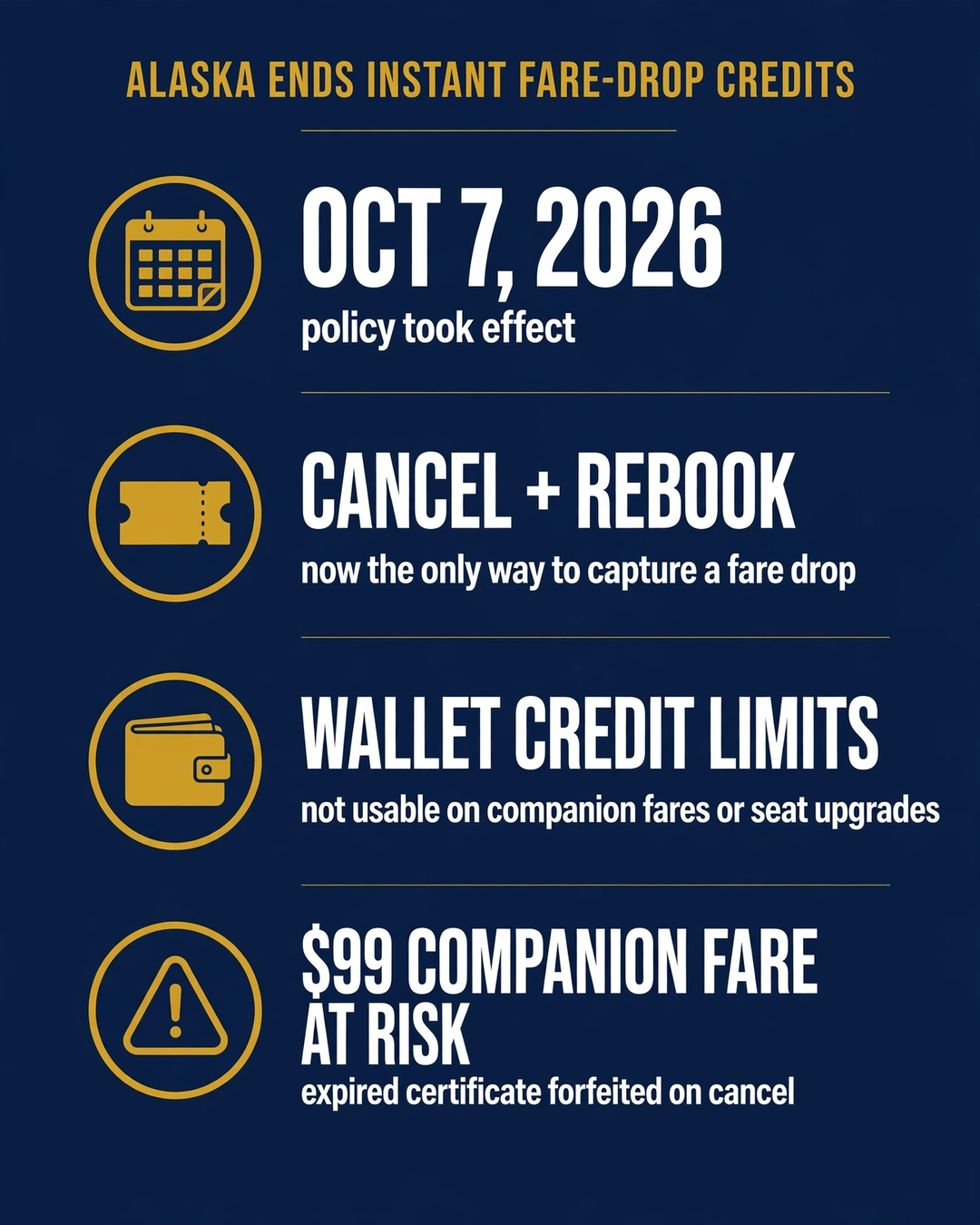
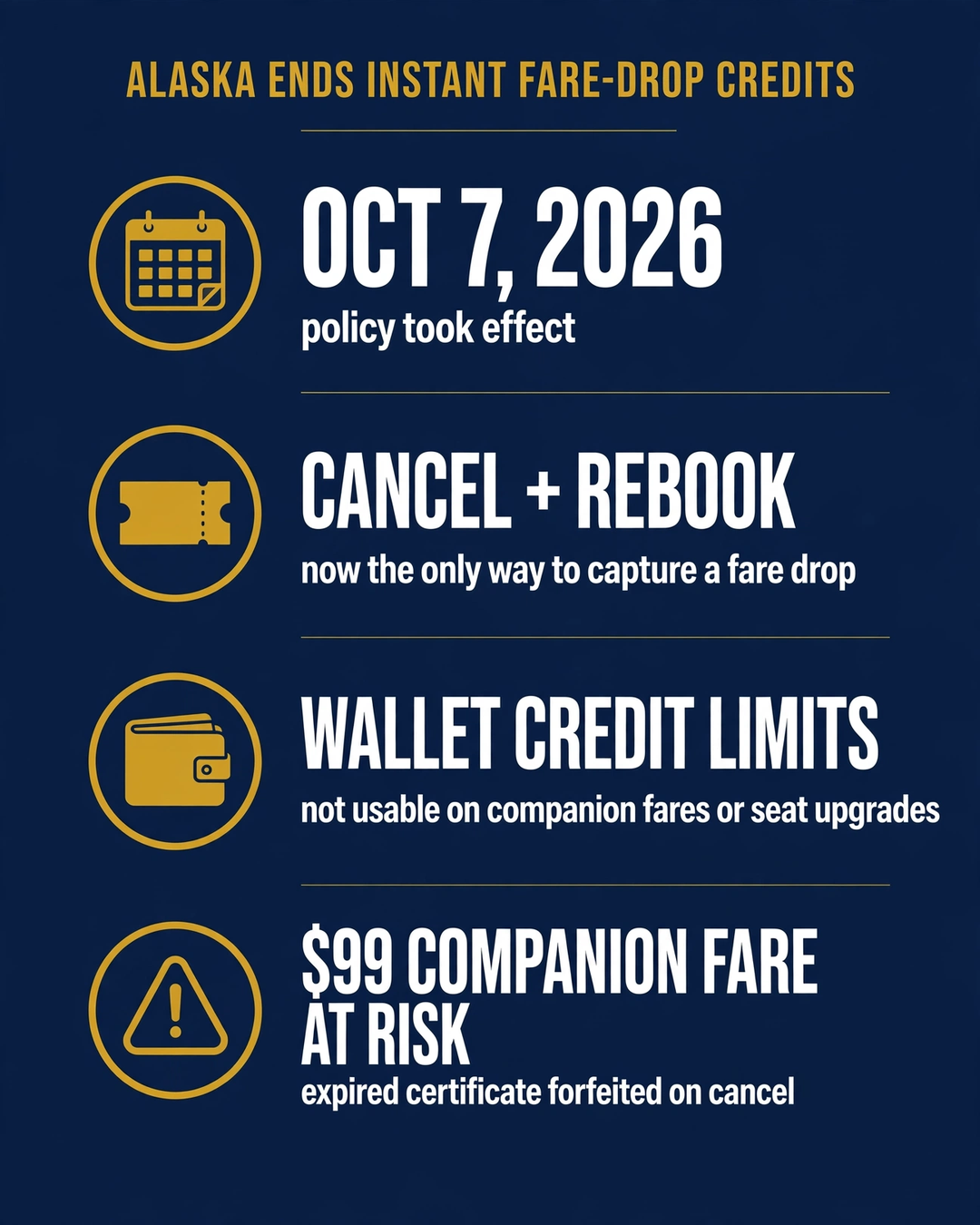
Alaska Airlines has quietly ended one of its most traveler-friendly habits. Effective October 7, the airline no longer lets agents issue a simple credit when the fare on an already-booked ticket drops. If you spot a lower price on your flight, the only way to capture it is now to cancel the entire reservation, take the resulting credit, and buy a brand-new ticket.
Alaska has issued no public announcement about the change, which surfaced this week when travelers who called in for the old one-step repricing were told the process had changed overnight. The dollars can still work out the same — cancel a $500 ticket, spend $400 of the credit on the cheaper replacement, keep $100 for later — but everything you had on the original booking has to be rebuilt from scratch, and the credit you're handed may not even be spendable on the replacement trip.
That's the catch, and it's a big one. Alaska's published terms say Wallet funds may not be used to purchase tickets with companion fare code discounts, and they prohibit spending Wallet funds on main cabin seat upgrades. In one reported case this week, a traveler who canceled a December trip to Hawaii to chase a fare drop discovered the resulting credit couldn't pay for the companion-fare rebooking — and had to charge the whole trip again while Alaska sat on the original money. Alaska eventually refunded the credit to the original payment method, but only after a second call.
The timing is notable. Alaska has spent recent weeks talking up its Alaska Accelerate initiative — new ways to earn Atmos Rewards elite status, a new debit card, new partner earning — while quietly making one of the program's practical perks harder to use. The change doesn't restore the $125 change fee Alaska dropped back in 2020. It just makes capturing a fare drop enough of a hassle that most travelers won't bother.
What changed — and the rules that still apply
- Old process (through October 6): call or message Alaska, an agent repriced your reservation to the lower fare, and the difference was issued as a credit — one step, original booking intact.
- New process (from October 7): no more fare-adjustment credits. You must cancel the reservation, receive the applicable credit (typically to your Alaska Wallet, or a credit certificate by email), and purchase a new ticket at the lower fare yourself.
- No change fees still apply to Main and First Class fares — that 2020 change stands. Saver fares remain non-changeable and non-cancelable after the 24-hour window, though Alaska offers a 50% credit when a Saver ticket is canceled at least 14 days before departure.
- Wallet credit restrictions (published terms): Wallet funds may not be used to purchase tickets with companion fare code discounts; canceling a nonrefundable ticket sends both the airfare and seat fees into Wallet, but Alaska's seat terms prohibit spending Wallet funds on main cabin seat upgrades — so a paid seat you held becomes credit you can't spend to buy the seat again.
- Companion Fare certificate risk: an unexpired Companion Fare code is returned with its original expiration date when you cancel; an expired code is forfeited entirely. A certificate that was valid when you booked may have expired since — canceling could cost you the discount altogether.
- Credit validity: cancellation credits are typically valid for a limited window (usually 12 months). The 24-hour DOT rule still gives a full refund to the original payment method within a day of booking.
The math: a stealth change fee by another name
In the simplest case the numbers are unchanged: a $100 fare drop still yields a $100 credit. Alaska hasn't reintroduced a change fee — it has introduced friction, and friction is a tax on savings that works almost as well.
Consider who stops claiming. Someone who would have called for a $40 fare-difference credit will often leave the ticket alone when saving the money means canceling the reservation, releasing their seats and any confirmed upgrade, rebuilding the booking, and hoping the lower fare is still there. Multiply that across millions of bookings and Alaska retains a meaningful slice of fare drops without ever charging a fee.
The asymmetry is what matters. Alaska can still discount a flight at the last minute to fill empty seats; it just no longer has to share that discount with everyone who already bought in. And the travelers who feel this most aren't the $500-ticket crowd — they're the companion-fare users, Alaska's most loyal cardholders. A $99 Companion Fare (from $121 with taxes) is the single most valuable perk on the Bank of America Atmos cards, and it's precisely the booking where the new process breaks: your credit can't pay for the rebooking, and your certificate can die in transit.
Against competitors, Alaska now looks like the outlier. American's agents can still reprice an eligible ticket and issue the difference as Trip Credit. Delta reprices and issues an eCredit — and Delta's companion certificate terms allow payment with eCredits. United's change process issues future flight credit when you switch to a cheaper flight. Southwest lets eligible fares capture the difference directly. Only Alaska and JetBlue now effectively require the full cancel-and-rebuild dance.
Who benefits—and who should skip it
Still works for: flexible travelers who book Main cabin or First Class fares, set Google Flights price alerts on their actual flights, and know they'll fly Alaska again within 12 months to use a Wallet credit. Refundable First Class buyers are untouched — cancel, take the refund to your card, rebook. If a fare drops $150+ and your booking is simple, the two-step process is still worth the ten minutes.
Be very careful if: you used the $99 Companion Fare. Before touching anything, check your certificate's expiration date — and know that even a valid code may leave you paying the rebooking on a fresh card charge while your original money sits in Wallet. Travelers report inconsistent enforcement of the Wallet-on-companion-fare restriction (some accounts can, some can't), so don't count on it working.
Skip the dance entirely if: you bought a Saver fare (locked after 24 hours regardless), you paid for seat upgrades (the money lands in Wallet but can't buy the seat back), or you're traveling as a family that needs to sit together — released seats are usually still there when you rebook, but "usually" is a thin promise when the fare drop was only $30.
Awardtrail analysis
This is a loyalty-program-adjacent story with a direct wallet impact: the confidence to "buy high and buy early" was one of the quiet perks of booking Alaska, and it's now priced in friction. The change is most punishing exactly where Alaska's loyalty pitch is strongest — the companion fare that justifies the Atmos cards' annual fees.
What to do: keep watching fares after you book — price alerts are free, and the credit is still real money. But before you cancel anything, screenshot your seat assignments, note your companion certificate's expiration date, and do the honest math on whether the drop is big enough to justify rebuilding the reservation. For small drops on complex bookings, the rational move is now to leave it alone — which is, of course, exactly what Alaska is counting on.
What to watch: whether Alaska formalizes this in writing on its policy pages, and whether the inconsistent Wallet-on-companion-fare enforcement hardens into a strict block. If it does, the Famous Companion Fare gets meaningfully worse for anyone who reprices — and the Atmos cards' value proposition takes another quiet hit.
Primary source: Alaska Airlines — Changing your travel plans
Verified: October 9, 2026
Why This Matters for Your Strategy
News in the points-and-miles world moves fast, and promotional changes often have a short window. If this announcement affects a card or program you hold, log into your awardtrail dashboard to check your current benefit usage, bonus progress, and whether a transfer or redemption makes sense right now — before terms change.
As a general rule: transfer points only when you have a specific redemption in mind — transfers are almost always one-way and non-reversible. If you're unsure of the value, check our redemption guides before acting.
Explore Related Tools
- 🎯 Sign-Up Bonus Tracker
Track your MSR progress and deadlines
- 💳 Benefit & Credit Tracker
See which card credits you haven't used yet
- 🔢 Chase 5/24 Calculator
Know exactly when slots open up
- ❓ Rewards FAQ
Answers to the most common questions
More Recent News

October 8, 2026, 9:16 PM



October 5, 2026, 6:39 PM
Comments (0)
Community Discussion
Sign in to share your experiences and insights with fellow award travelers.