

Disclosure: awardtrail earns revenue through display advertising and may earn commissions on some links at no cost to you. Commercial relationships never influence our editorial content or recommendations. Full disclosure →
The offer, in one paragraph
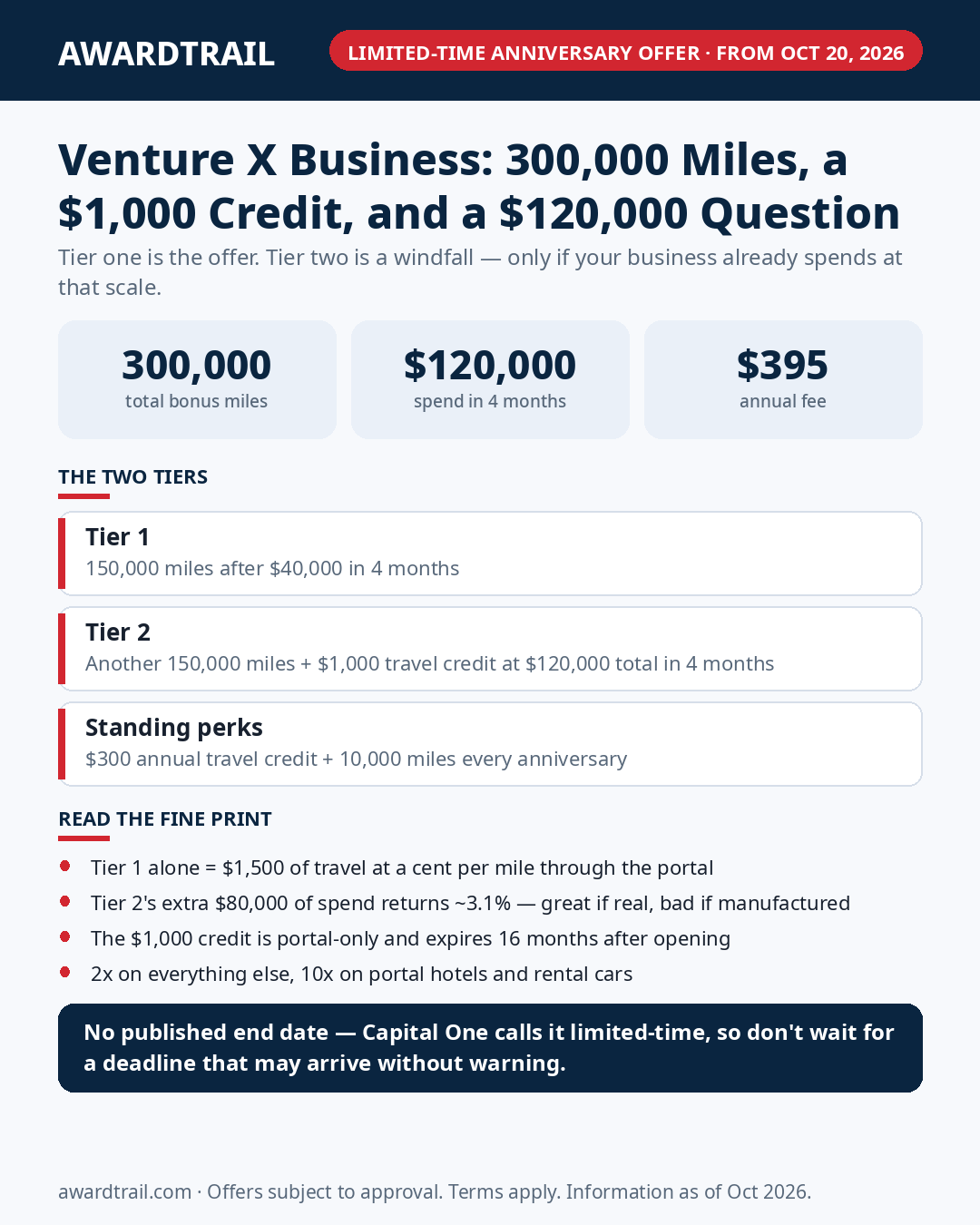
Capital One is marking the Venture X Business card's third anniversary with a new two-tier welcome offer. New cardholders earn 150,000 bonus miles after spending $40,000 on purchases in the first four months from account opening. Spend $120,000 total in that same four-month window and you pick up another 150,000 miles plus a one-time $1,000 Capital One Business Travel credit. Add it up and the headline is 300,000 miles and $1,000 in travel credit, on top of the card's standing $300 annual Capital One Business Travel credit. Capital One frames the whole package as up to $4,300 in travel value. The annual fee is $395, and it is not waived in the first year.
Why the first tier is the real story
Most coverage will lead with 300,000 miles. Ignore that for a second and look at tier one on its own: 150,000 miles for $40,000 of spending in four months. That is $10,000 a month — a real number, but one that plenty of businesses hit through ordinary operations: inventory, advertising, software subscriptions, vendor payments, quarterly tax payments. And the miles themselves are flexible in a way most airline miles are not. Redeem them through Capital One Business Travel at a cent apiece and tier one alone is $1,500 of travel. Transfer them to one of Capital One's 15-plus airline and hotel partners — Air Canada Aeroplan, Air France-KLM Flying Blue, British Airways Club, Turkish Miles & Smiles, Virgin Atlantic Flying Club, Choice Privileges and Wyndham Rewards among them — and the ceiling is higher, if you have a specific redemption in mind.
Compare it with what this card offered until days ago: 150,000 miles after $30,000 in three months. The new first tier asks for $10,000 more spending but gives you an extra month to do it. On a per-dollar basis that is a slightly worse deal — 3.75 miles per dollar of required spend versus 5.0 before — but the practical difference matters more than the ratio. Four months instead of three is the difference between a comfortable runway and a scramble for a business with lumpy revenue.
The second tier: $80,000 more for 150,000 miles and $1,000
Here is where the offer turns from generous to demanding. Tier two requires an additional $80,000 of spending in the same four months — $30,000 a month, every month, for four straight months — to unlock the second 150,000 miles and the $1,000 credit. The miles-per-required-dollar on that incremental spend is under 1.9, before the credit. Add the $1,000 credit and the incremental haul is worth roughly $2,500 at portal value against $80,000 of spending, or about 3.1% back on that stretch.
That is not a bad return on spending you were going to do anyway. It is a terrible reason to manufacture spending you were not. Paying fees to move money around, prepaying expenses at a discount to your cash flow, or pulling forward purchases your business does not need will eat that 3.1% fast. The honest test for tier two is simple: look at your last four months of actual card spending. If it already clears $120,000, take the full offer and enjoy it. If it lands between $40,000 and $120,000, take tier one, bank the 150,000 miles, and do not contort your business to chase tier two.
The $1,000 credit has strings worth reading
The $1,000 Capital One Business Travel credit is not cash and it is not a statement credit. It lands in your Capital One Business Travel balance within two billing cycles of qualifying, it can be spread across more than one booking, and it expires 16 months after account opening. That last detail matters: 16 months is generous, but it is a deadline, and the credit only works inside Capital One Business Travel. If your business books travel direct with airlines and hotels for elite status and flexibility, a portal-only credit is worth less to you than its face value. Price the portal booking against the direct price before you call the credit a full $1,000 win.
The same logic applies to the card's standing $300 annual credit, which also only works through Capital One Business Travel. Together the two credits are $1,300 of portal value in year one — Capital One's $4,300 headline is exactly that $1,300 plus the 300,000 miles at a cent each. Nothing hidden there, but nothing extra either.
What the card keeps paying after the bonus
Welcome offers get the headlines; the ongoing earn is what decides whether the card stays in your wallet after month four. The Venture X Business earns 10 miles per dollar on hotels and rental cars booked through Capital One Business Travel, 5 miles per dollar on flights and vacation rentals through the portal, and 2 miles per dollar on everything else. That 2x floor is the quiet strength of the card — no rotating categories to track, no bonus-category ceiling to watch. A business that puts $10,000 a month of unbonused spending on the card earns 20,000 miles a month, 240,000 a year, before any portal bookings.
Then there is the anniversary package: a $300 Capital One Business Travel credit each membership year, plus 10,000 bonus miles every year starting on the first anniversary, with no spending requirement attached. Against the $395 annual fee, the $300 credit and 10,000 miles (worth $100 at portal value) cover the fee on paper in year two and beyond — as long as you actually use portal bookings. If you never book through the portal, the fee math falls apart, and that is the single best reason to pass on this card.
Lounges round out the premium case: complimentary access to Capital One Lounges and Priority Pass lounges for the primary cardholder, plus up to a $120 statement credit for a Global Entry or TSA PreCheck application fee. There is also a fourth-night-free benefit at select Premier Collection and Lifestyle Collection hotels when you book four or more nights through Capital One Business Travel — useful for a conference trip, less useful if you book direct for status.
The timing trap nobody is talking about
Capital One calls this a limited-time anniversary offer, and it launched October 20, 2026 — but as of publication, Capital One has not published an end date for the new-cardholder offer. That cuts both ways. There is no deadline forcing a rushed application this week, and there is also no guarantee the offer survives into next month. Offers on this card do not change often, and when this one ends, the replacement will very likely be a lower, single-tier offer — the previous one was 150,000 miles, full stop.
The practical move: if tier one fits your real spending, apply while the offer is live rather than waiting for a deadline that may arrive without warning. If you are on the fence about whether your business can clear $40,000 in four months, the four-month window itself is your friend — apply when a heavy-spend period is starting, not in a quiet month, so the clock works for you instead of against you.
One more eligibility note: Capital One says the bonus may not be available to existing or previous Capital One Business cardholders. If you already hold or recently held a Capital One business card, check your eligibility before you count on the bonus — a second card does not automatically mean a second bonus.
Who should get this card, and who should skip it
Get it if your business already spends $10,000 or more a month on a card, you are comfortable booking at least some travel through Capital One Business Travel, and you want a flexible miles currency rather than miles locked to one airline. The first tier alone justifies the application for that profile, and the second tier is a windfall if your spending already clears $120,000.
Skip it — or at least wait — if your monthly card spending is well under $10,000, if you book all your travel direct and would never touch the portal credits, or if you already hold a Capital One business card and cannot confirm bonus eligibility. A 150,000-mile bonus you cannot earn is worth nothing, and a $395 fee for portal credits you will not use is a bad trade.
The Venture X Business anniversary offer is not a trick. It is a genuinely large bonus attached to genuinely large spending requirements, with portal strings on the credits and no published end date. Treat tier one as the offer, tier two as a bonus for businesses already spending at that scale, and the $1,000 credit as a 16-month homework assignment — and this card earns its place in your wallet.
💡 Why This Matters for Your Strategy
News in the points-and-miles world moves fast, and promotional changes often have a short window. If this announcement affects a card or program you hold, log into your awardtrail dashboard to check your current benefit usage, bonus progress, and whether a transfer or redemption makes sense right now — before terms change.
As a general rule: transfer points only when you have a specific redemption in mind — transfers are almost always one-way and non-reversible. If you're unsure of the value, check our redemption guides before acting.
View Redemption Guides · Read Our In-Depth Analysis
Explore Related Tools
- 🎯 Sign-Up Bonus Tracker — Track your MSR progress and deadlines
- 💳 Benefit & Credit Tracker — See which card credits you haven't used yet
- 🔢 Chase 5/24 Calculator — Know exactly when slots open up
- ❓ Rewards FAQ — Answers to the most common questions
Written by Brian — Founder, awardtrail
Brian has been travel hacking for over 17 years and has personally completed 300+ credit card applications across Chase, Amex, Citi, Capital One, and more. He built awardtrail out of frustration with spreadsheet chaos, and writes from direct, first-hand experience — not marketing copy. All analysis and recommendations on this site reflect real-world strategy tested across hundreds of card applications and award bookings.
Continue Reading
Comments (0)
Join the Discussion
Sign in to share your thoughts and experiences with fellow award travelers.