

Disclosure: awardtrail earns revenue through display advertising and may earn commissions on some links at no cost to you. Commercial relationships never influence our editorial content or recommendations. Full disclosure →
The Best Deal in Travel Has a Calendar Problem
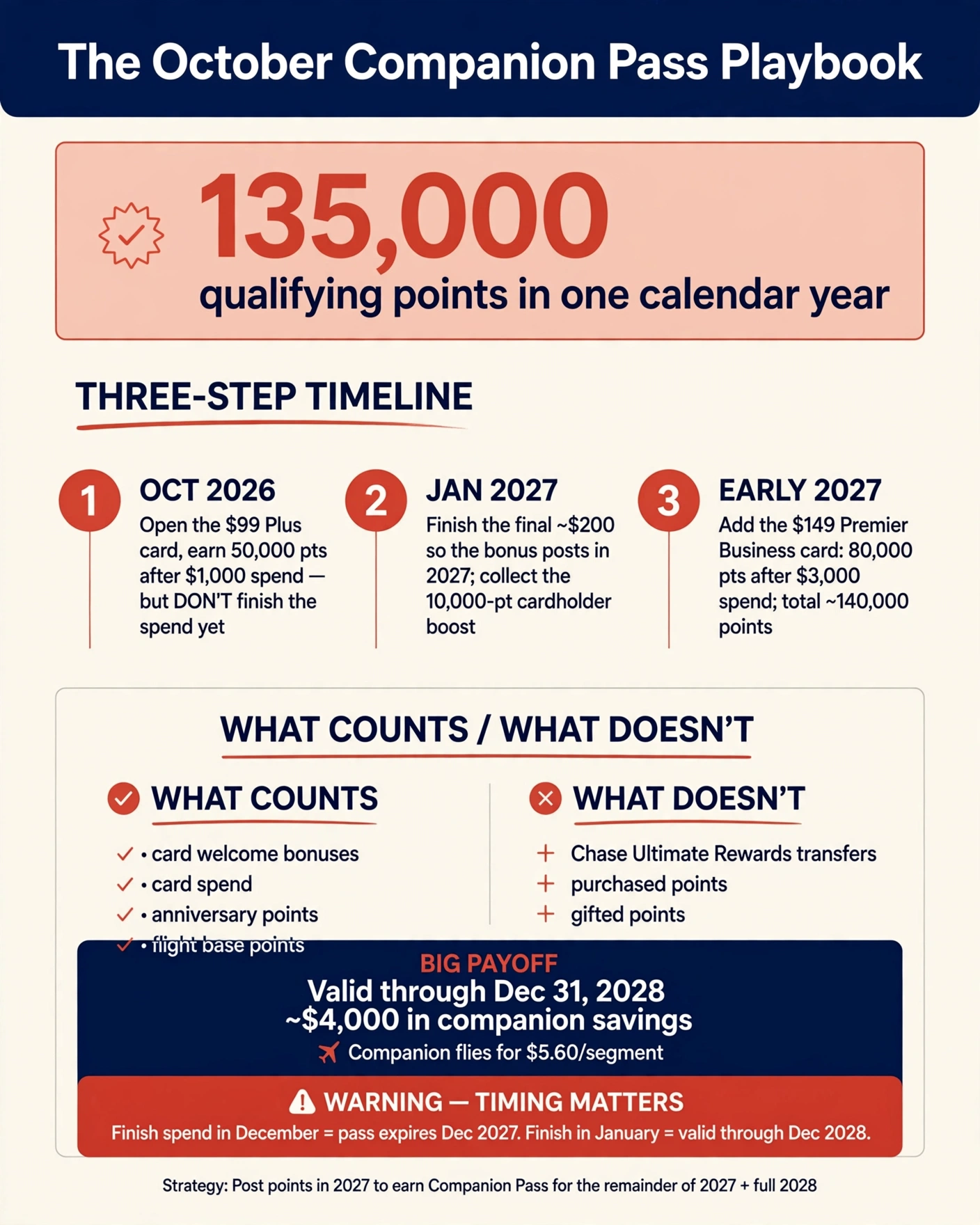
The Southwest Companion Pass lets a designated companion fly with you for the price of taxes and fees — $5.60 a segment on domestic flights — on every Southwest flight you take. Not one free ticket. Every ticket. Earn it in the first week of January, and it's valid through the end of next December: nearly two full years. Earn it in December instead, and it dies a year earlier. Same work, half the payoff.
October is the month this strategy gets built, because the moves you make now determine which year your bonus points post in — and that determines everything.
The Actual Rules (2026 Edition)
Earn the pass one of two ways in a single calendar year:
- 135,000 Companion Pass qualifying points (CPQP) in a calendar year, or
- 100 qualifying one-way flights.
If you hold a Southwest co-branded credit card when the calendar turns, you get a 10,000-point boost deposited within the first month of the year. Those points count toward the 135,000 but can't be redeemed for travel — they're a head start, not spending money. With the boost, your real target is 125,000 points.
What counts: welcome bonuses and all spend on Southwest Chase cards, anniversary bonus points, base points from paid Southwest flights, and partner activity like hotels and dining.
What does NOT count: points transferred from Chase Ultimate Rewards, Amex Membership Rewards, or any program; points purchased outright; gifted points; promotional points unless explicitly designated CPQP-eligible. This is where people trip up — UR transfers inflate your redeemable balance but do zero for the pass.
What matters most: points count in the calendar year they post to your Rapid Rewards account, not when you spend the money. Chase posts your welcome bonus when your statement closes. That timing is the entire game.
The Current Card Bonuses
Chase's five Southwest cards are all offering elevated welcome bonuses right now:
- Plus ($99/year): 50,000 points after $1,000 in 3 months
- Premier ($149/year): 55,000 points after $1,500 in 3 months
- Priority ($229/year): 60,000 points after $2,000 in 3 months
- Premier Business ($149/year): 80,000 points after $3,000 in 3 months
- Performance Business ($299/year): 80,000 points after $5,000 in 3 months
Chase's eligibility rules: you can only hold one personal Southwest card at a time, and you can't earn a bonus on a personal card if you've earned one on any personal Southwest card in the last 24 months. Business cards live under their own set of rules — you can hold both, and each has its own 24-month clock.
The Playbook: 140,000 Points for $348 in Fees
Here's the concrete sequence for maximum value:
Now (October 2026): Apply for one personal card — the Plus at $99 is the cheapest entry, and its $1,000 spend requirement is the easiest to pace. Start spending, but do not finish the minimum spend in 2026. Spend about $800 of the $1,000 and park the card.
January 2027: Finish the remaining ~$200 after January 1. The 50,000-point bonus posts with your January or February statement close — in the 2027 calendar year. Meanwhile, your 10,000-point cardholder boost lands in your account.
Also January 2027: Apply for a Southwest business card — the Premier Business at $149 with 80,000 points after $3,000 in three months is the lower-fee play; the Performance Business at $299 works the same if you want the bigger card. Meet the spend normally.
By March 2027: Your tally is 50,000 (personal bonus) + ~2,000–3,000 (spend points) + 80,000 (business bonus) + ~3,000–5,000 (spend points) + 10,000 (boost) = ~140,000+ qualifying points. The pass triggers and is valid through December 31, 2028 — roughly 21–22 months of companion travel from ~$348 in annual fees.
The $4,000 Difference One Month Makes
Run the numbers on a couple who flies Southwest six round trips a year at, say, $350 average per round trip. Without the pass, two fares cost $700 per trip. With the pass, the second ticket costs about $11.20 in taxes. Six trips save ~$2,100 a year — and over nearly two years, that's roughly $4,000 from two cards and $348 in fees.
Now imagine you got impatient and finished that Plus card's spend in December 2026. The 50,000-point bonus posts in 2026, your pass would have to be earned in 2026, and it would expire December 31, 2027. You'd leave roughly a full year of companion flights — about $2,100 in our example — on the table. The work is identical. The calendar is the difference.
Three Traps That Kill the Strategy
Trap 1: Finishing spend too early. Returns count against minimum-spend totals, so the classic mistake isn't just overspending — it's a December refund that drops you below the threshold and delays everything. Stay well clear of the full requirement until January.
Trap 2: The 24-month personal-card rule. If you earned a welcome bonus on any personal Southwest card after October 2024, you're ineligible for another personal-card bonus right now. Check your history before you apply — the business card path is unaffected.
Trap 3: Earning it "accidentally" this year. If you're already at 100,000+ qualifying points for 2026, stop. Crossing the line in 2026 gets you the pass through December 2027. If you don't need a companion this year, hold off and let the points reset.
How the Companion Actually Works
Once earned, you designate one companion (you can change them up to three times per calendar year). You book your flight first, then add the companion from your reservation for taxes and fees only. The companion can't fly without you — it's tied to your booking. With Southwest's 2026 shift to assigned seating, book early and the companion gets seated alongside you on the same reservation.
The Bottom Line
The Companion Pass is the single highest-value, lowest-complexity prize in the points game: two card bonuses and patience worth ~$4,000 in flights. But it rewards the disciplined and punishes the rushed. October's job is simple — open the personal card, spend most of the minimum, and wait. The calendar does the rest.
💡 Why This Matters for Your Strategy
News in the points-and-miles world moves fast, and promotional changes often have a short window. If this announcement affects a card or program you hold, log into your awardtrail dashboard to check your current benefit usage, bonus progress, and whether a transfer or redemption makes sense right now — before terms change.
As a general rule: transfer points only when you have a specific redemption in mind — transfers are almost always one-way and non-reversible. If you're unsure of the value, check our redemption guides before acting.
View Redemption Guides · Read Our In-Depth Analysis
Explore Related Tools
- 🎯 Sign-Up Bonus Tracker — Track your MSR progress and deadlines
- 💳 Benefit & Credit Tracker — See which card credits you haven't used yet
- 🔢 Chase 5/24 Calculator — Know exactly when slots open up
- ❓ Rewards FAQ — Answers to the most common questions
Written by Brian — Founder, awardtrail
Brian has been travel hacking for over 17 years and has personally completed 300+ credit card applications across Chase, Amex, Citi, Capital One, and more. He built awardtrail out of frustration with spreadsheet chaos, and writes from direct, first-hand experience — not marketing copy. All analysis and recommendations on this site reflect real-world strategy tested across hundreds of card applications and award bookings.
Continue Reading
Comments (0)
Join the Discussion
Sign in to share your thoughts and experiences with fellow award travelers.