

Disclosure: awardtrail earns revenue through display advertising and may earn commissions on some links at no cost to you. Commercial relationships never influence our editorial content or recommendations. Full disclosure →
The Deal: 25% More LifeMiles Through October 24
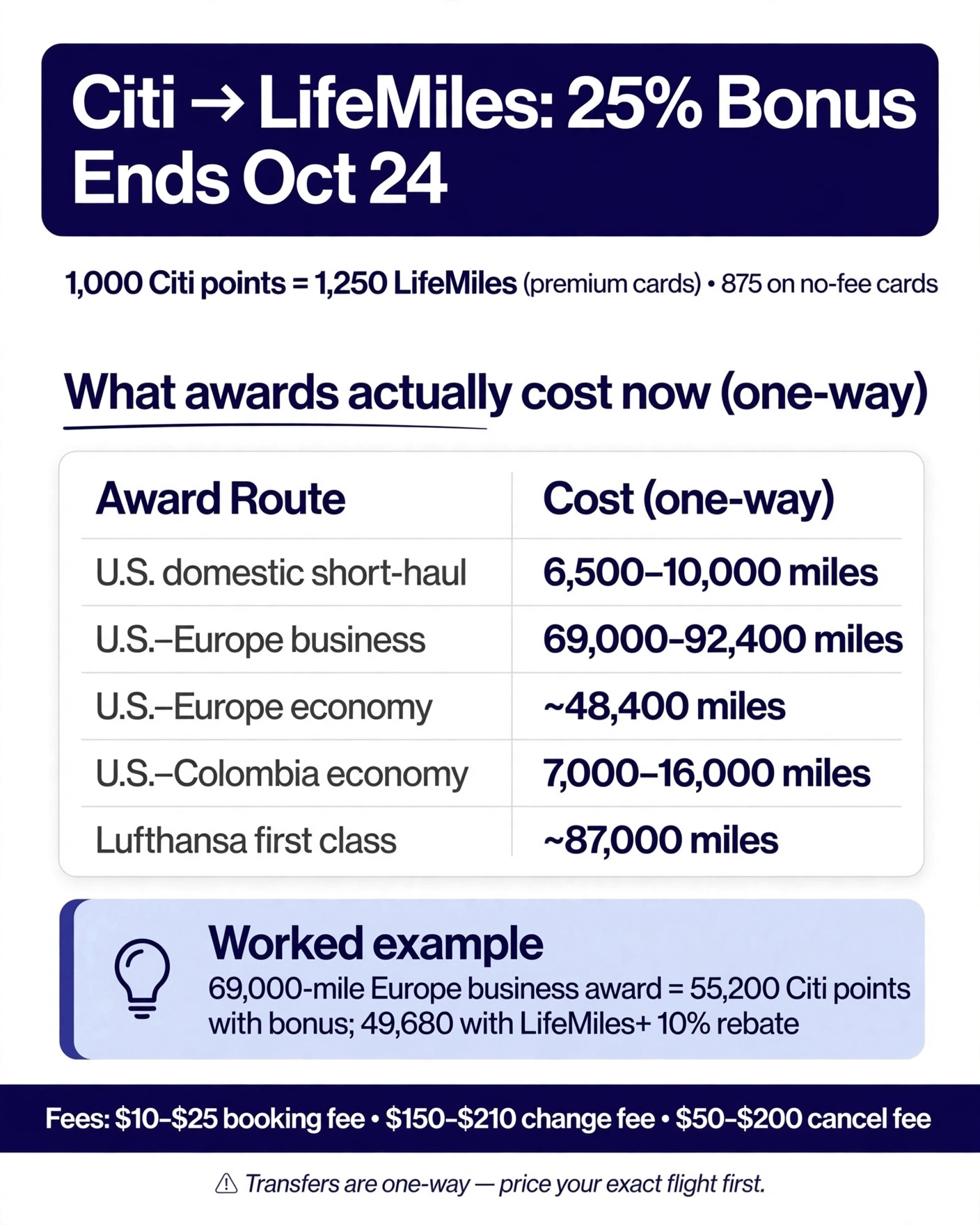
Through 11:59 PM Eastern on October 24, 2026, Citi ThankYou points transfer to Avianca LifeMiles with a 25% bonus. If you hold a Citi Strata Elite, Strata Premier, Prestige, or AT&T Access More card, 1,000 ThankYou points become 1,250 LifeMiles instead of 1,000. Cardholders with select no-annual-fee Citi cards get 875 LifeMiles per 1,000 points, up from a 0.7 base ratio. The minimum transfer is 1,000 points, no registration is required, and transfers land near-instantly.
Here is the first thing to understand about this bonus: 25% is the ceiling, and it always has been. Citi has run this exact 25% bonus to Avianca repeatedly since 2018 — never once higher. That cuts both ways. You are not missing a better offer by transferring now, and you are not getting anything rare. The bonus is worth exactly what it is: a 20% discount on the point cost of any LifeMiles award, since every 1,000 points buys 1,250 miles and 1 divided by 1.25 is 0.8.
So the real question is not whether 25% is generous. It is whether LifeMiles awards are still worth buying at any price. And that question got a lot harder over the last 15 months.
The Uncomfortable Truth: Three Devaluations Killed the Old Chart
LifeMiles used to be the easiest program in the game to explain. A fixed, published award chart, no fuel surcharges, and famous sweet spots you could recite from memory: 63,000 miles for business class to Europe, 7,500 miles for a short domestic hop on United, 75,000 miles for business class to Asia. If you have read any of those numbers recently, treat them as history, not pricing.
Avianca raised award prices three times in the 15 months leading up to August 2026, and walked away from its published chart in the process. Pricing now varies by route, carrier, date, and even search method. The same route can price differently depending on which airline operates it — United-operated awards took the deepest cuts and are now typically the worst value in the program, while the same city pair on SWISS, Lufthansa, ANA, or EVA can price substantially lower. Anyone quoting you the old chart numbers is selling you a program that no longer exists.
That does not make LifeMiles useless. It makes it a program you have to price live, route by route, before you move a single point. And on certain routes, it is still the cheapest way to fly Star Alliance premium cabins on the planet.
What LifeMiles Actually Costs Now
These are the ranges showing up in live searches through mid-2026, one-way, from the mainland United States. Treat every figure as a starting point for your own search, not a guarantee:
- U.S. domestic, short-haul: 6,500–10,000 miles in economy. The old 7,500-mile rate still appears on some routes; others now price at 10,000.
- U.S. to Europe: around 48,400 miles in economy; business class from 69,000 miles on the routes that survived the devaluations best, up to roughly 92,400 on the hardest-hit ones. Lufthansa first class still prices around 87,000 miles.
- U.S. to Central America and Colombia: roughly 7,000–16,000 miles in economy on Avianca's own flights, with business class in the 35,000–45,000 range. A Washington–Bogota economy award has been spotted at 14,150 miles.
- U.S. to South America: 25,000–35,000 miles in economy, 50,000–65,000 in business class.
- U.S. to Asia: 55,000–66,550 miles in economy; business class 75,000–90,000, with EVA and ANA generally pricing better than United-operated routings.
- U.S. to Australia and New Zealand: 40,000–55,000 miles in economy, around 100,000 in business class.
The pattern is clear: economy awards are broadly uncompetitive against programs like Aeroplan and Flying Blue at these rates. LifeMiles earns its keep in premium cabins, on partner-operated flights, and on routes where its lack of fuel surcharges changes the total cost.
Where LifeMiles Still Wins
First, the fuel surcharge advantage is real and it is large. LifeMiles does not pass through partner fuel surcharges on most Star Alliance carriers. A Lufthansa first-class award that another program might load with $700 or more in surcharges prices at taxes only through LifeMiles — roughly $80 in many cases. On premium-cabin awards, that alone can be worth more than the transfer bonus.
Second, there is carrier arbitrage. Because LifeMiles prices by operating carrier, the same city pair can cost dramatically different amounts depending on whose metal you fly. A U.S.–Europe business award that prices at 92,400 miles on a United-operated routing might price at 69,000 on a Lufthansa, SWISS, or Air Canada routing. The search tool does not advertise this. You find it by searching each carrier's routing separately.
Third, LifeMiles still books a small number of first-class awards that other Star Alliance programs have made expensive or unavailable, notably Lufthansa first class at around 87,000 miles. With the Citi bonus, that is 69,600 ThankYou points for a seat that routinely sells for thousands of dollars in cash.
The Stack: LifeMiles+ Turns 25% Into Something Bigger
LifeMiles+ is Avianca's subscription program, starting at $20 per month with a six-month minimum commitment. Its headline benefit is a 10% rebate on Star Alliance award redemptions, and all tiers above the entry-level Lite plan also waive change and cancellation fees. Stacked with the Citi bonus, the math gets genuinely interesting.
Take the 69,000-mile U.S.–Europe business-class award. The 25% Citi bonus alone cuts the ThankYou cost from 69,000 points to 55,200. Add the 10% LifeMiles+ rebate — 6,900 miles back after booking — and the net cost falls to 62,100 LifeMiles, or 49,680 ThankYou points. You have turned a 69,000-mile award into a sub-50,000-point award, a 28% total discount. The subscription costs $120 for six months at the entry tier, so it pays for itself on a single premium-cabin booking and then some. If you are booking two business-class seats, it is not even close.
The Fees Nobody Puts in the Headline
LifeMiles is not a low-fee program, and the fees are the reason speculative transfers are a bad idea. Expect a $10–$25 award ticketing fee on most bookings — it does not appear until checkout, so your search results will understate the cash cost. Changing an award costs roughly $150–$210, and only date changes are allowed; you cannot change the origin or destination. Cancelling and redepositing miles costs $50 for travel within a single region and $200 for travel across regions, and some awards are entirely non-refundable.
There is also the operational reality: LifeMiles' website is unreliable, phantom availability appears, and customer service is widely regarded as one of the weakest in the industry. A schedule change that another program would rebook in minutes can turn into a long phone ordeal here. None of this is a reason to avoid the program. It is a reason to book only trips you are certain about, on dates you will not change.
The Booking Protocol
If you are going to use this bonus, do it in this order. First, find the exact award you want on LifeMiles' own site, and cross-check the space on United's site — Star Alliance availability is roughly synced across programs, so if United shows the seat, LifeMiles usually has it too. Second, screenshot or note the exact mileage price and routing, including the operating carrier, because the same route can reprice. Third, transfer only the exact number of points you need — transfers are one-way and irreversible, and LifeMiles miles expire after 12 months without earning activity. Fourth, book immediately after the transfer lands.
Do not transfer speculatively because a bonus is live. A 25% bonus on miles sitting in a devaluing program with $200 cancellation fees is not a deal; it is a trap with good marketing. The bonus runs until October 24. That is eleven days to find a real trip, not eleven days to panic-move points.
The Verdict
This bonus is worth taking when you have a specific Star Alliance premium-cabin award in hand, priced live, on a partner-operated routing, where LifeMiles beats Aeroplan and United MileagePlus on total cost including surcharges. It is at its best for Lufthansa and SWISS business and first class to Europe, Avianca's own flights to Colombia and Central America, and EVA or ANA business class to Asia. It is at its worst for speculative transfers, economy awards, and United-operated routings priced at the top of the new ranges.
Citi's 25% bonus is not rare, and LifeMiles is not what it was two years ago. But for the traveler who prices a real trip, checks the operating carrier, and transfers the exact amount — possibly stacked with LifeMiles+ — it is still one of the sharpest tools in award travel. The old sweet spots are dead. The new ones just require more work to find.
💡 Why This Matters for Your Strategy
News in the points-and-miles world moves fast, and promotional changes often have a short window. If this announcement affects a card or program you hold, log into your awardtrail dashboard to check your current benefit usage, bonus progress, and whether a transfer or redemption makes sense right now — before terms change.
As a general rule: transfer points only when you have a specific redemption in mind — transfers are almost always one-way and non-reversible. If you're unsure of the value, check our redemption guides before acting.
View Redemption Guides · Read Our In-Depth Analysis
Explore Related Tools
- 🎯 Sign-Up Bonus Tracker — Track your MSR progress and deadlines
- 💳 Benefit & Credit Tracker — See which card credits you haven't used yet
- 🔢 Chase 5/24 Calculator — Know exactly when slots open up
- ❓ Rewards FAQ — Answers to the most common questions
Written by Brian — Founder, awardtrail
Brian has been travel hacking for over 17 years and has personally completed 300+ credit card applications across Chase, Amex, Citi, Capital One, and more. He built awardtrail out of frustration with spreadsheet chaos, and writes from direct, first-hand experience — not marketing copy. All analysis and recommendations on this site reflect real-world strategy tested across hundreds of card applications and award bookings.
Continue Reading

Comments (0)
Join the Discussion
Sign in to share your thoughts and experiences with fellow award travelers.