

Disclosure: awardtrail earns revenue through display advertising and may earn commissions on some links at no cost to you. Commercial relationships never influence our editorial content or recommendations. Full disclosure →
Six cards, one deadline, and a very different kind of headline offer
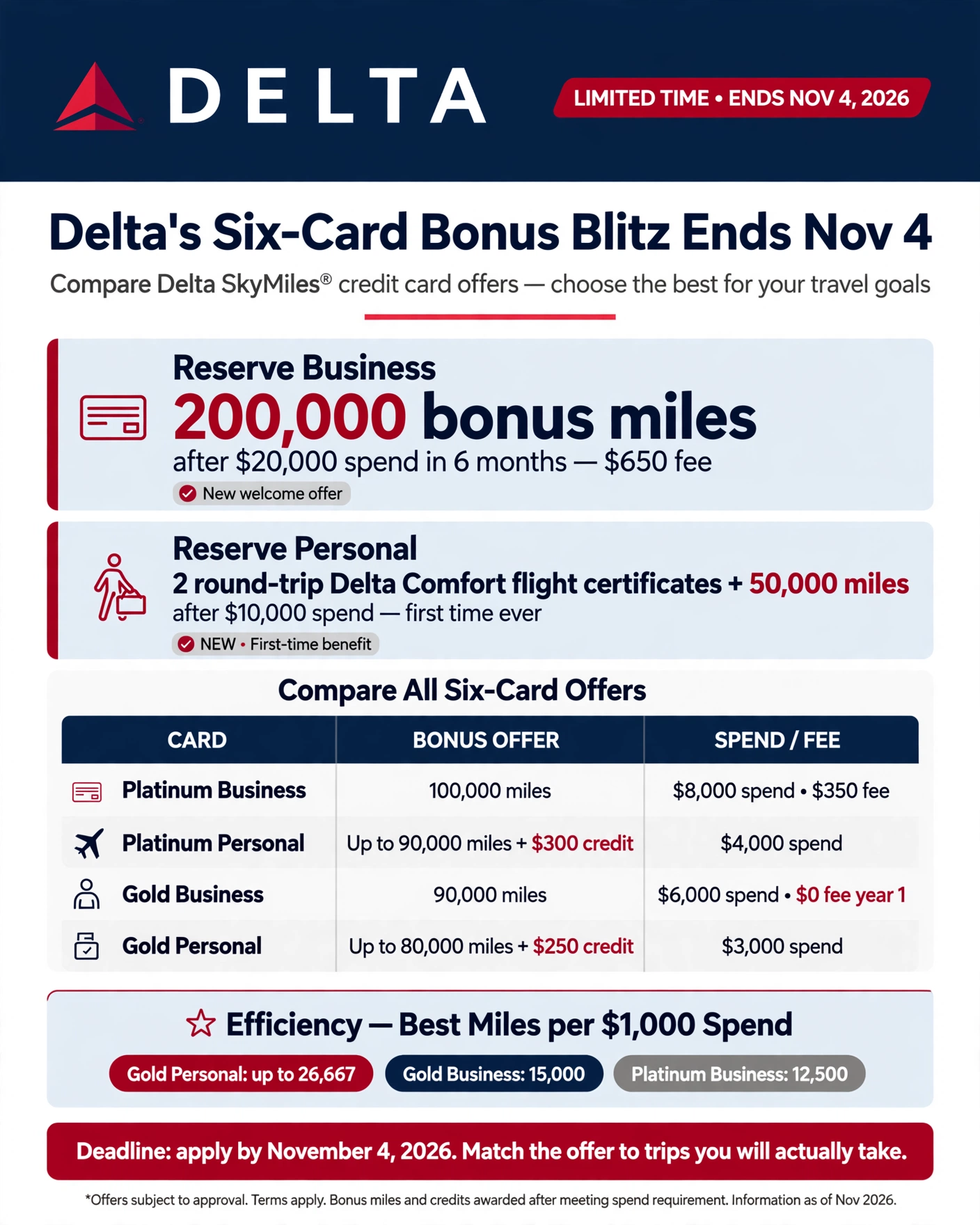
Delta and American Express put elevated welcome offers on all six Delta SkyMiles cards on August 27, and every one of them ends November 4, 2026. You then get six months from account opening to hit the spending requirement. The headline number belongs to the Delta SkyMiles Reserve Business card: 200,000 bonus miles after $20,000 in purchases. But the most interesting offer in the group is not the biggest number. It is the personal Reserve card, which for the first time ever swaps a pile of miles for two round-trip Delta Comfort flight certificates plus 50,000 bonus miles after $10,000 in spending.
That split — miles on five cards, actual flights on one — is what makes this round worth a careful look instead of a quick application. A 200,000-mile bonus is easy to understand and easy to overvalue. Two flight certificates are harder to price, harder to use well, and potentially worth more than any mileage bonus in the group if your travel plans line up. The wrong way to approach November 4 is to chase the biggest number. The right way is to match the offer to trips you will actually take, spending you will actually do, and a card you would actually keep.
The six offers, with the math done for you
Here is the full table, using a commonly used benchmark of 1.2 cents per SkyMile to put the mileage offers on a comparable footing. Treat that valuation as a yardstick, not a promise: Delta uses dynamic award pricing, so the same route can cost wildly different mileage on different days.
| Card | Welcome offer | Spend required | Annual fee | Miles per $1,000 of required spend | |---|---|---|---|---| | Reserve Business | 200,000 bonus miles | $20,000 in 6 months | $650 | 10,000 | | Reserve (personal) | 2 round-trip Comfort certificates + 50,000 miles | $10,000 in 6 months | $650 | 5,000 miles + certificates | | Platinum Business | 100,000 bonus miles | $8,000 in 6 months | $350 | 12,500 | | Platinum (personal) | Up to 90,000 miles + $300 statement credit | $4,000 in 6 months | $350 | Up to 22,500 | | Gold Business | 90,000 bonus miles | $6,000 in 6 months | $0 first year, then $150 | 15,000 | | Gold (personal) | Up to 80,000 miles + $250 statement credit | $3,000 in 6 months | $0 first year, then $150 | Up to 26,667 |
Read that last column before you read anything else. The Reserve Business card has the biggest bonus and the worst efficiency in the group: 10,000 miles per $1,000 of required spending. The Gold Business card delivers 15,000 miles per $1,000 with no annual fee in year one. The personal Gold, if you are offered the top tier, delivers up to 26,667 miles per $1,000. Big numbers sell cards. Efficiency is what actually fills your account.
The 200,000-mile offer: enormous, and the hardest to justify
Start with the Reserve Business card, because it is the one most people will fixate on. The standard offer on this card was 80,000 miles after $12,000 in spending. The limited-time version pays two and a half times the miles — but requires $8,000 more spending to get there. At the 1.2-cent benchmark, 200,000 miles is roughly $2,400 in award value. The $20,000 you spend to earn it also earns miles at the card's normal rates — at least 1 mile per dollar — so the realistic haul is at least 220,000 miles, worth roughly $2,640 at that benchmark, against a $650 annual fee.
That is real value, but only under two conditions. First, you must be able to put $20,000 of genuine spending on the card in six months — about $3,334 a month — without buying things you do not need. Manufactured spending to chase a bonus is how a great offer turns into a bad financial decision. Second, you must actually fly Delta enough for 220,000 SkyMiles to be useful. SkyMiles are a single-airline currency with dynamic pricing and no transfer partners to escape to. If Delta is not your airline, 200,000 of its miles are worth less to you than 100,000 transferable points, full stop.
For a business owner who already routes real business spending through a card and already flies Delta, this is Amex's highest bonus-miles offer on a Delta card this year. For everyone else, the smaller cards are the better play.
The Reserve personal card: two flights instead of a pile of miles
The personal Reserve card's offer is the only one in the group that is not really a mileage bonus. Two round-trip Delta Comfort flight certificates plus 50,000 bonus miles after $10,000 in spending, $650 annual fee. The certificates cover round-trip travel on Delta or Delta Connection flights within the lower 48 states, Puerto Rico, and the U.S. Virgin Islands, in Delta Comfort or Delta Main, with no blackout dates. You book at least 21 days ahead and pay taxes and fees of up to $80 per person.
The right way to value this offer is to price two Comfort round trips you would genuinely take. If each of those trips would cost you $400 to $700 in cash, the certificates alone are worth $800 to $1,400, plus roughly $600 in benchmark value from the 50,000 miles — a $1,400 to $2,000 gross package against a $650 fee. If you would not otherwise buy Comfort seats, or you have to invent trips to use the certificates, the value collapses. There is also a hard clock: travel must be booked and fully flown by January 15, 2028. Certificate tickets do not earn miles or Medallion Qualification Dollars, though they are eligible for complimentary upgrades. And expect the certificates and miles to arrive 8 to 12 weeks after you hit the spending threshold, so do not apply for this card counting on a flight next month.
Think of it this way: the Reserve Business offer pays you in currency. The personal Reserve offer pays you in trips. Currency is flexible; trips are only valuable if you take them.
The middle of the lineup is where the efficiency lives
The two Platinum cards and two Gold cards are less dramatic and, for most applicants, better deals per dollar of required spending.
The Platinum Business card pays a fixed 100,000 miles after $8,000 in spending, up from a standard offer of 70,000 after $6,000. That is roughly $1,200 in benchmark award value plus a card that carries a $2,500 MQD Headstart, an annual Companion Certificate after renewal, and a 15% discount on Delta award flights. At 12,500 miles per $1,000 of required spend, it beats the Reserve Business card on efficiency while asking for less than half the spending.
The Gold Business card is the quiet star of the group: a fixed 90,000 miles after $6,000 in spending, up from a standard 60,000 after $4,000, with no annual fee in the first year. That is roughly $1,080 in benchmark value for $6,000 of spending you would plausibly do anyway, on a card that costs nothing to hold for year one. Fifteen thousand miles per $1,000 of required spend, zero first-year fee. If you have a business and you fly Delta even occasionally, this is the easiest yes in the entire lineup.
The personal Platinum and Gold cards offer the highest headline efficiency — up to 90,000 miles plus a $300 statement credit after $4,000, and up to 80,000 miles plus a $250 statement credit after $3,000 — but with a catch the business cards do not have. The personal offers are "apply and find out": the advertised number is a ceiling, and your actual offer may be lower. Do not budget around 90,000 miles until you see your offer during the application. The Gold personal card's $0 first-year fee makes it a low-risk way to find out.
The benefits that keep paying after the bonus posts
A welcome offer is a one-time event. The card you keep is the one whose everyday benefits you will actually use, and the Delta lineup has a clear hierarchy worth understanding before you apply.
Every one of these six cards gives you TakeOff 15: a 15% discount on the mileage portion of award flights on Delta-operated flights booked through Delta's website or app. It does not apply to partner-operated flights or to taxes and fees, but on Delta metal it is automatic and permanent. A 100,000-mile round trip becomes 85,000 miles. That single benefit quietly raises the value of every SkyMile you hold.
Every card also gives you a free first checked bag for yourself and up to eight companions on the same reservation, plus a free second bag for the cardholder on domestic Delta flights. American Express puts the first-bag saving at up to $90 per person on a round trip. A family of four checking one bag each saves up to $360 on a single round trip — which, on the Gold cards, can exceed the annual fee by itself.
The Platinum and Reserve cards add the status machinery. Each deposits a $2,500 MQD Headstart into your account every qualification year, and MQD Boost adds $1 of MQD for every $20 spent on Platinum cards or every $10 spent on Reserve cards. Headstarts stack across Delta American Express cards, so holding more than one card can build a meaningful MQD base before you fly at all. Both tiers also add an annual Companion Certificate after renewal, with taxes and fees of $22 to $250 — but the cabins differ. The Platinum certificate covers a round-trip Delta Main flight on domestic, Caribbean, and Central American routes. The Reserve certificate covers a round-trip flight in Delta First, Delta Premium Select, Delta Comfort, or Delta Main across the same geographies.
The Reserve cards alone come with Delta Sky Club access, and it is capped: 15 visits per Medallion year, with unlimited access unlocked after $75,000 in card spending in a calendar year, plus Centurion and Escape lounge access when flying Delta. This is the single most common misunderstanding in the lineup. The Platinum and Gold cards do not include Sky Club access. If lounge access is the reason you want a Delta card, only the Reserve cards deliver it, and even then it is a capped benefit, not an all-you-can-visit pass.
The traps: variable offers, the once-per-lifetime rule, and 5/24
Three warnings before anyone applies. First, the personal Gold and Platinum offers vary by applicant. The business card offers are fixed. If you are comparing a guaranteed 90,000 miles on the Gold Business card against a possible 80,000 on the personal Gold card, the guaranteed one wins until you know your actual personal offer.
Second, American Express generally limits you to one welcome offer per card per lifetime — in practice, closer to one every five to seven years — and if you have held the card before, you may not be eligible at all. The application usually tells you with a pop-up before a hard credit pull if you will not get the bonus. Do not assume eligibility; read the pop-up.
Third, the business cards have a structural advantage for anyone managing Chase's 5/24 rule: business cards from American Express generally do not report to personal credit bureaus and do not add to your 5/24 count. That does not make the business cards free — they still carry a hard inquiry and a real annual fee — but for someone planning a Chase application next, the business versions keep the personal-card lane clear.
Who should pick which card
If you run a business with real card spending and you fly Delta: the Reserve Business card's 200,000 miles is the biggest haul, but the Gold Business card's 90,000 miles for $6,000 of spending with no first-year fee is the better value per dollar. Many business owners should take the Gold Business card first and only reach for the Reserve Business card if the $20,000 spend is genuinely effortless.
If you fly Delta with a partner and want two upgraded trips: the personal Reserve card's certificates are the unique offer in this group, and nothing else here replicates them. Price your two trips first. If the math works, apply before November 4 and put the January 15, 2028 flown-by deadline on your calendar the day you are approved.
If you want the best return on the least spending: the personal Gold card at up to 80,000 miles plus $250 after $3,000, with no fee in year one, is the lowest-risk entry point — as long as you confirm your actual offer. The Platinum personal card adds the Companion Certificate, MQD Headstart, and statement credits for a $350 fee, and it is the right pick if you fly Delta often enough to use the companion ticket every year.
If you mostly want lounge access: only the Reserve cards qualify, and the 15-visit cap means you should count your actual lounge visits before paying $650 for the privilege.
Conclusion
Delta's November 4 deadline is real, and these are genuinely elevated offers — the Reserve Business bonus is two and a half times its standard offer, and the Gold Business card pays 50% more miles than usual for no first-year fee. But the right choice here is not the biggest number. It is the offer whose spending requirement fits your real budget, whose rewards fit trips you will actually take, and whose card you would keep after the bonus posts. Work through that test, apply by November 4 if a card passes it, and let the rest of the lineup go. A bonus you cannot use is not a bonus at all.
💡 Why This Matters for Your Strategy
News in the points-and-miles world moves fast, and promotional changes often have a short window. If this announcement affects a card or program you hold, log into your awardtrail dashboard to check your current benefit usage, bonus progress, and whether a transfer or redemption makes sense right now — before terms change.
As a general rule: transfer points only when you have a specific redemption in mind — transfers are almost always one-way and non-reversible. If you're unsure of the value, check our redemption guides before acting.
View Redemption Guides · Read Our In-Depth Analysis
Explore Related Tools
- 🎯 Sign-Up Bonus Tracker — Track your MSR progress and deadlines
- 💳 Benefit & Credit Tracker — See which card credits you haven't used yet
- 🔢 Chase 5/24 Calculator — Know exactly when slots open up
- ❓ Rewards FAQ — Answers to the most common questions
Written by Brian — Founder, awardtrail
Brian has been travel hacking for over 17 years and has personally completed 300+ credit card applications across Chase, Amex, Citi, Capital One, and more. He built awardtrail out of frustration with spreadsheet chaos, and writes from direct, first-hand experience — not marketing copy. All analysis and recommendations on this site reflect real-world strategy tested across hundreds of card applications and award bookings.
Continue Reading

Comments (0)
Join the Discussion
Sign in to share your thoughts and experiences with fellow award travelers.