


Disclosure: awardtrail earns revenue through display advertising and may earn commissions on some links at no cost to you. Commercial relationships never influence our editorial content or recommendations. Full disclosure →
In the "Gold Standard" era of 2026, where a 2.0 cents per point (CPP) yield is the benchmark for success, the debate between using the Chase/Amex travel portals versus direct transfer partners has reached a fever pitch. As dynamic pricing becomes the industry norm, your choice of platform is the single biggest factor in your return on investment.
1. The Travel Portal: Simplicity at a Ceiling
Travel portals (like Chase Travel℠ or Amex Travel) act as online travel agencies. You are effectively paying for a cash ticket with points at a fixed rate—usually 1.0 to 1.5 cents each.
Pros:
No Availability Games: If there is a seat for sale on the airline's website, you can book it. No searching for "Saver" award space or dealing with "Phantom availability."
Earn Miles while Spending Points: Portal bookings are treated as "cash" by airlines. This means you earn frequent flyer miles and elite status credits on a flight you paid for with points.
Price Parity: For cheap domestic "puddle jumpers," the 1.5 CPP rate often costs fewer points than the flat-rate miles required by a transfer partner.
Cons:
The 1.5 CPP Hard Cap: You will almost never hit the 2.0 CPP "Gold Standard" here.
The "Middleman" Headache: If a flight is delayed or canceled, you must deal with the portal’s customer service rather than the airline directly, which can be a logistical nightmare during mass disruptions.
2. Transfer Partners: High Risk, High Reward
Transferring moves your points directly into an airline or hotel’s loyalty program (e.g., Chase to Hyatt, or Amex to Virgin Atlantic). This is where 2.0+ CPP redemptions are born.
Pros:
Outsized Value: This is the only way to get "outsized" value. A $4,000 Business Class seat for 50,000 points yields a massive 8.0 CPP.
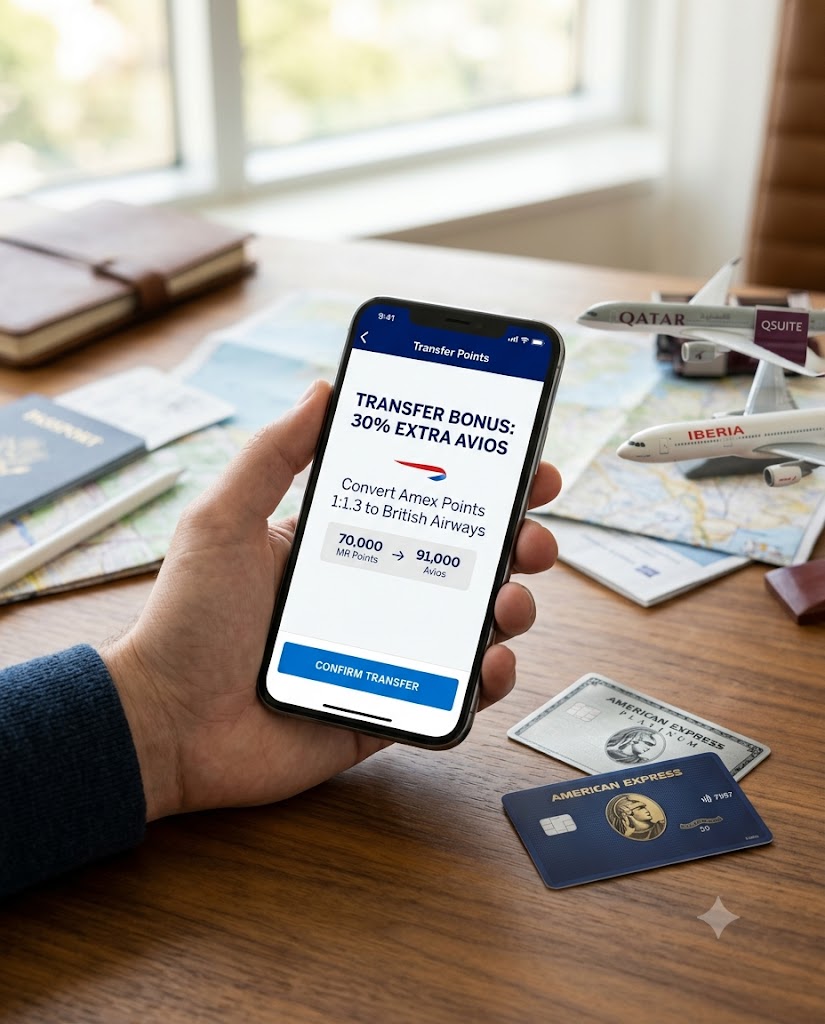
Transfer Bonuses: Amex, Chase, and Bilt often offer 20–30% bonuses. If you move points during a bonus, you’re essentially getting a "discount" on the award price.
Direct Control: You own the reservation directly with the carrier. If things go wrong, you are the airline’s customer, not the portal’s.
Cons:
Limited Seats: Airlines only release a few "award seats" per flight. If you don't book early (or very late), you may find nothing.
The One-Way Trap: Once you move points from Chase to United, you can never move them back. If you don't book the flight, those points are stuck in that airline's ecosystem.
When to Use Which: 2026 Comparison Table
| Scenario | Recommended Method | The Logic |
| Domestic Coach (Short Haul) | Portal | Cash prices are often so low that the portal rate beats the 10k-15k "Saver" minimums. |
| International Business/First | Transfer Partner | Portal redemptions are tied to cash prices ($3k+); Transfer partners use fixed charts (50k-80k). |
| Chasing Airline Status | Portal | Portal tickets count as "revenue" and earn elite qualifying dollars; transfers do not. |
| Boutique or Small Hotels | Portal | Many luxury independent hotels aren't in big chains; portals allow you to use points for them. |
| Peak Season/Holidays | Transfer Partner | Cash prices skyrocket (bad for portal), but "Saver" award seats stay at a flat price. |
The 2026 Expert Verdict
For the everyday "utility" trip—a quick flight to see family or a weekend wedding—the Portal is your best friend. It’s efficient and earns you miles back.
However, if you are aiming for the 2.0 CPP Gold Standard, you must master Transfer Partners. The portal is for the floor; partners are for the ceiling. If your redemption yields less than 1.6 CPP in a portal, spend five minutes checking a transfer partner—you might just double your value.
Written by Brian — Founder, awardtrail
Brian has been travel hacking for over 17 years and has personally completed 300+ credit card applications across Chase, Amex, Citi, Capital One, and more. He built awardtrail out of frustration with spreadsheet chaos, and writes from direct, first-hand experience — not marketing copy. All analysis and recommendations on this site reflect real-world strategy tested across hundreds of card applications and award bookings.
Continue Reading

Comments (0)
Join the Discussion
Sign in to share your thoughts and experiences with fellow award travelers.