

Disclosure: awardtrail earns revenue through display advertising and may earn commissions on some links at no cost to you. Commercial relationships never influence our editorial content or recommendations. Full disclosure →
The program that quietly won 2025 just made its biggest move yet
A year ago, Alaska Airlines and Hawaiian Airlines folded Mileage Plan and HawaiianMiles into a single program, Atmos Rewards. It won "best airline rewards program" honors from both NerdWallet and U.S. News & World Report, and the numbers since then explain why: more than 890,000 members now hold Atmos status, and the program delivered over 63,000 premium-cabin upgrades in 2025 alone. More than half of its new status members are Gen Z — a demographic no other U.S. airline program is capturing at that rate.
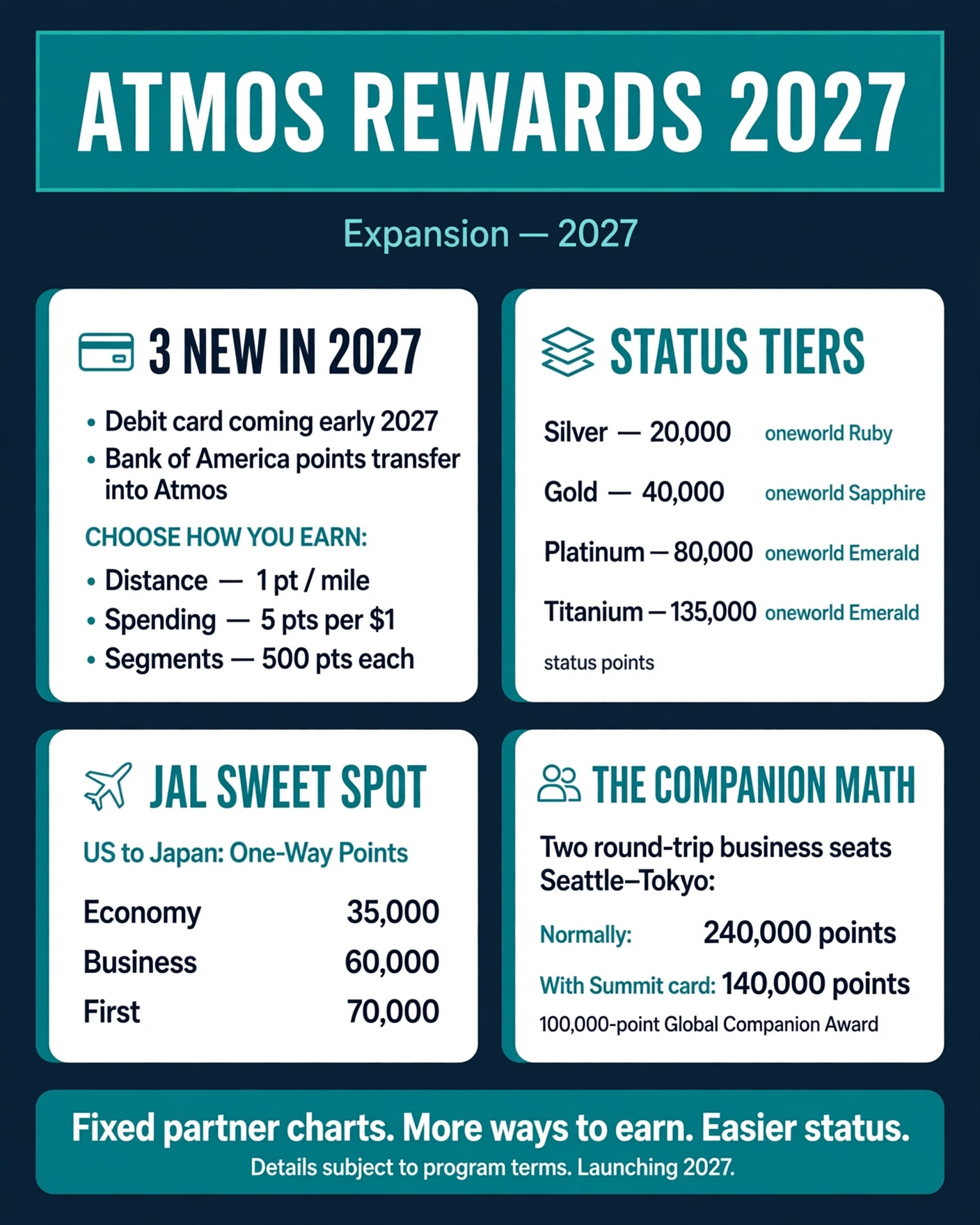
Now Alaska is expanding Atmos again, and the three announcements that matter most land in 2027: a new Atmos Rewards debit card, points transfers from Bank of America card products, and the ability to choose how you earn status. Each one changes a different piece of the strategy. Taken together, they turn a program that was already the best value in domestic loyalty into something much harder to ignore — even if you never fly Alaska.
The three 2027 changes, and why each one matters
A debit card that earns points and status. Planned for early 2027, with pre-registration already open, the Atmos Rewards debit card is aimed at travelers who pay with debit — a group traditional airline cards have never served. It will earn Atmos points and status points, offer a choice of card designs, flight and onboard purchase discounts, free points sharing, no foreign transaction fees, and the ability to pay certain account fees with points. Details on earning rates are still to come, but the direction is clear: Alaska wants status to be reachable without a credit card.
Bank of America points will transfer into Atmos. In 2027, Alaska plans to let customers with eligible Bank of America card products transfer points into Atmos Rewards. This is the single biggest structural change of the three. Until now, Atmos points have been hard to get without flying Alaska or Hawaiian, holding a co-branded card, or transferring from a short list of partners. A transfer path from one of the largest U.S. banks puts Atmos points within reach of millions of cardholders who have never set foot on an Alaska plane — and it gives the program a genuine transfer-currency pipeline for the first time.
You choose how you earn. Starting January 1, 2027, Atmos members will pick one of three earning methods for flights on Alaska, Hawaiian, and partners: by distance, by price, or by segments. Distance earning credits 1 status point per mile flown, including on award redemptions. Spending-based earning credits 5 status points per dollar spent on flight purchases. Segment-based earning credits 500 status points per segment flown, again including award redemptions. The choice is the point: the program stops forcing one earning model on every traveler and lets you match it to how you actually fly.
Run the earning math before January 1
The right choice depends entirely on your flying pattern, and the differences are large enough to decide a status tier.
Take a cheap transcontinental flight: Seattle to New York is roughly 2,400 miles each way. Under distance earning, a round trip banks about 4,800 status points. If that ticket cost $350, spending-based earning would pay just 1,750. Distance wins by a wide margin on cheap long-haul flying.
Now flip it. A $600 round trip from Seattle to Anchorage is about 1,400 miles each way. Distance earning pays roughly 2,800 status points. Spending-based earning pays 3,000. The expensive short-haul flyer wins with the price model.
And the segment model rewards frequency above all: a road warrior flying 40 short segments a year banks 20,000 status points on segments alone — exactly enough for Atmos Silver — regardless of how cheap those tickets were. The lesson is simple: if you fly far on cheap fares, pick distance. If you fly short on expensive fares, pick spending. If you fly constantly, pick segments. Alaska will let you keep the default distance model if you do nothing, so make the choice deliberately rather than by inertia.
The status ladder, and the fastest ways up it
Atmos status runs on status points that reset to zero every January 1. Earning for each year ends December 31, and status lasts through January 31 of the following year. The tiers: Silver at 20,000 status points, Gold at 40,000, Platinum at 80,000, and Titanium at 135,000. They map to oneworld Ruby, Sapphire, Emerald, and Emerald — which means Atmos status travels with you onto American, British Airways, Cathay Pacific, Qantas, JAL, Finnair, and the rest of the alliance, with lounge access from Gold upward on eligible international itineraries.
There are two shortcuts worth knowing. First, milestone perks kick in as early as 10,000 status points, so the climb pays off before you reach Silver. Second, award travel earns status points — 1 per mile flown — which almost no other U.S. program offers. A points-funded trip to London still moves your status meter.
The fastest non-flying path runs through the co-branded cards, issued by Bank of America. The premium Atmos Rewards Summit card ($395 annual fee) earns 1 status point per $2 spent, with no cap, plus 10,000 bonus status points on every card anniversary. Spend $60,000 on the Summit in a cardmember year and the math is exact: 30,000 status points from spend plus 10,000 anniversary points equals 40,000 — Atmos Gold, without a single flight. The $95 Atmos Rewards Ascent card and the $70 business card (plus $25 per card) earn 1 status point per $3 spent, also uncapped.
If you already hold status with another airline, the status match is the other shortcut: Alaska grants a 90-day trial of matched status, and you keep it by earning just 5,000 base points on Alaska or Hawaiian flights for Silver, 10,000 for Gold, or 20,000 for Platinum. Start the match between July and December and, once you clear the flying requirement, your status runs through the end of the following calendar year.
Why Atmos points are still the best value in the game
The expansion news matters because the currency it feeds is already unusually strong. Atmos prices partner awards on published, distance-based charts — not the dynamic pricing that has quietly inflated award costs at other U.S. programs. Alaska's published chart for Japan Airlines is the headline example: U.S. or Canada to Japan costs 35,000 points in economy, 60,000 in business, and 70,000 in first class, one-way. Southeast Asia runs 40,000 / 65,000 / 75,000. A $12.50 partner booking fee applies per ticket, and partner awards have long included a free stopover in the gateway city on each direction — so a single award can cover two cities.
The partner bench behind those charts is what makes the program global: 30 global partners across oneworld and beyond, reaching more than 1,000 destinations. When you book a partner flight directly through Alaska or Hawaiian, you earn 100% of the miles flown in points, and business-class fares earn 250% of the distance flown across all partners. That earning rate, combined with fixed award pricing, is the core engine of Atmos value: points are both easier to accumulate and harder to devalue than at most competitors.
The companion awards are the Summit card's real headline
The Summit card's welcome offer — 70,000 bonus points plus a 25,000-point Global Companion Award after $3,000 in purchases in the first 90 days — is solid. The card's ongoing companion benefits are the reason to keep it.
Every card anniversary delivers a fresh 25,000-point Global Companion Award, and spending $60,000 or more in a cardmember year earns a second award worth 100,000 points. Each award discounts a companion's award ticket by its face value when two people travel on the same itinerary — on Alaska, Hawaiian, oneworld, and eligible partners, in any cabin.
Run the JAL example all the way through. Two round-trip business-class seats between Seattle and Tokyo Narita cost 120,000 points per person at the published 60,000-each-way rate — 240,000 points total. Apply the 100,000-point Global Companion Award and the companion's ticket drops to 20,000 points. The trip costs 140,000 points for two people in business class, plus taxes and fees. That is the kind of math that makes a $395 annual fee look small — and it stacks with the same $60,000 of spending that earned Gold status.
The Ascent card plays a different, cheaper role: 50,000 bonus points plus a $99 Companion Fare (plus taxes and fees from $23) after $1,500 in the first 90 days, then a $99 Companion Fare each anniversary after $6,000 in annual spend, a free checked bag for you and up to six companions, and 2x points on gas, EV charging, transit, cable, and streaming. For a West Coast flyer who wants one companion perk a year without the Summit's fee, it is the right card.
What to do before the year ends
Three deadlines shape the next ten weeks. First, 2026 status earning ends December 31. If you are within striking distance of a tier, this is the window: a status match started now keeps matched status through the end of 2027 once you clear the modest flying requirement, and a card-spending push before year-end still counts toward 2026 status. Second, pick your 2027 earning method before January 1, when the new choices take effect — run the distance-versus-spending-versus-segments math on your actual 2026 flying, not on a guess. Third, if the debit card or BofA transfers interest you, pre-register for the debit card now and watch for transfer details as 2027 approaches; neither is live yet, and early announcements will carry the terms that matter.
Atmos Rewards spent its first year proving that a combined Alaska–Hawaiian program could keep Mileage Plan's best features — fixed partner charts, generous earning, real status perks — while adding Hawaiian's network and oneworld reach. The 2027 expansion is the second act: new ways to earn, new ways to get points, and a debit card that opens the program to people the credit-card game never reached. The programs that win in loyalty are the ones that make their currency easier to earn and harder to devalue at the same time. Right now, that is exactly what Atmos is doing.
💡 Why This Matters for Your Strategy
News in the points-and-miles world moves fast, and promotional changes often have a short window. If this announcement affects a card or program you hold, log into your awardtrail dashboard to check your current benefit usage, bonus progress, and whether a transfer or redemption makes sense right now — before terms change.
As a general rule: transfer points only when you have a specific redemption in mind — transfers are almost always one-way and non-reversible. If you're unsure of the value, check our redemption guides before acting.
View Redemption Guides · Read Our In-Depth Analysis
Explore Related Tools
- 🎯 Sign-Up Bonus Tracker — Track your MSR progress and deadlines
- 💳 Benefit & Credit Tracker — See which card credits you haven't used yet
- 🔢 Chase 5/24 Calculator — Know exactly when slots open up
- ❓ Rewards FAQ — Answers to the most common questions
Written by Brian — Founder, awardtrail
Brian has been travel hacking for over 17 years and has personally completed 300+ credit card applications across Chase, Amex, Citi, Capital One, and more. He built awardtrail out of frustration with spreadsheet chaos, and writes from direct, first-hand experience — not marketing copy. All analysis and recommendations on this site reflect real-world strategy tested across hundreds of card applications and award bookings.
Continue Reading
Comments (0)
Join the Discussion
Sign in to share your thoughts and experiences with fellow award travelers.