

Disclosure: awardtrail earns revenue through display advertising and may earn commissions on some links at no cost to you. Commercial relationships never influence our editorial content or recommendations. Full disclosure →
The last 1:1 door is closing
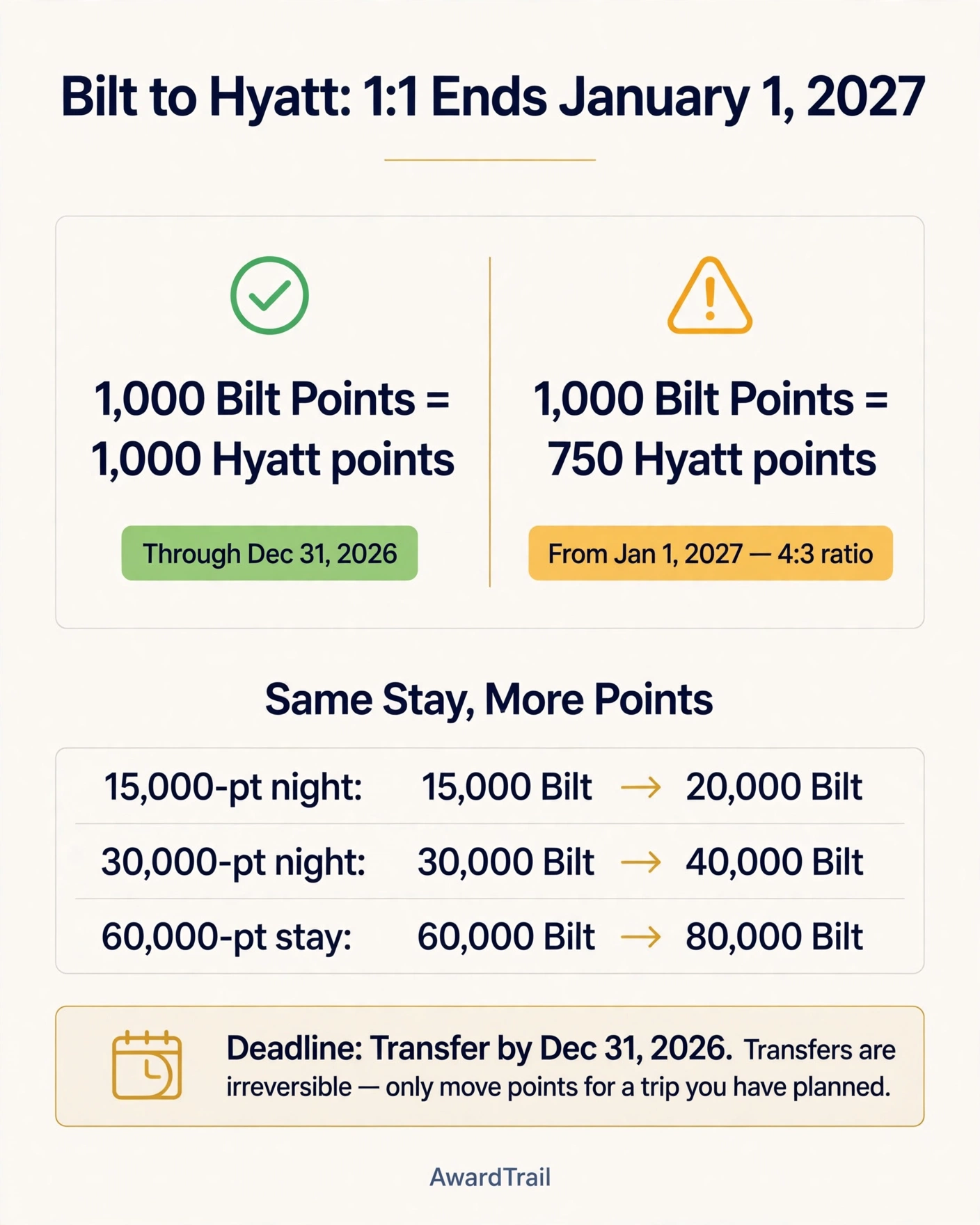
On October 1, Bilt Rewards posted a notice on its World of Hyatt transfer page: the transfer ratio will change to 4:3 beginning January 1, 2027. Until then, Bilt Points still move to Hyatt at 1:1. After that, every 1,000 Bilt Points you send will land as just 750 Hyatt points.
This is the second shoe dropping, not the first. That same day, October 1, Chase's cut took effect for Sapphire Preferred and Ink Business Preferred cardholders, who now also transfer to Hyatt at 4:3. The difference is that Chase left an escape hatch: Sapphire Reserve and Sapphire Reserve for Business cardholders still transfer at 1:1. Bilt left none. The change applies to every Bilt member and every Bilt card — the no-fee Blue, the Obsidian, and even the $495-per-year Palladium.
From January 1, the $795-per-year Sapphire Reserve cards will be the only way to move credit card points to Hyatt without losing a quarter of them in transit. That is a remarkable sentence to write about a program that, until a few months ago, treated 1:1 Hyatt transfers as the industry default.
The math, in nights
A 4:3 ratio sounds abstract. In award nights, it is concrete: you need exactly one-third more Bilt Points for every Hyatt stay you book.
- A Category 4 standard night at 15,000 Hyatt points goes from 15,000 Bilt Points to 20,000 — an extra 5,000 points per night.
- A 30,000-point night goes from 30,000 Bilt Points to 40,000.
- A 60,000-point stay — say, three nights at a 20,000-point Category 5 property — goes from 60,000 Bilt Points to 80,000.
- A five-night Category 4 trip at standard pricing (75,000 Hyatt points) jumps from 75,000 to 100,000 Bilt Points. That is 25,000 extra points for the same trip, roughly two months of rent at $2,000 a month on a 1x housing earn rate.
The flip side is what makes this sting: Hyatt's award chart is still one of the few that is actually a chart. A Category 1 standard room is 5,000 points, a Category 4 is 15,000, a Category 8 is 40,000, with off-peak and peak bands on either side. Hyatt points are worth protecting precisely because the chart makes their value predictable. The transfer tax doesn't change the chart — it changes what it costs you to get onto it.
Should you transfer before December 31?
The standard advice — never transfer speculatively, because transfers are irreversible — still applies. But this is the rare case where the exception deserves real thought, because the deadline is real and the math is certain.
Transfer now if you have a specific Hyatt stay in mind for 2027: a trip with dates, a property, and a category you have already checked for award availability. Moving the points before December 31 locks in the 1:1 rate and saves you 25% of the Bilt Points you would otherwise spend. If you were going to book that stay anyway, the transfer is not speculative — it is a discount with a deadline.
Do not transfer if you have no trip in mind. Bilt Points are flexible; Hyatt points are not. Once points leave Bilt, they can never come back, and a pile of Hyatt points with no plan is a pile of points exposed to whatever Hyatt does next. The 25% you "save" by transferring early is worthless if the points sit unused while award prices move.
The middle case is the one most people actually face: a trip you are fairly sure about but have not booked. Here, the tiebreaker is availability. Hyatt award space at popular properties is capacity-controlled, and moving points early does not reserve a room. Before transferring anything, check that the property and dates you want actually have standard award rooms available — or can be held. If the room is not there, the points should stay in Bilt.
One mechanical warning: Bilt says transfers are usually immediate but to allow up to 48 hours. A transfer started on December 30 or 31 is cutting it close to the cutoff. If you decide to move points, do it in the first half of December, not the last week. The minimum transfer is 2,000 Bilt Points for Blue members and 1,000 for Silver, Gold, or Platinum members, in 1,000-point increments.
What Bilt Points are still good for
The devaluation hits Bilt's single most valuable hotel partner, but it does not gut the program. Bilt's transfer list remains the broadest in the business: 1:1 transfers to Atmos Rewards (Alaska + Hawaiian), United MileagePlus, Air France/KLM Flying Blue, Virgin Atlantic, Emirates, British Airways, Cathay Pacific, Turkish, Aer Lingus, Iberia, Aeroplan, TAP, Southwest, Japan Airlines, Qatar Airways, Etihad, and Avianca LifeMiles, plus Hilton, Marriott, IHG, Wyndham, and Accor at 3:2.
That breadth is the strategic point. A Bilt Point after January 1 is still a 1:1 ticket into JAL Mileage Bank, Aeroplan, and Atmos Rewards — programs where premium-cabin sweet spots still exist. The rational response to the Hyatt cut is not to abandon Bilt; it is to stop treating Bilt as a Hyatt pipeline and start treating it as what it actually is: the most flexible airline-points currency on the market, with a hotel option attached.
Rent Day still matters, too. On the first of each month, Bilt has historically run transfer bonuses and promotions. There is no guarantee of a Hyatt bonus on the November 1 or December 1 Rent Days — and you should not count on one — but if Bilt does offer a final Hyatt sweetener before the cutoff, those are the dates to watch. Do not let a rumored bonus delay a transfer you have already decided to make.
The new Hyatt earning playbook
If Hyatt stays are a core part of your travel, the 2027 answer is to earn Hyatt points directly instead of paying a transfer tax to get them. Three routes now compete, and the right one depends on how you spend.
Route 1: The World of Hyatt Card. The $95-per-year personal card earns 4 points per dollar at Hyatt properties — up to 9 points total when stacked with the base points you earn as a World of Hyatt member — plus 2 points per dollar on dining, flights booked directly with the airline, local transit, and gym memberships, and 1 point elsewhere. It also comes with a Category 1-4 free night every account anniversary and automatic Discoverist status. For anyone who stays at Hyatt properties a few times a year, this card now earns its keep more easily than it did a month ago, because the alternative — transferring in from Bilt or a mid-tier Chase card — just got 33% more expensive.
Route 2: Sapphire Reserve. At $795 a year, this is the expensive way to keep 1:1 Hyatt transfers — and the only way left. It makes sense only if you already value the card's travel credits, lounge access, and 3x earning on travel and dining on their own merits. Buying a $795 card solely to preserve a Hyatt transfer ratio is paying a premium to protect a discount. Run the numbers on your actual annual Hyatt transfer volume before going this way: at 4:3, the "tax" on transferring 100,000 points a year is 33,333 extra points. Whether that is worth $795 depends on what those points are worth to you — and on whether you would use the Reserve's other benefits anyway.
Route 3: Bilt for everything else. Keep earning Bilt Points on rent and everyday spend, but redirect their destination. The Palladium's 2x on everyday purchases and up to 1.25x on rent and mortgage payments with no transaction fee, and the Blue card's no-fee structure, still make Bilt one of the strongest everyday earners available. Just stop mentally pricing every Bilt Point as a future Hyatt point. Price it as a future airline point, and let Hyatt points come from the Hyatt card and from paid stays.
The bigger pattern
Step back, and the Bilt cut is part of a clear industry shift. Within the last year, American Express cut transfer ratios to Cathay Pacific and Emirates and dropped Etihad entirely. Chase dropped Emirates as a partner rather than accept a worse ratio. Chase cut Hyatt to 4:3 for most of its cardholders. Now Bilt has followed. The 1:1 transfer, once the default for premium currencies, is becoming something you pay a premium annual fee to keep — or lose.
That is the real lesson of this devaluation. Transfer ratios are no longer a permanent feature of a program; they are a negotiated price that moves when the economics change. The programs that survive as good value are the ones where you earn the points directly — from the hotel's own card, from stays, from the partners that still price at 1:1 — rather than relying on a transfer pipeline that can be repriced with a single website notice.
The bottom line
You have until December 31, 2026, to move Bilt Points to Hyatt at 1:1. After that, the same stays cost one-third more Bilt Points, with no premium-card exception. If you have a real 2027 Hyatt trip in mind, check availability, then move the points in early December. If you don't, leave them in Bilt — and start building your 2027 Hyatt balance the direct way, with the card and the stays that earn points without a transfer tax. The window is real, but so is the rule that has always governed this game: flexible points are worth more than locked-in ones, and the best time to lock in is when you know exactly what you are locking in for.
💡 Why This Matters for Your Strategy
News in the points-and-miles world moves fast, and promotional changes often have a short window. If this announcement affects a card or program you hold, log into your awardtrail dashboard to check your current benefit usage, bonus progress, and whether a transfer or redemption makes sense right now — before terms change.
As a general rule: transfer points only when you have a specific redemption in mind — transfers are almost always one-way and non-reversible. If you're unsure of the value, check our redemption guides before acting.
View Redemption Guides · Read Our In-Depth Analysis
Explore Related Tools
- 🎯 Sign-Up Bonus Tracker — Track your MSR progress and deadlines
- 💳 Benefit & Credit Tracker — See which card credits you haven't used yet
- 🔢 Chase 5/24 Calculator — Know exactly when slots open up
- ❓ Rewards FAQ — Answers to the most common questions
Written by Brian — Founder, awardtrail
Brian has been travel hacking for over 17 years and has personally completed 300+ credit card applications across Chase, Amex, Citi, Capital One, and more. He built awardtrail out of frustration with spreadsheet chaos, and writes from direct, first-hand experience — not marketing copy. All analysis and recommendations on this site reflect real-world strategy tested across hundreds of card applications and award bookings.
Continue Reading

Comments (0)
Join the Discussion
Sign in to share your thoughts and experiences with fellow award travelers.