

Disclosure: awardtrail earns revenue through display advertising and may earn commissions on some links at no cost to you. Commercial relationships never influence our editorial content or recommendations. Full disclosure →
A practical guide to earning more points, choosing better awards, and avoiding low-value redemptions
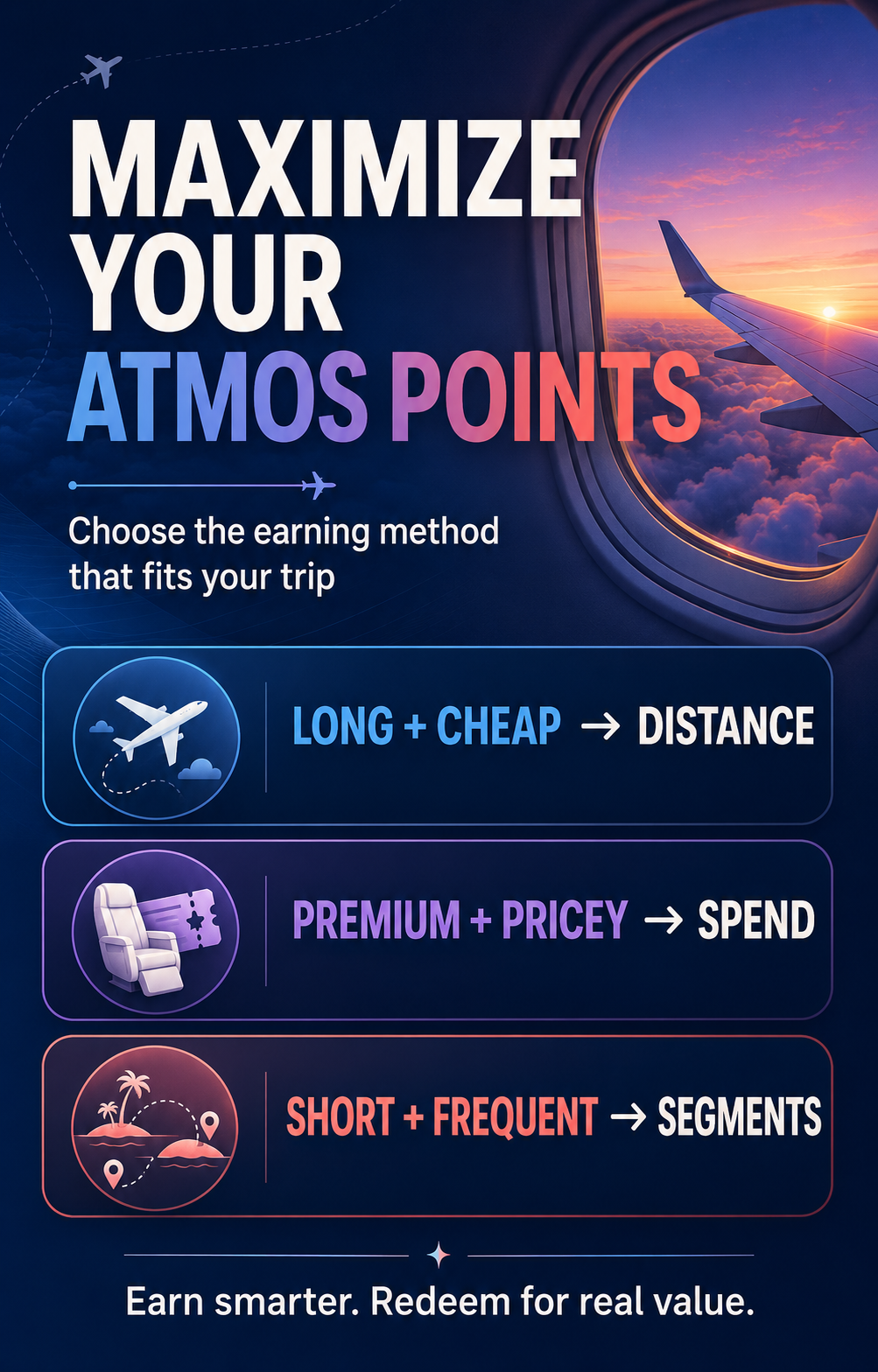
Atmos Rewards—the combined loyalty program of Alaska Airlines and Hawaiian Airlines—gives travelers an unusual amount of control. During 2026, members can choose to earn on eligible Alaska- and Hawaiian-marketed flights by distance, eligible dollars spent, or flight segments. That flexibility is valuable only if you select the method that fits your actual travel pattern.
This guide uses realistic route and fare examples. Dollar fares and award availability change constantly, so treat the examples as a repeatable decision method rather than a promise that a particular seat will be available at a quoted price.
1. Start with the three earning choices
Under the announced 2026 structure, the basic comparison is straightforward:
Method | Base formula | Usually best for | Quick break-even test |
Distance | 1 point per mile flown | Long, inexpensive trips | Distance beats spend when miles flown > 5 × eligible dollars |
Spend | 5 points per eligible $1 | Expensive tickets and premium cabins | Spend beats distance when 5 × eligible dollars > miles flown |
Segments | 500 points per segment | Many short hops | Segments beat distance when the average leg is under 500 miles |
Real example A: Cheap transcontinental travel
Suppose you fly New York–JFK to San Francisco round trip for $320 in eligible base fare, covering roughly 5,170 flown miles across two nonstop segments.
Distance: about 5,170 points
Spend: about 1,600 points (5 × $320)
Segments: 1,000 points (2 × 500)
Winner: distance. It produces more than three times the spend-based total. This is the classic Atmos sweet spot: a long flight bought at a low fare. |
Real example B: An expensive premium ticket
Now suppose a Seattle–New York round trip costs $1,600 in eligible fare and covers roughly 4,840 flown miles over two nonstop segments.
Distance: about 4,840 points
Spend: about 8,000 points (5 × $1,600)
Segments: 1,000 points
Winner: spend. At this price, spend-based earning generates about 65% more points than distance. The mathematical crossover is approximately $968 of eligible spend: 4,840 ÷ 5. |
Real example C: Frequent short hops
Imagine four Honolulu–Kahului round trips during the year: eight short flight segments and roughly 800 total flown miles.
Distance: about 800 points
Segments: 4,000 points (8 × 500)
Winner: segments. Short-haul flyers can earn several times more through the segment method. The tradeoff is that the selected earning preference generally applies broadly, so judge it across your full year—not one itinerary. |
2. Credit flights where the multiplier is strongest
Partner flights require extra attention. Atmos says partner itineraries booked directly through Alaska or Hawaiian can earn 100% of flown distance in economy and 250% in business class. Tickets bought from a partner may instead earn according to fare class and the partner chart.
Example: A partner business-class itinerary covering 6,000 flown miles could earn 15,000 base points at a 250% rate when eligible and booked through Alaska or Hawaiian. The same route bought elsewhere may credit differently. Before paying, compare the operating carrier, marketing carrier, ticketing channel, and fare class—then save a screenshot of the earning table.
3. Redeem with a cents-per-point test
A high point balance is not the goal; useful travel is. Before booking an award, calculate:
Value per point = (comparable cash fare − taxes and fees charged on the award) ÷ points required × 100 |
Redemption example A: Strong value
A flight costs $620 in cash or 25,000 points + $20. The value is ($620 − $20) ÷ 25,000 × 100 = 2.4 cents per point. That is a strong use if the cash itinerary is genuinely comparable and you would otherwise buy it.
Redemption example B: Pay cash and save the points
A short flight costs $109 or 10,000 points + $6. The value is ($109 − $6) ÷ 10,000 × 100 = 1.03 cents per point. Paying cash may be smarter, especially if the paid ticket also earns points and status credit.
Redemption example C: Premium-cabin leverage
A partner business-class seat costs $3,200 or 75,000 points + $60. The value is ($3,200 − $60) ÷ 75,000 × 100 = 4.19 cents per point. That looks excellent, but only if you would reasonably pay something close to that fare. Do not let an inflated cash price manufacture fake value.
4. Stretch every balance further
Search one-way and date-by-date. Award inventory can differ by direction and day. Splitting a round trip may uncover a lower price or a better partner.
Compare nearby gateways. Seattle, Portland, Los Angeles, San Francisco, Honolulu, and major partner hubs may show different inventory. Include the positioning cost in your calculation.
Price the whole trip, not just the seat. Add award taxes, partner fees, positioning flights, overnight hotels, bags, and cancellation restrictions.
Avoid speculative transfers or purchases. Move or buy points only after confirming bookable space and understanding that availability can disappear.
Use card benefits deliberately. A free checked bag or companion benefit may be worth more than a small difference in point earnings, but annual fees and benefit rules still matter.
Do not hoard indefinitely. Atmos points do not expire under current program messaging, but loyalty programs can change. Earn with a purpose and redeem when the trip and value are both good.
5. A simple annual playbook
Estimate your year. List expected routes, eligible fares, and segment counts.
Run all three totals. Distance = miles; spend = eligible dollars × 5; segments = legs × 500.
Choose the largest realistic result. Do not optimize around a single unusual trip.
Recheck before the annual preference deadline. Your travel pattern may have changed.
Set a personal redemption floor. A practical starting rule is to investigate awards above roughly 1.5 cents per point, while recognizing that flexibility and personal cash constraints also matter.
Book when value and availability align. The perfect theoretical redemption is worthless if it prevents a trip you actually want.
Bottom line: Maximizing Atmos Rewards is a two-part discipline: earn according to your travel economics, then redeem according to real value. Cheap long-haul flyers should examine distance earning; premium-cabin buyers should test spend earning; short-hop regulars should test segments. At redemption time, calculate cents per point and compare the complete trip cost. |
Written by Brian — Founder, awardtrail
Brian has been travel hacking for over 17 years and has personally completed 300+ credit card applications across Chase, Amex, Citi, Capital One, and more. He built awardtrail out of frustration with spreadsheet chaos, and writes from direct, first-hand experience — not marketing copy. All analysis and recommendations on this site reflect real-world strategy tested across hundreds of card applications and award bookings.
Continue Reading


Comments (0)
Join the Discussion
Sign in to share your thoughts and experiences with fellow award travelers.